The Moderating Role of the Five-Factor Model of Personality in the Relationship between Job Demands/Resources and Work Engagement: An Online Cross-Sectional Study.
{"title":"The Moderating Role of the Five-Factor Model of Personality in the Relationship between Job Demands/Resources and Work Engagement: An Online Cross-Sectional Study.","authors":"Toshiki Fukuzaki, Noboru Iwata","doi":"10.3390/bs14100936","DOIUrl":null,"url":null,"abstract":"<p><p>When organizations or managers utilize personality assessments for their workers, it is crucial to consider not only personality profiles but also the interaction between these profiles and the psychosocial environmental factors in the workplace. The present study aimed to examine the moderating effects of the five-factor model (FFM) of personality traits on the relationship between job demands/resources and work engagement (WE). A cross-sectional online survey was conducted between November and December 2022, targeting full-time workers in Japan. Data were collected from 1500 participants (757 men and 743 women). The survey included demographic variables, job demands and resources (job control, supervisor, and coworker support), WE, and the FFM. The primary statistical analysis was hierarchical regression analysis, which tested the interactions between job demands/resources and each personality trait. Four significant interactions were found: job demands and neuroticism, control and neuroticism, control and conscientiousness, and supervisor support and extraversion. High conscientiousness was associated with higher WE when job control was abundant. Moreover, low levels of both neuroticism and extraversion were linked to higher WE. The results suggest that managers can enhance WE by aligning workplace factors with employee personality traits. These insights can be applied to organizational staffing decisions.</p>","PeriodicalId":8742,"journal":{"name":"Behavioral Sciences","volume":"14 10","pages":""},"PeriodicalIF":2.5000,"publicationDate":"2024-10-12","publicationTypes":"Journal Article","fieldsOfStudy":null,"isOpenAccess":false,"openAccessPdf":"https://www.ncbi.nlm.nih.gov/pmc/articles/PMC11505521/pdf/","citationCount":"0","resultStr":null,"platform":"Semanticscholar","paperid":null,"PeriodicalName":"Behavioral Sciences","FirstCategoryId":"102","ListUrlMain":"https://doi.org/10.3390/bs14100936","RegionNum":3,"RegionCategory":"心理学","ArticlePicture":[],"TitleCN":null,"AbstractTextCN":null,"PMCID":null,"EPubDate":"","PubModel":"","JCR":"Q2","JCRName":"PSYCHOLOGY, MULTIDISCIPLINARY","Score":null,"Total":0}
引用次数: 0
Abstract
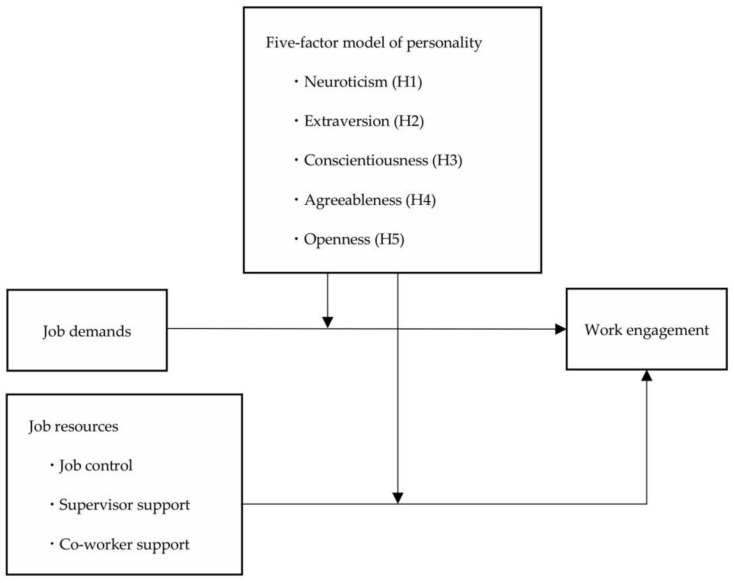
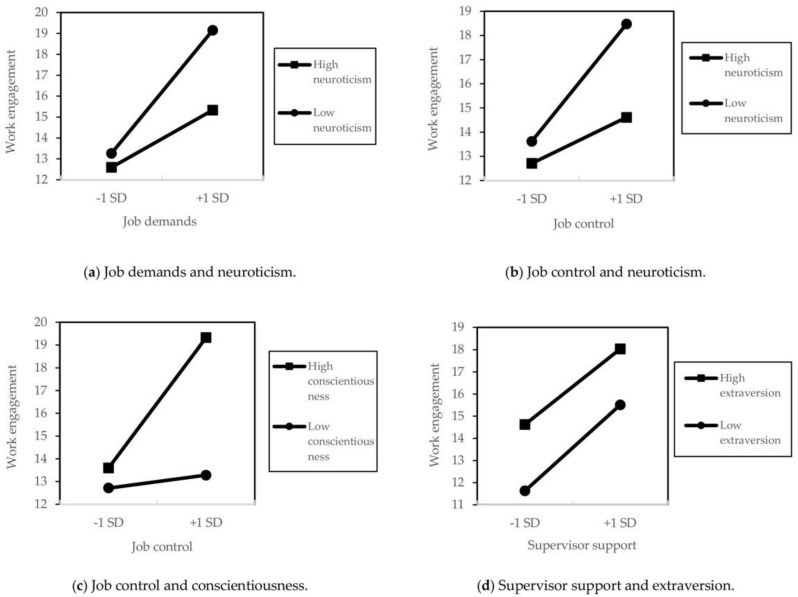
When organizations or managers utilize personality assessments for their workers, it is crucial to consider not only personality profiles but also the interaction between these profiles and the psychosocial environmental factors in the workplace. The present study aimed to examine the moderating effects of the five-factor model (FFM) of personality traits on the relationship between job demands/resources and work engagement (WE). A cross-sectional online survey was conducted between November and December 2022, targeting full-time workers in Japan. Data were collected from 1500 participants (757 men and 743 women). The survey included demographic variables, job demands and resources (job control, supervisor, and coworker support), WE, and the FFM. The primary statistical analysis was hierarchical regression analysis, which tested the interactions between job demands/resources and each personality trait. Four significant interactions were found: job demands and neuroticism, control and neuroticism, control and conscientiousness, and supervisor support and extraversion. High conscientiousness was associated with higher WE when job control was abundant. Moreover, low levels of both neuroticism and extraversion were linked to higher WE. The results suggest that managers can enhance WE by aligning workplace factors with employee personality traits. These insights can be applied to organizational staffing decisions.




 京公网安备 11010802042870号
京ICP备2023020795号-1
京公网安备 11010802042870号
京ICP备2023020795号-1

 分享
分享
 求助内容:
求助内容: 应助结果提醒方式:
 扫码关注我们
