{"title":"Methodological Variations to Explore Conflicting Results in the Existing Literature of Masking Smile Judgment.","authors":"Annalie Pelot, Adèle Gallant, Marie-Pier Mazerolle, Annie Roy-Charland","doi":"10.3390/bs14100944","DOIUrl":null,"url":null,"abstract":"<p><p>Although a smile can serve as an expression of genuine happiness, it can also be generated to conceal negative emotions. The traces of negative emotion present in these types of smiles can produce micro-expressions, subtle movements of the facial muscles manifested in the upper or lower half of the face. Studies examining the judgment of smiles masking negative emotions have mostly employed dichotomous rating measures, while also assuming that dichotomous categorization of a smile as happy or not is synonymous with judgments of the smile's authenticity. The aim of the two studies was to explore the judgment of enjoyment and masking smiles using unipolar and bipolar continuous rating measures and examine differences in the judgment when instruction varied between judgments of happiness and authenticity. In Experiment 1, participants rated smiles on 7-point scales on perceived happiness and authenticity. In Experiment 2, participants rated the smiles on bipolar 7-point scales between happiness and a negative emotion label. In both studies, similar patterns were observed: faces with traces of fear were rated significantly less happy/authentic and those with traces of anger in the brows were rated significantly happier/more authentic. Regarding varied instruction type, no effect was found for the two instruction types, indicating that participants perceive and judge enjoyment and masking smiles similarly according to these two instructions. Additionally, the use of bipolar scales with dimensions between a negative emotion label and happiness were not consistently effective in influencing the judgement of the masking smile.</p>","PeriodicalId":8742,"journal":{"name":"Behavioral Sciences","volume":"14 10","pages":""},"PeriodicalIF":2.5000,"publicationDate":"2024-10-14","publicationTypes":"Journal Article","fieldsOfStudy":null,"isOpenAccess":false,"openAccessPdf":"https://www.ncbi.nlm.nih.gov/pmc/articles/PMC11505263/pdf/","citationCount":"0","resultStr":null,"platform":"Semanticscholar","paperid":null,"PeriodicalName":"Behavioral Sciences","FirstCategoryId":"102","ListUrlMain":"https://doi.org/10.3390/bs14100944","RegionNum":3,"RegionCategory":"心理学","ArticlePicture":[],"TitleCN":null,"AbstractTextCN":null,"PMCID":null,"EPubDate":"","PubModel":"","JCR":"Q2","JCRName":"PSYCHOLOGY, MULTIDISCIPLINARY","Score":null,"Total":0}
引用次数: 0
Abstract
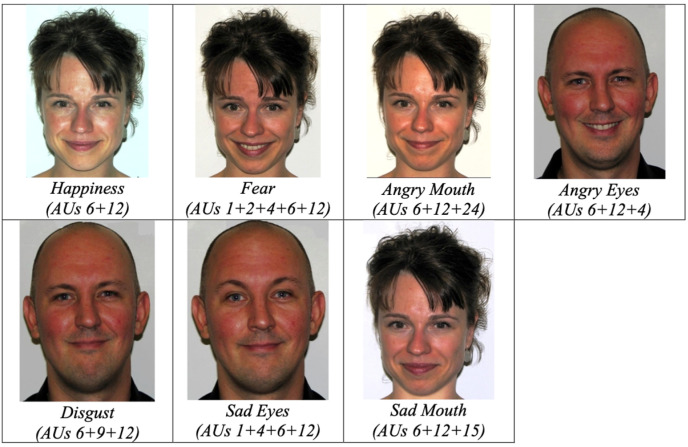
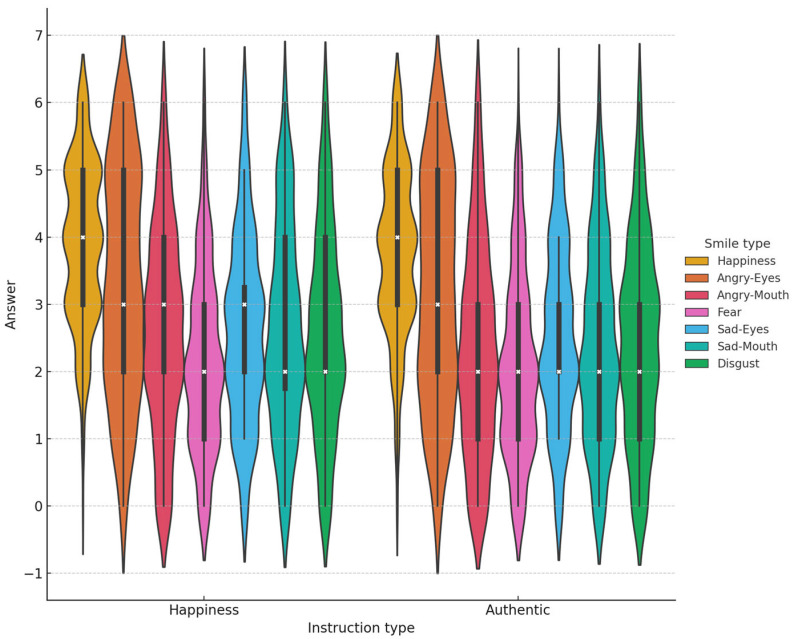
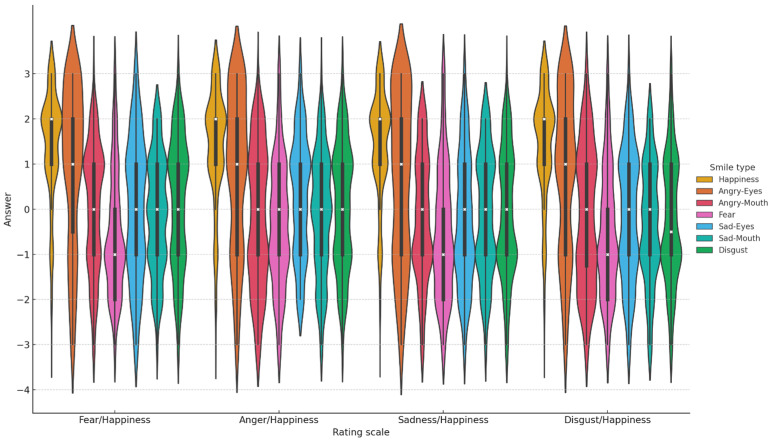
Although a smile can serve as an expression of genuine happiness, it can also be generated to conceal negative emotions. The traces of negative emotion present in these types of smiles can produce micro-expressions, subtle movements of the facial muscles manifested in the upper or lower half of the face. Studies examining the judgment of smiles masking negative emotions have mostly employed dichotomous rating measures, while also assuming that dichotomous categorization of a smile as happy or not is synonymous with judgments of the smile's authenticity. The aim of the two studies was to explore the judgment of enjoyment and masking smiles using unipolar and bipolar continuous rating measures and examine differences in the judgment when instruction varied between judgments of happiness and authenticity. In Experiment 1, participants rated smiles on 7-point scales on perceived happiness and authenticity. In Experiment 2, participants rated the smiles on bipolar 7-point scales between happiness and a negative emotion label. In both studies, similar patterns were observed: faces with traces of fear were rated significantly less happy/authentic and those with traces of anger in the brows were rated significantly happier/more authentic. Regarding varied instruction type, no effect was found for the two instruction types, indicating that participants perceive and judge enjoyment and masking smiles similarly according to these two instructions. Additionally, the use of bipolar scales with dimensions between a negative emotion label and happiness were not consistently effective in influencing the judgement of the masking smile.




 京公网安备 11010802042870号
京ICP备2023020795号-1
京公网安备 11010802042870号
京ICP备2023020795号-1

 分享
分享
 求助内容:
求助内容: 应助结果提醒方式:
 扫码关注我们
