Comparing Participation and Interim Effectiveness of Endoscopy and Biomarker-Based Screening for Gastric Cancer: A Cluster Randomized Controlled Trial.
{"title":"Comparing Participation and Interim Effectiveness of Endoscopy and Biomarker-Based Screening for Gastric Cancer: A Cluster Randomized Controlled Trial.","authors":"Haifan Xiao, Hao Luo, Ang Qin, Wenxian Shu, Xiangyu Liu, Fengfan Xiao, Xianzhen Liao, Zhaohui Shi, Yanhua Zou, Kekui Xu, Shiyu Cao, Can Li, Yingyun Hu, Senmao Zhang, Jia Guo, Shiyu Wang, Shipeng Yan","doi":"10.7150/jca.99100","DOIUrl":null,"url":null,"abstract":"<p><p><b>Background:</b> To improve compliance with endoscopic screening for gastric cancer (GC), we assessed five biomarkers-pepsinogen I (PG I), pepsinogen II (PG II), PG I/II ratio, helicobacter pylori antibody (HP-Ab), and gastrin 17 (G17) - for secondary GC screening by comparing participation and effectiveness of traditional endoscopy and biomarker-based screening in a randomized trial with baseline results. <b>Methods:</b> Seventy-four communities were randomly assigned to traditional endoscopy arm (TEA) or biomarker-based endoscopy arm (BEA). TEA uses a questionnaire for risk assessment, and BEA combines a questionnaire with biomarker detection. High-risk individuals in both arms underwent endoscopic screening. Participation and interim screening effectiveness in two arms were reported with baseline analysis. <b>Results:</b> In total, 5,798 participants in TEA and 5,158 in BEA were recruited, with a participation rate of 26.9%. BEA showed a significantly lower high-risk rate than TEA (15.2% vs. 38.9%) and a higher endoscopic participation rate for high-risk individuals (64.9% vs. 53.0%). The endoscopic screening results showed that there was no significant difference in detection rate of GC abnormalities between the two arms. Education level, frequent drinking, hot, rough and hard food consumption, family history of GC, and history of reflux esophagitis or gastropathy influenced participation rates in biomarker-based screening. Age group, sex and regular consumption of meat, eggs and milk products were associated with stomach abnormalities.Cumulative incidence and specific death rates did not significantly differ in intention-to-screen and per-protocol analyses. <b>Conclusions:</b> Biomarker-based screening effectively identifies high-risk individuals and increases endoscopic participation, providing value insights for improving screening efficiency as a secondary procedure.</p>","PeriodicalId":15183,"journal":{"name":"Journal of Cancer","volume":"15 18","pages":"6110-6121"},"PeriodicalIF":3.2000,"publicationDate":"2024-10-07","publicationTypes":"Journal Article","fieldsOfStudy":null,"isOpenAccess":false,"openAccessPdf":"https://www.ncbi.nlm.nih.gov/pmc/articles/PMC11492997/pdf/","citationCount":"0","resultStr":null,"platform":"Semanticscholar","paperid":null,"PeriodicalName":"Journal of Cancer","FirstCategoryId":"3","ListUrlMain":"https://doi.org/10.7150/jca.99100","RegionNum":3,"RegionCategory":"医学","ArticlePicture":[],"TitleCN":null,"AbstractTextCN":null,"PMCID":null,"EPubDate":"2024/1/1 0:00:00","PubModel":"eCollection","JCR":"Q2","JCRName":"ONCOLOGY","Score":null,"Total":0}
引用次数: 0
Abstract
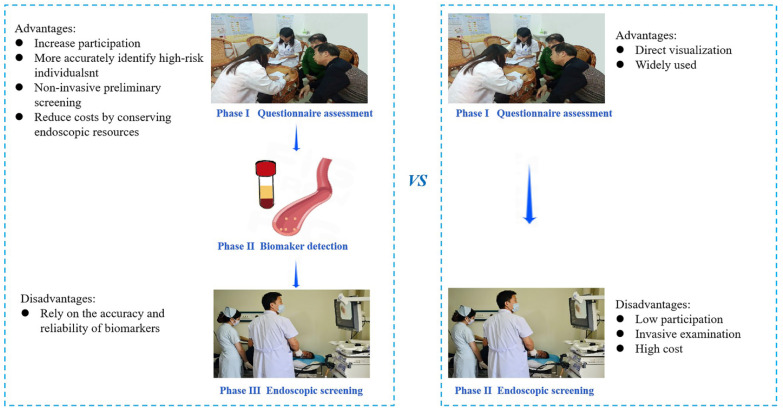
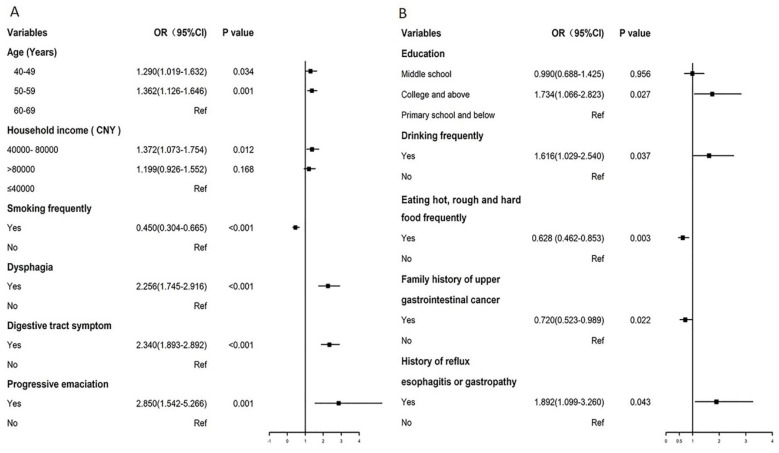
Background: To improve compliance with endoscopic screening for gastric cancer (GC), we assessed five biomarkers-pepsinogen I (PG I), pepsinogen II (PG II), PG I/II ratio, helicobacter pylori antibody (HP-Ab), and gastrin 17 (G17) - for secondary GC screening by comparing participation and effectiveness of traditional endoscopy and biomarker-based screening in a randomized trial with baseline results. Methods: Seventy-four communities were randomly assigned to traditional endoscopy arm (TEA) or biomarker-based endoscopy arm (BEA). TEA uses a questionnaire for risk assessment, and BEA combines a questionnaire with biomarker detection. High-risk individuals in both arms underwent endoscopic screening. Participation and interim screening effectiveness in two arms were reported with baseline analysis. Results: In total, 5,798 participants in TEA and 5,158 in BEA were recruited, with a participation rate of 26.9%. BEA showed a significantly lower high-risk rate than TEA (15.2% vs. 38.9%) and a higher endoscopic participation rate for high-risk individuals (64.9% vs. 53.0%). The endoscopic screening results showed that there was no significant difference in detection rate of GC abnormalities between the two arms. Education level, frequent drinking, hot, rough and hard food consumption, family history of GC, and history of reflux esophagitis or gastropathy influenced participation rates in biomarker-based screening. Age group, sex and regular consumption of meat, eggs and milk products were associated with stomach abnormalities.Cumulative incidence and specific death rates did not significantly differ in intention-to-screen and per-protocol analyses. Conclusions: Biomarker-based screening effectively identifies high-risk individuals and increases endoscopic participation, providing value insights for improving screening efficiency as a secondary procedure.
期刊介绍:
Journal of Cancer is an open access, peer-reviewed journal with broad scope covering all areas of cancer research, especially novel concepts, new methods, new regimens, new therapeutic agents, and alternative approaches for early detection and intervention of cancer. The Journal is supported by an international editorial board consisting of a distinguished team of cancer researchers. Journal of Cancer aims at rapid publication of high quality results in cancer research while maintaining rigorous peer-review process.




 京公网安备 11010802042870号
京ICP备2023020795号-1
京公网安备 11010802042870号
京ICP备2023020795号-1

 分享
分享
 求助内容:
求助内容: 应助结果提醒方式:
 扫码关注我们
