Influenza Vaccine Effectiveness against Influenza A-Associated Outpatient and Emergency-Department-Attended Influenza-like Illness during the Delayed 2022-2023 Season in Beijing, China.
Li Zhang, Guilan Lu, Chunna Ma, Jiaojiao Zhang, Jia Li, Wei Duan, Jiaxin Ma, Weixian Shi, Yingying Wang, Ying Sun, Daitao Zhang, Quanyi Wang, Da Huo
{"title":"Influenza Vaccine Effectiveness against Influenza A-Associated Outpatient and Emergency-Department-Attended Influenza-like Illness during the Delayed 2022-2023 Season in Beijing, China.","authors":"Li Zhang, Guilan Lu, Chunna Ma, Jiaojiao Zhang, Jia Li, Wei Duan, Jiaxin Ma, Weixian Shi, Yingying Wang, Ying Sun, Daitao Zhang, Quanyi Wang, Da Huo","doi":"10.3390/vaccines12101124","DOIUrl":null,"url":null,"abstract":"<p><strong>Background: </strong>During the 2022-2023 influenza season, the influenza activities in most regions of China were postponed, including Beijing. The unusually delayed influenza epidemic posed a challenge to the effectiveness of the influenza vaccine.</p><p><strong>Methods: </strong>Using the test-negative design, we evaluated influenza vaccine effectiveness (VE) during the 2022-2023 influenza season against influenza A-associated outpatient and emergency-department-attended influenza-like illness (ILI) in Beijing, China, from 9 January to 30 April 2023.</p><p><strong>Results: </strong>The analysis included 8301 medically attended ILI patients, of which 1342 (46.2%) had influenza A(H1N1)pdm09, 1554 (53.4%) had influenza A(H3N2), and 11 (0.4%) had co-infection of the two viruses. VE against influenza A-associated ILI patients was 23.2% (95% CI: -6.5% to 44.6%) overall, and 23.1%, 9.9%, and 33.8% among children aged 6 months to 17 years, adults aged 18-59 years, and adults aged ≥60 years, respectively. VE against influenza A(H1N1)pdm09 and against influenza A(H3N2) were 36.2% (95% CI: -1.9% to 60.1%) and 9.5% (95% CI: -34.1% to 39.0%), respectively. VE of the group with vaccination intervals of 14-90 days (70.1%, 95% CI: -145.4 to 96.4) was higher than that of the groups with a vaccination interval of 90-149 days (18.7%, 95% CI: -42.4% to 53.6%) and ≥150 days (21.2%, 95% CI: -18.8% to 47.7%).</p><p><strong>Conclusions: </strong>A moderate VE against influenza A(H1N1)pdm09 and a low VE against influenza A(H3N2) were observed in Beijing during the 2022-2023 influenza season, a season characterized with a delayed and high-intensity influenza epidemic. VE appears to be better within three months after vaccination. Our findings indicate a potential need for the optimization of vaccination policies and underscore the importance of continuous monitoring of influenza to enhance vaccines and optimizing vaccination timing.</p>","PeriodicalId":23634,"journal":{"name":"Vaccines","volume":"12 10","pages":""},"PeriodicalIF":5.2000,"publicationDate":"2024-09-30","publicationTypes":"Journal Article","fieldsOfStudy":null,"isOpenAccess":false,"openAccessPdf":"https://www.ncbi.nlm.nih.gov/pmc/articles/PMC11511380/pdf/","citationCount":"0","resultStr":null,"platform":"Semanticscholar","paperid":null,"PeriodicalName":"Vaccines","FirstCategoryId":"3","ListUrlMain":"https://doi.org/10.3390/vaccines12101124","RegionNum":3,"RegionCategory":"医学","ArticlePicture":[],"TitleCN":null,"AbstractTextCN":null,"PMCID":null,"EPubDate":"","PubModel":"","JCR":"Q1","JCRName":"IMMUNOLOGY","Score":null,"Total":0}
引用次数: 0
Abstract
Background: During the 2022-2023 influenza season, the influenza activities in most regions of China were postponed, including Beijing. The unusually delayed influenza epidemic posed a challenge to the effectiveness of the influenza vaccine.
Methods: Using the test-negative design, we evaluated influenza vaccine effectiveness (VE) during the 2022-2023 influenza season against influenza A-associated outpatient and emergency-department-attended influenza-like illness (ILI) in Beijing, China, from 9 January to 30 April 2023.
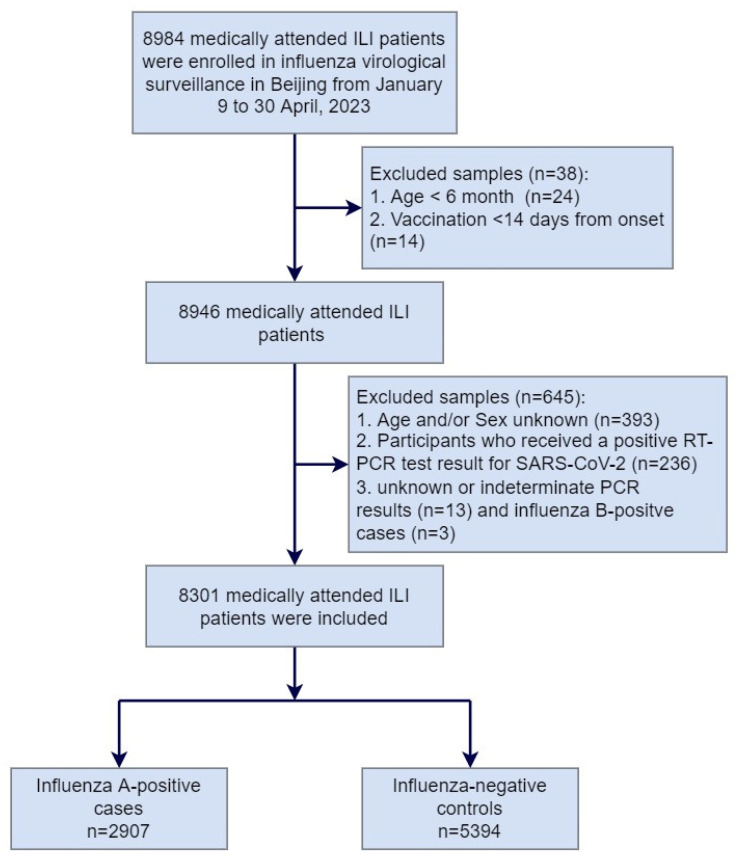
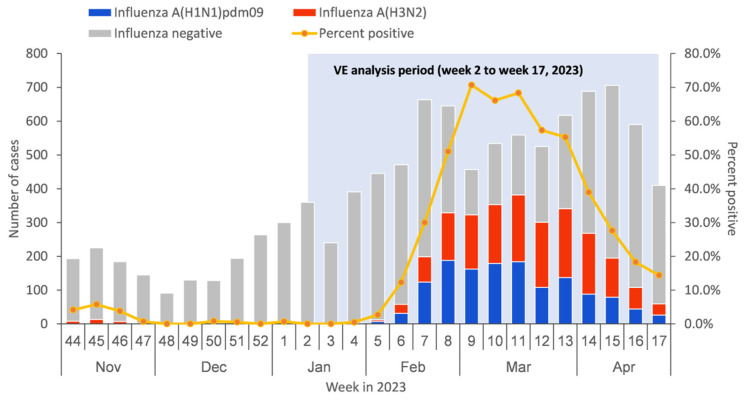
Results: The analysis included 8301 medically attended ILI patients, of which 1342 (46.2%) had influenza A(H1N1)pdm09, 1554 (53.4%) had influenza A(H3N2), and 11 (0.4%) had co-infection of the two viruses. VE against influenza A-associated ILI patients was 23.2% (95% CI: -6.5% to 44.6%) overall, and 23.1%, 9.9%, and 33.8% among children aged 6 months to 17 years, adults aged 18-59 years, and adults aged ≥60 years, respectively. VE against influenza A(H1N1)pdm09 and against influenza A(H3N2) were 36.2% (95% CI: -1.9% to 60.1%) and 9.5% (95% CI: -34.1% to 39.0%), respectively. VE of the group with vaccination intervals of 14-90 days (70.1%, 95% CI: -145.4 to 96.4) was higher than that of the groups with a vaccination interval of 90-149 days (18.7%, 95% CI: -42.4% to 53.6%) and ≥150 days (21.2%, 95% CI: -18.8% to 47.7%).
Conclusions: A moderate VE against influenza A(H1N1)pdm09 and a low VE against influenza A(H3N2) were observed in Beijing during the 2022-2023 influenza season, a season characterized with a delayed and high-intensity influenza epidemic. VE appears to be better within three months after vaccination. Our findings indicate a potential need for the optimization of vaccination policies and underscore the importance of continuous monitoring of influenza to enhance vaccines and optimizing vaccination timing.
VaccinesPharmacology, Toxicology and Pharmaceutics-Pharmacology
CiteScore
8.90
自引率
16.70%
发文量
1853
审稿时长
18.06 days
期刊介绍:
Vaccines (ISSN 2076-393X) is an international, peer-reviewed open access journal focused on laboratory and clinical vaccine research, utilization and immunization. Vaccines publishes high quality reviews, regular research papers, communications and case reports.



 京公网安备 11010802042870号
京ICP备2023020795号-1
京公网安备 11010802042870号
京ICP备2023020795号-1

 分享
分享
 求助内容:
求助内容: 应助结果提醒方式:
 扫码关注我们
