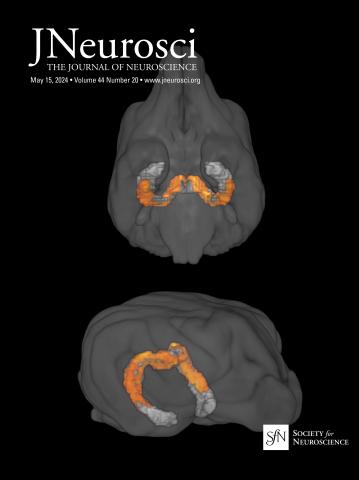
{"title":"Revealing the Spatial Pattern of Brain Hemodynamic Sensitivity to Healthy Aging through Sparse Dynamic Causal Model.","authors":"Giorgia Baron, Erica Silvestri, Danilo Benozzo, Alessandro Chiuso, Alessandra Bertoldo","doi":"10.1523/JNEUROSCI.1940-23.2024","DOIUrl":null,"url":null,"abstract":"<p><p>Age-related changes in the BOLD response could reflect neurovascular coupling modifications rather than simply impairments in neural functioning. In this study, we propose the use of a sparse dynamic causal model (sDCM) to decouple neuronal and vascular factors in the BOLD signal, with the aim of characterizing the whole-brain spatial pattern of hemodynamic sensitivity to healthy aging, as well as to test the role of hemodynamic features as independent predictors in an age-classification model. sDCM was applied to the resting-state functional magnetic resonance imaging data of a cohort of 126 healthy individuals in a wide age range (31 females), providing reliable estimates of the hemodynamic response function (HRF) for each subject and each region of interest. Then, some features characterizing each HRF curve were extracted and used to fit a multivariate logistic regression model predicting the age class of each individual. Ultimately, we tested the final predictive model on an independent dataset of 338 healthy subjects (173 females) selected from the Human Connectome Project in Aging and Development cohorts. Our results entail the spatial heterogeneity of the age effects on the hemodynamic component, since its impact resulted to be strongly region- and population-specific, discouraging any space-invariant-corrective procedures that attempt to correct for vascular factors when carrying out functional studies involving groups with different ages. Moreover, we demonstrated that a strong interaction exists between certain right-hemisphere hemodynamic features and age, further supporting the essential role of the hemodynamic factor as independent predictor of biological aging, rather than a simple confounding variable.</p>","PeriodicalId":50114,"journal":{"name":"Journal of Neuroscience","volume":" ","pages":""},"PeriodicalIF":4.0000,"publicationDate":"2025-01-01","publicationTypes":"Journal Article","fieldsOfStudy":null,"isOpenAccess":false,"openAccessPdf":"https://www.ncbi.nlm.nih.gov/pmc/articles/PMC11694405/pdf/","citationCount":"0","resultStr":null,"platform":"Semanticscholar","paperid":null,"PeriodicalName":"Journal of Neuroscience","FirstCategoryId":"3","ListUrlMain":"https://doi.org/10.1523/JNEUROSCI.1940-23.2024","RegionNum":2,"RegionCategory":"医学","ArticlePicture":[],"TitleCN":null,"AbstractTextCN":null,"PMCID":null,"EPubDate":"","PubModel":"","JCR":"Q1","JCRName":"NEUROSCIENCES","Score":null,"Total":0}
引用次数: 0
Abstract
Age-related changes in the BOLD response could reflect neurovascular coupling modifications rather than simply impairments in neural functioning. In this study, we propose the use of a sparse dynamic causal model (sDCM) to decouple neuronal and vascular factors in the BOLD signal, with the aim of characterizing the whole-brain spatial pattern of hemodynamic sensitivity to healthy aging, as well as to test the role of hemodynamic features as independent predictors in an age-classification model. sDCM was applied to the resting-state functional magnetic resonance imaging data of a cohort of 126 healthy individuals in a wide age range (31 females), providing reliable estimates of the hemodynamic response function (HRF) for each subject and each region of interest. Then, some features characterizing each HRF curve were extracted and used to fit a multivariate logistic regression model predicting the age class of each individual. Ultimately, we tested the final predictive model on an independent dataset of 338 healthy subjects (173 females) selected from the Human Connectome Project in Aging and Development cohorts. Our results entail the spatial heterogeneity of the age effects on the hemodynamic component, since its impact resulted to be strongly region- and population-specific, discouraging any space-invariant-corrective procedures that attempt to correct for vascular factors when carrying out functional studies involving groups with different ages. Moreover, we demonstrated that a strong interaction exists between certain right-hemisphere hemodynamic features and age, further supporting the essential role of the hemodynamic factor as independent predictor of biological aging, rather than a simple confounding variable.
期刊介绍:
JNeurosci (ISSN 0270-6474) is an official journal of the Society for Neuroscience. It is published weekly by the Society, fifty weeks a year, one volume a year. JNeurosci publishes papers on a broad range of topics of general interest to those working on the nervous system. Authors now have an Open Choice option for their published articles



 京公网安备 11010802042870号
京ICP备2023020795号-1
京公网安备 11010802042870号
京ICP备2023020795号-1

 分享
分享
 求助内容:
求助内容: 应助结果提醒方式:
 扫码关注我们
