Ryan J. LaRue, Samuel Koo, Ashleigh Warren, Yves G. McKay, David R. Latulippe
{"title":"A strategy for quantifying microplastic particles in membrane filtration processes using flow cytometry","authors":"Ryan J. LaRue, Samuel Koo, Ashleigh Warren, Yves G. McKay, David R. Latulippe","doi":"10.1016/j.chemosphere.2024.143613","DOIUrl":null,"url":null,"abstract":"<div><div>Microplastic (MP) pollution is ubiquitous in the aquatic environment, with significant quantities of MPs originating from municipal wastewater treatment plants. Efforts to evaluate and implement MP removal processes are underway, with membrane technologies often recommended as an “ideal” solution. A key challenge in evaluating these technologies involves efficiently quantifying MP concentrations in samples. Here, flow cytometry (FC) is demonstrated as an effective technique to obtain concentration measurements of plastic microbeads (MBs; 1–5 μm) suspended in water with/without added humic acid. Regardless of solution conditions, MB concentrations were easily quantified via FC. Subsequently, two microfiltration membranes were challenged to these suspensions. As measured via FC, the 0.45 μm membrane demonstrated effective MB rejection (>99%) whereas the 5 μm membrane exhibited a broad range of rejections (40% to >95%) depending on solution conditions and filtration time. Finally, a model was formulated utilizing FC forward light scattering intensity measurements to estimate MB sizes in samples. Using the model, a 33% reduction in median MB size, on average, was noted across the 5 μm membrane when filtering MBs suspended in humic acid solution, affirming a preferential permeation of smaller particles. Overall, this study advances MP quantification techniques towards validating removal processes.</div></div>","PeriodicalId":276,"journal":{"name":"Chemosphere","volume":"368 ","pages":"Article 143613"},"PeriodicalIF":8.1000,"publicationDate":"2024-11-01","publicationTypes":"Journal Article","fieldsOfStudy":null,"isOpenAccess":false,"openAccessPdf":"","citationCount":"0","resultStr":null,"platform":"Semanticscholar","paperid":null,"PeriodicalName":"Chemosphere","FirstCategoryId":"93","ListUrlMain":"https://www.sciencedirect.com/science/article/pii/S004565352402513X","RegionNum":2,"RegionCategory":"环境科学与生态学","ArticlePicture":[],"TitleCN":null,"AbstractTextCN":null,"PMCID":null,"EPubDate":"2024/10/23 0:00:00","PubModel":"Epub","JCR":"Q1","JCRName":"ENVIRONMENTAL SCIENCES","Score":null,"Total":0}
引用次数: 0
Abstract
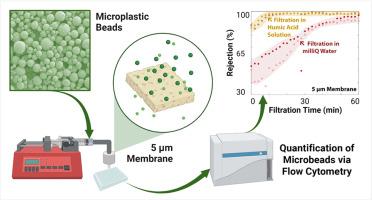
Microplastic (MP) pollution is ubiquitous in the aquatic environment, with significant quantities of MPs originating from municipal wastewater treatment plants. Efforts to evaluate and implement MP removal processes are underway, with membrane technologies often recommended as an “ideal” solution. A key challenge in evaluating these technologies involves efficiently quantifying MP concentrations in samples. Here, flow cytometry (FC) is demonstrated as an effective technique to obtain concentration measurements of plastic microbeads (MBs; 1–5 μm) suspended in water with/without added humic acid. Regardless of solution conditions, MB concentrations were easily quantified via FC. Subsequently, two microfiltration membranes were challenged to these suspensions. As measured via FC, the 0.45 μm membrane demonstrated effective MB rejection (>99%) whereas the 5 μm membrane exhibited a broad range of rejections (40% to >95%) depending on solution conditions and filtration time. Finally, a model was formulated utilizing FC forward light scattering intensity measurements to estimate MB sizes in samples. Using the model, a 33% reduction in median MB size, on average, was noted across the 5 μm membrane when filtering MBs suspended in humic acid solution, affirming a preferential permeation of smaller particles. Overall, this study advances MP quantification techniques towards validating removal processes.
期刊介绍:
Chemosphere, being an international multidisciplinary journal, is dedicated to publishing original communications and review articles on chemicals in the environment. The scope covers a wide range of topics, including the identification, quantification, behavior, fate, toxicology, treatment, and remediation of chemicals in the bio-, hydro-, litho-, and atmosphere, ensuring the broad dissemination of research in this field.



 京公网安备 11010802042870号
京ICP备2023020795号-1
京公网安备 11010802042870号
京ICP备2023020795号-1

 分享
分享
 求助内容:
求助内容: 应助结果提醒方式:
 扫码关注我们
