Eleftheria Theodoropoulou , Paula Pierozan , Francesco Marabita , Andrey Höglund , Oskar Karlsson
{"title":"Persistent effects of di-n-butyl phthalate on liver transcriptome: Impaired energy and lipid metabolic pathways","authors":"Eleftheria Theodoropoulou , Paula Pierozan , Francesco Marabita , Andrey Höglund , Oskar Karlsson","doi":"10.1016/j.chemosphere.2024.143605","DOIUrl":null,"url":null,"abstract":"<div><div>The environmental contaminant dibutyl phthalate (DBP) is reported to be hepatotoxic, but the underlying molecular pathways and pathological processes remain unclear. Here we used RNA-sequencing to characterize persistent hepatic transcriptional effects one week after the conclusion of five weeks oral exposure to 10 mg/kg/day or 100 mg/kg/day DBP in adult male mice. The exploratory transcriptome analysis demonstrated five differentially expressed genes (DEGs) in the 10 mg/kg/day group and 13 in the 100 mg/kg/day group. Gene Set Enrichment Analysis (GSEA), which identifies affected biological pathways rather than focusing solely on individual genes, revealed nine significantly enriched Reactome pathways shared by both DBP treatment groups. Additionally, we found 54 upregulated and one downregulated Reactome pathways in the 10 mg/kg/day DBP group, and 29 upregulated and 13 downregulated pathways in the 100 mg/kg/day DBP group. DBP exposure disrupted several key biological processes, including protein translation, protein folding, apoptosis, Hedgehog signaling, degradation of extracellular matrix and alterations in the energy/lipid metabolism. Subsequent liver tissue analysis confirmed that DBP exposure induced tissue disorganization, oxidative stress, lipid accumulation, increased TNF-α, ATP and glucokinase levels, and affected key metabolic proteins, predominantly in a dose-response manner. Overall, the results show that DBP can cause hepatic stress and damage and suggest a potential role for DBP in the development of non-alcoholic fatty liver disease, the most prevalent liver disease worldwide.</div></div>","PeriodicalId":276,"journal":{"name":"Chemosphere","volume":"368 ","pages":"Article 143605"},"PeriodicalIF":8.1000,"publicationDate":"2024-11-01","publicationTypes":"Journal Article","fieldsOfStudy":null,"isOpenAccess":false,"openAccessPdf":"","citationCount":"0","resultStr":null,"platform":"Semanticscholar","paperid":null,"PeriodicalName":"Chemosphere","FirstCategoryId":"93","ListUrlMain":"https://www.sciencedirect.com/science/article/pii/S0045653524025050","RegionNum":2,"RegionCategory":"环境科学与生态学","ArticlePicture":[],"TitleCN":null,"AbstractTextCN":null,"PMCID":null,"EPubDate":"2024/10/22 0:00:00","PubModel":"Epub","JCR":"Q1","JCRName":"ENVIRONMENTAL SCIENCES","Score":null,"Total":0}
引用次数: 0
Abstract
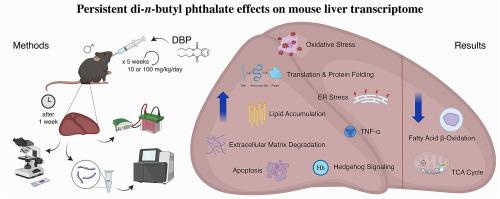
The environmental contaminant dibutyl phthalate (DBP) is reported to be hepatotoxic, but the underlying molecular pathways and pathological processes remain unclear. Here we used RNA-sequencing to characterize persistent hepatic transcriptional effects one week after the conclusion of five weeks oral exposure to 10 mg/kg/day or 100 mg/kg/day DBP in adult male mice. The exploratory transcriptome analysis demonstrated five differentially expressed genes (DEGs) in the 10 mg/kg/day group and 13 in the 100 mg/kg/day group. Gene Set Enrichment Analysis (GSEA), which identifies affected biological pathways rather than focusing solely on individual genes, revealed nine significantly enriched Reactome pathways shared by both DBP treatment groups. Additionally, we found 54 upregulated and one downregulated Reactome pathways in the 10 mg/kg/day DBP group, and 29 upregulated and 13 downregulated pathways in the 100 mg/kg/day DBP group. DBP exposure disrupted several key biological processes, including protein translation, protein folding, apoptosis, Hedgehog signaling, degradation of extracellular matrix and alterations in the energy/lipid metabolism. Subsequent liver tissue analysis confirmed that DBP exposure induced tissue disorganization, oxidative stress, lipid accumulation, increased TNF-α, ATP and glucokinase levels, and affected key metabolic proteins, predominantly in a dose-response manner. Overall, the results show that DBP can cause hepatic stress and damage and suggest a potential role for DBP in the development of non-alcoholic fatty liver disease, the most prevalent liver disease worldwide.
期刊介绍:
Chemosphere, being an international multidisciplinary journal, is dedicated to publishing original communications and review articles on chemicals in the environment. The scope covers a wide range of topics, including the identification, quantification, behavior, fate, toxicology, treatment, and remediation of chemicals in the bio-, hydro-, litho-, and atmosphere, ensuring the broad dissemination of research in this field.




 京公网安备 11010802042870号
京ICP备2023020795号-1
京公网安备 11010802042870号
京ICP备2023020795号-1

 分享
分享
 求助内容:
求助内容: 应助结果提醒方式:
 扫码关注我们
