Jian Huang, Jin Xu, Xuefeng Wu, Chengsong Wang, Chen Jin, Xiang Ji, Tian Han
{"title":"Effects of Different Forging Ratios on Microstructure, Mechanical Properties and Friction and Wear Behavior of Q355D Steel","authors":"Jian Huang, Jin Xu, Xuefeng Wu, Chengsong Wang, Chen Jin, Xiang Ji, Tian Han","doi":"10.1134/S2070205124701612","DOIUrl":null,"url":null,"abstract":"<p>In order to meet the mechanical performance demands of large oil cylinder barrels and piston rods, an investigation into the forging process of Q355D low-alloy high-strength steel was conducted. This study rigorously examined the impact of various forging ratios (2.6, 4.3, and 6.2) on both the microstructural characteristics and mechanical properties (including tensile strength, hardness, elongation, and impact toughness) of Q355D steel through a comprehensive systematic analysis. The findings revealed that an escalation in the forging ratio resulted in a refinement of the grain size in both ferrite and pearlite, concurrently with the fragmentation of MnS inclusions. The augmentation in both hardness and impact toughness correlated proportionally with the increased forging ratio, primarily attributed to the grain size refinement and augmented dislocation density. The yield strength exhibited a corresponding increase with the forging ratio increments: 303.56, 324.32, and 346.69 MPa, while hardness values were recorded as 174.32, 187.31, and 200.95 HV, respectively. Furthermore, grain refinement significantly contributed to enhancing the steel’s ductility and toughness. Additionally, the escalated forging ratio notably reduced the duration required for the steel to reach a stabilized friction coefficient and reduced the stabilized friction coefficient, consequently amplifying the steel’s resistance to frictional wear.</p>","PeriodicalId":745,"journal":{"name":"Protection of Metals and Physical Chemistry of Surfaces","volume":"60 2","pages":"270 - 281"},"PeriodicalIF":0.8000,"publicationDate":"2024-10-25","publicationTypes":"Journal Article","fieldsOfStudy":null,"isOpenAccess":false,"openAccessPdf":"","citationCount":"0","resultStr":null,"platform":"Semanticscholar","paperid":null,"PeriodicalName":"Protection of Metals and Physical Chemistry of Surfaces","FirstCategoryId":"88","ListUrlMain":"https://link.springer.com/article/10.1134/S2070205124701612","RegionNum":4,"RegionCategory":"材料科学","ArticlePicture":[],"TitleCN":null,"AbstractTextCN":null,"PMCID":null,"EPubDate":"","PubModel":"","JCR":"Q3","JCRName":"METALLURGY & METALLURGICAL ENGINEERING","Score":null,"Total":0}
引用次数: 0
Abstract
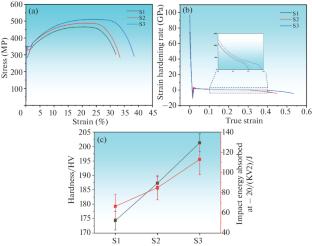
In order to meet the mechanical performance demands of large oil cylinder barrels and piston rods, an investigation into the forging process of Q355D low-alloy high-strength steel was conducted. This study rigorously examined the impact of various forging ratios (2.6, 4.3, and 6.2) on both the microstructural characteristics and mechanical properties (including tensile strength, hardness, elongation, and impact toughness) of Q355D steel through a comprehensive systematic analysis. The findings revealed that an escalation in the forging ratio resulted in a refinement of the grain size in both ferrite and pearlite, concurrently with the fragmentation of MnS inclusions. The augmentation in both hardness and impact toughness correlated proportionally with the increased forging ratio, primarily attributed to the grain size refinement and augmented dislocation density. The yield strength exhibited a corresponding increase with the forging ratio increments: 303.56, 324.32, and 346.69 MPa, while hardness values were recorded as 174.32, 187.31, and 200.95 HV, respectively. Furthermore, grain refinement significantly contributed to enhancing the steel’s ductility and toughness. Additionally, the escalated forging ratio notably reduced the duration required for the steel to reach a stabilized friction coefficient and reduced the stabilized friction coefficient, consequently amplifying the steel’s resistance to frictional wear.
期刊介绍:
Protection of Metals and Physical Chemistry of Surfaces is an international peer reviewed journal that publishes articles covering all aspects of the physical chemistry of materials and interfaces in various environments. The journal covers all related problems of modern physical chemistry and materials science, including: physicochemical processes at interfaces; adsorption phenomena; complexing from molecular and supramolecular structures at the interfaces to new substances, materials and coatings; nanoscale and nanostructured materials and coatings, composed and dispersed materials; physicochemical problems of corrosion, degradation and protection; investigation methods for surface and interface systems, processes, structures, materials and coatings. No principe restrictions exist related systems, types of processes, methods of control and study. The journal welcomes conceptual, theoretical, experimental, methodological, instrumental, environmental, and all other possible studies.



 京公网安备 11010802042870号
京ICP备2023020795号-1
京公网安备 11010802042870号
京ICP备2023020795号-1

 分享
分享
 求助内容:
求助内容: 应助结果提醒方式:
 扫码关注我们
