{"title":"Optimizing the spin qubit performance of lanthanide-based metal–organic frameworks†","authors":"Xiya Du and Lei Sun","doi":"10.1039/D4QI02324B","DOIUrl":null,"url":null,"abstract":"<p >Lanthanide-based spin qubits are intriguing candidates for high-fidelity quantum memories owing to their spin-optical interfaces. Metal–organic frameworks (MOFs) offer promising solid-state platforms to host lanthanide ions because their bottom-up synthesis enables rational optimization of both spin coherence and luminescence. Here, we incorporated Nd<small><sup>3+</sup></small> and Gd<small><sup>3+</sup></small> into a La<small><sup>3+</sup></small>-based MOF with various doping levels and examined their qubit performance including the spin relaxation time (<em>T</em><small><sub>1</sub></small>) and phase memory time (<em>T</em><small><sub>m</sub></small>). Both Nd<small><sup>3+</sup></small> and Gd<small><sup>3+</sup></small> behave as spin qubits with <em>T</em><small><sub>1</sub></small> exceeding 1 ms and <em>T</em><small><sub>m</sub></small> approaching 2 μs at 3.2 K at low doping levels. Variable-temperature spin dynamic studies unveiled spin relaxation and decoherence mechanisms, highlighting the critical roles of spin–phonon coupling and spin–spin dipolar coupling. Accordingly, reducing the spin concentration, spin–orbit coupling strength, and ground spin state improves the qubit performance of lanthanide-based MOFs. These optimization strategies serve as guidelines for the future development of solid-state lanthanide qubits targeting quantum information technologies.</p>","PeriodicalId":79,"journal":{"name":"Inorganic Chemistry Frontiers","volume":" 24","pages":" 8660-8670"},"PeriodicalIF":6.2000,"publicationDate":"2024-10-28","publicationTypes":"Journal Article","fieldsOfStudy":null,"isOpenAccess":false,"openAccessPdf":"","citationCount":"0","resultStr":null,"platform":"Semanticscholar","paperid":null,"PeriodicalName":"Inorganic Chemistry Frontiers","FirstCategoryId":"92","ListUrlMain":"https://pubs.rsc.org/en/content/articlelanding/2024/qi/d4qi02324b","RegionNum":1,"RegionCategory":"化学","ArticlePicture":[],"TitleCN":null,"AbstractTextCN":null,"PMCID":null,"EPubDate":"","PubModel":"","JCR":"Q1","JCRName":"CHEMISTRY, INORGANIC & NUCLEAR","Score":null,"Total":0}
引用次数: 0
Abstract
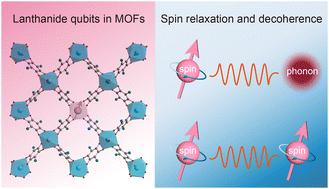
Lanthanide-based spin qubits are intriguing candidates for high-fidelity quantum memories owing to their spin-optical interfaces. Metal–organic frameworks (MOFs) offer promising solid-state platforms to host lanthanide ions because their bottom-up synthesis enables rational optimization of both spin coherence and luminescence. Here, we incorporated Nd3+ and Gd3+ into a La3+-based MOF with various doping levels and examined their qubit performance including the spin relaxation time (T1) and phase memory time (Tm). Both Nd3+ and Gd3+ behave as spin qubits with T1 exceeding 1 ms and Tm approaching 2 μs at 3.2 K at low doping levels. Variable-temperature spin dynamic studies unveiled spin relaxation and decoherence mechanisms, highlighting the critical roles of spin–phonon coupling and spin–spin dipolar coupling. Accordingly, reducing the spin concentration, spin–orbit coupling strength, and ground spin state improves the qubit performance of lanthanide-based MOFs. These optimization strategies serve as guidelines for the future development of solid-state lanthanide qubits targeting quantum information technologies.




 京公网安备 11010802042870号
京ICP备2023020795号-1
京公网安备 11010802042870号
京ICP备2023020795号-1

 分享
分享
 求助内容:
求助内容: 应助结果提醒方式:
 扫码关注我们
