Sha Jianchun, Wang Qiang, Li Xue, Liu Zhoulin, Bao Jiaxin, Li Lianhui, Tian Jie, Chen Weilong, Liu Wenhong and Zhang Zhiqiang
{"title":"Achieving high power density and stability in aqueous Mg–air batteries using taurine electrolyte additives†","authors":"Sha Jianchun, Wang Qiang, Li Xue, Liu Zhoulin, Bao Jiaxin, Li Lianhui, Tian Jie, Chen Weilong, Liu Wenhong and Zhang Zhiqiang","doi":"10.1039/D4QI01842G","DOIUrl":null,"url":null,"abstract":"<p >Aqueous Mg–air batteries are promising candidates for large-scale energy storage, but their practical application is significantly hindered by water-induced parasitic reactions and the chunk effect. In this study, taurine (Tau) is an effective electrolyte additive for aqueous Mg–air batteries utilizing various magnesium anodes. The non-sacrificial Tau molecules, possessing both donor and acceptor groups, disrupt the inherent hydrogen bond network of H<small><sub>2</sub></small>O and replace solvated H<small><sub>2</sub></small>O in the Mg<small><sup>2+</sup></small> solvation sheath, forming dynamic adsorption on Mg and creating a hydrophobic electric double layer. Consequently, taurine inhibits H<small><sub>2</sub></small>O attack on Mg, promoting uniform Mg stripping. An appropriate amount of Tau not only enhances the discharge activity of the AZ31 anode but also suppresses its self-discharge phenomenon, achieving a surprising effect of simultaneously boosting voltage and anode utilization. Therefore, 0.2 M Tau was identified as the optimal electrolyte concentration and successfully incorporated in Mg–air batteries utilizing various routine Mg anodes (such as VW83, VW103, and LA103Z). The results demonstrate that Tau effectively enhances the discharge properties for Mg–air batteries employing various magnesium anodes.</p>","PeriodicalId":79,"journal":{"name":"Inorganic Chemistry Frontiers","volume":" 23","pages":" 8445-8463"},"PeriodicalIF":6.2000,"publicationDate":"2024-10-28","publicationTypes":"Journal Article","fieldsOfStudy":null,"isOpenAccess":false,"openAccessPdf":"","citationCount":"0","resultStr":null,"platform":"Semanticscholar","paperid":null,"PeriodicalName":"Inorganic Chemistry Frontiers","FirstCategoryId":"92","ListUrlMain":"https://pubs.rsc.org/en/content/articlelanding/2024/qi/d4qi01842g","RegionNum":1,"RegionCategory":"化学","ArticlePicture":[],"TitleCN":null,"AbstractTextCN":null,"PMCID":null,"EPubDate":"","PubModel":"","JCR":"Q1","JCRName":"CHEMISTRY, INORGANIC & NUCLEAR","Score":null,"Total":0}
引用次数: 0
Abstract
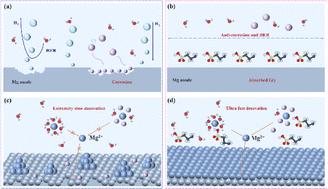
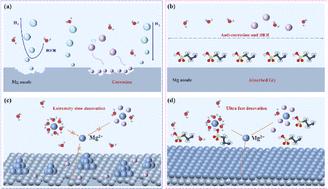
Aqueous Mg–air batteries are promising candidates for large-scale energy storage, but their practical application is significantly hindered by water-induced parasitic reactions and the chunk effect. In this study, taurine (Tau) is an effective electrolyte additive for aqueous Mg–air batteries utilizing various magnesium anodes. The non-sacrificial Tau molecules, possessing both donor and acceptor groups, disrupt the inherent hydrogen bond network of H2O and replace solvated H2O in the Mg2+ solvation sheath, forming dynamic adsorption on Mg and creating a hydrophobic electric double layer. Consequently, taurine inhibits H2O attack on Mg, promoting uniform Mg stripping. An appropriate amount of Tau not only enhances the discharge activity of the AZ31 anode but also suppresses its self-discharge phenomenon, achieving a surprising effect of simultaneously boosting voltage and anode utilization. Therefore, 0.2 M Tau was identified as the optimal electrolyte concentration and successfully incorporated in Mg–air batteries utilizing various routine Mg anodes (such as VW83, VW103, and LA103Z). The results demonstrate that Tau effectively enhances the discharge properties for Mg–air batteries employing various magnesium anodes.




 京公网安备 11010802042870号
京ICP备2023020795号-1
京公网安备 11010802042870号
京ICP备2023020795号-1

 分享
分享
 求助内容:
求助内容: 应助结果提醒方式:
 扫码关注我们
