Angela Lesley Baufeldt, Nikos Evangelou, Nima Moghaddam, Mark Gresswell, Roshan das Nair
{"title":"Consensus-Based Guidelines for Communicating a Misdiagnosis of Multiple Sclerosis to Reduce Psychological Distress","authors":"Angela Lesley Baufeldt, Nikos Evangelou, Nima Moghaddam, Mark Gresswell, Roshan das Nair","doi":"10.1002/brb3.70109","DOIUrl":null,"url":null,"abstract":"<div>\n \n \n <section>\n \n <h3> Background</h3>\n \n <p>Multiple sclerosis (MS) misdiagnosis is common, and when discovered, frequently leads to substantial disruption to patients’ lives and anxiety for clinicians. Our objective was to develop expert consensus-based guidelines about how to communicate a misdiagnosis of MS to a patient, to reduce the potential for both psychological distress and litigation.</p>\n </section>\n \n <section>\n \n <h3> Methods</h3>\n \n <p>A modified Delphi method using a systematic literature review on doctor and patient experiences of the MS diagnosis communication was used to populate items for a first-round questionnaire. Our Delphi panel represented three perspectives (clinicians, people with MS, and published experts in health communication), and we recruited 18 panelists in total (6 per perspective). Consensus was defined a priori as 75% of panelists giving an item the same rating. A feedback round was undertaken with six external reviewers, naïve to the guideline development process, and the panelists. Items were reviewed by the study team and synthesized to create the finalized guidelines.</p>\n </section>\n \n <section>\n \n <h3> Results</h3>\n \n <p>Consensus was reached for 45 items rated as “very important” and presented in the feedback round. The study team synthesized the 45 items to 27 items. Ten items related specifically to the communication of the MS misdiagnosis and 17 items to generic guidelines highlighted as important in the MS misdiagnosis appointment. Seven recommendations form the guidelines presented here.</p>\n </section>\n \n <section>\n \n <h3> Conclusions</h3>\n \n <p>Seven consensus-based recommendations offer guidance to practising neurologists in their communication with patients in a situation that has the potential to be highly distressing, for both clinician and patient.</p>\n </section>\n </div>","PeriodicalId":9081,"journal":{"name":"Brain and Behavior","volume":"14 10","pages":""},"PeriodicalIF":2.7000,"publicationDate":"2024-10-28","publicationTypes":"Journal Article","fieldsOfStudy":null,"isOpenAccess":false,"openAccessPdf":"https://onlinelibrary.wiley.com/doi/epdf/10.1002/brb3.70109","citationCount":"0","resultStr":null,"platform":"Semanticscholar","paperid":null,"PeriodicalName":"Brain and Behavior","FirstCategoryId":"102","ListUrlMain":"https://onlinelibrary.wiley.com/doi/10.1002/brb3.70109","RegionNum":3,"RegionCategory":"心理学","ArticlePicture":[],"TitleCN":null,"AbstractTextCN":null,"PMCID":null,"EPubDate":"","PubModel":"","JCR":"Q2","JCRName":"BEHAVIORAL SCIENCES","Score":null,"Total":0}
引用次数: 0
Abstract
Background
Multiple sclerosis (MS) misdiagnosis is common, and when discovered, frequently leads to substantial disruption to patients’ lives and anxiety for clinicians. Our objective was to develop expert consensus-based guidelines about how to communicate a misdiagnosis of MS to a patient, to reduce the potential for both psychological distress and litigation.
Methods
A modified Delphi method using a systematic literature review on doctor and patient experiences of the MS diagnosis communication was used to populate items for a first-round questionnaire. Our Delphi panel represented three perspectives (clinicians, people with MS, and published experts in health communication), and we recruited 18 panelists in total (6 per perspective). Consensus was defined a priori as 75% of panelists giving an item the same rating. A feedback round was undertaken with six external reviewers, naïve to the guideline development process, and the panelists. Items were reviewed by the study team and synthesized to create the finalized guidelines.
Results
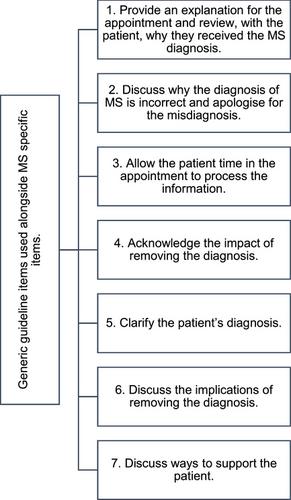
Consensus was reached for 45 items rated as “very important” and presented in the feedback round. The study team synthesized the 45 items to 27 items. Ten items related specifically to the communication of the MS misdiagnosis and 17 items to generic guidelines highlighted as important in the MS misdiagnosis appointment. Seven recommendations form the guidelines presented here.
Conclusions
Seven consensus-based recommendations offer guidance to practising neurologists in their communication with patients in a situation that has the potential to be highly distressing, for both clinician and patient.
期刊介绍:
Brain and Behavior is supported by other journals published by Wiley, including a number of society-owned journals. The journals listed below support Brain and Behavior and participate in the Manuscript Transfer Program by referring articles of suitable quality and offering authors the option to have their paper, with any peer review reports, automatically transferred to Brain and Behavior.
* [Acta Psychiatrica Scandinavica](https://publons.com/journal/1366/acta-psychiatrica-scandinavica)
* [Addiction Biology](https://publons.com/journal/1523/addiction-biology)
* [Aggressive Behavior](https://publons.com/journal/3611/aggressive-behavior)
* [Brain Pathology](https://publons.com/journal/1787/brain-pathology)
* [Child: Care, Health and Development](https://publons.com/journal/6111/child-care-health-and-development)
* [Criminal Behaviour and Mental Health](https://publons.com/journal/3839/criminal-behaviour-and-mental-health)
* [Depression and Anxiety](https://publons.com/journal/1528/depression-and-anxiety)
* Developmental Neurobiology
* [Developmental Science](https://publons.com/journal/1069/developmental-science)
* [European Journal of Neuroscience](https://publons.com/journal/1441/european-journal-of-neuroscience)
* [Genes, Brain and Behavior](https://publons.com/journal/1635/genes-brain-and-behavior)
* [GLIA](https://publons.com/journal/1287/glia)
* [Hippocampus](https://publons.com/journal/1056/hippocampus)
* [Human Brain Mapping](https://publons.com/journal/500/human-brain-mapping)
* [Journal for the Theory of Social Behaviour](https://publons.com/journal/7330/journal-for-the-theory-of-social-behaviour)
* [Journal of Comparative Neurology](https://publons.com/journal/1306/journal-of-comparative-neurology)
* [Journal of Neuroimaging](https://publons.com/journal/6379/journal-of-neuroimaging)
* [Journal of Neuroscience Research](https://publons.com/journal/2778/journal-of-neuroscience-research)
* [Journal of Organizational Behavior](https://publons.com/journal/1123/journal-of-organizational-behavior)
* [Journal of the Peripheral Nervous System](https://publons.com/journal/3929/journal-of-the-peripheral-nervous-system)
* [Muscle & Nerve](https://publons.com/journal/4448/muscle-and-nerve)
* [Neural Pathology and Applied Neurobiology](https://publons.com/journal/2401/neuropathology-and-applied-neurobiology)