Willem S. van Boxtel, Michael Linge, Rylee Manning, Lily N. Haven, Jiyeon Lee
{"title":"Online Eye Tracking for Aphasia: A Feasibility Study Comparing Web and Lab Tracking and Implications for Clinical Use","authors":"Willem S. van Boxtel, Michael Linge, Rylee Manning, Lily N. Haven, Jiyeon Lee","doi":"10.1002/brb3.70112","DOIUrl":null,"url":null,"abstract":"<div>\n \n \n <section>\n \n <h3> Background & Aims</h3>\n \n <p>Studies using eye-tracking methodology have made important contributions to the study of language disorders such as aphasia. Nevertheless, in clinical groups especially, eye-tracking studies often include small sample sizes, limiting the generalizability of reported findings. Online, webcam-based tracking offers a potential solution to this issue, but web-based tracking has not been compared with in-lab tracking in past studies and has never been attempted in groups with language impairments.</p>\n </section>\n \n <section>\n \n <h3> Materials & Methods</h3>\n \n <p>Patients with post-stroke aphasia (<i>n </i>= 16) and age-matched controls (<i>n </i>= 16) completed identical sentence-picture matching tasks in the lab (using an EyeLink system) and on the web (using WebGazer.js), with the order of sessions counterbalanced. We examined whether web-based eye tracking is as sensitive as in-lab eye tracking in detecting group differences in sentence processing.</p>\n </section>\n \n <section>\n \n <h3> Results</h3>\n \n <p>Patients were less accurate and slower to respond to all sentence types than controls. Proportions of gazes to the target and foil picture were computed in 100 ms increments, which showed that the two modes of tracking were comparably sensitive to overall group differences across different sentence types. Web tracking showed comparable fluctuations in gaze proportions to target pictures to lab tracking in most analyses, whereas a delay of approximately 500–800 ms appeared in web compared to lab data.</p>\n </section>\n \n <section>\n \n <h3> Discussion & Conclusions</h3>\n \n <p>Web-based eye tracking is feasible to study impaired language processing in aphasia and is sensitive enough to detect most group differences between controls and patients. Given that validations of webcam-based tracking are in their infancy and how transformative this method could be to several disciplines, much more testing is warranted.</p>\n </section>\n </div>","PeriodicalId":9081,"journal":{"name":"Brain and Behavior","volume":"14 11","pages":""},"PeriodicalIF":2.7000,"publicationDate":"2024-10-29","publicationTypes":"Journal Article","fieldsOfStudy":null,"isOpenAccess":false,"openAccessPdf":"https://www.ncbi.nlm.nih.gov/pmc/articles/PMC11519703/pdf/","citationCount":"0","resultStr":null,"platform":"Semanticscholar","paperid":null,"PeriodicalName":"Brain and Behavior","FirstCategoryId":"102","ListUrlMain":"https://onlinelibrary.wiley.com/doi/10.1002/brb3.70112","RegionNum":3,"RegionCategory":"心理学","ArticlePicture":[],"TitleCN":null,"AbstractTextCN":null,"PMCID":null,"EPubDate":"","PubModel":"","JCR":"Q2","JCRName":"BEHAVIORAL SCIENCES","Score":null,"Total":0}
引用次数: 0
Abstract
Background & Aims
Studies using eye-tracking methodology have made important contributions to the study of language disorders such as aphasia. Nevertheless, in clinical groups especially, eye-tracking studies often include small sample sizes, limiting the generalizability of reported findings. Online, webcam-based tracking offers a potential solution to this issue, but web-based tracking has not been compared with in-lab tracking in past studies and has never been attempted in groups with language impairments.
Materials & Methods
Patients with post-stroke aphasia (n = 16) and age-matched controls (n = 16) completed identical sentence-picture matching tasks in the lab (using an EyeLink system) and on the web (using WebGazer.js), with the order of sessions counterbalanced. We examined whether web-based eye tracking is as sensitive as in-lab eye tracking in detecting group differences in sentence processing.
Results
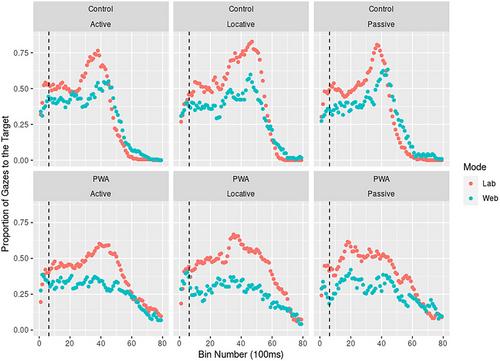
Patients were less accurate and slower to respond to all sentence types than controls. Proportions of gazes to the target and foil picture were computed in 100 ms increments, which showed that the two modes of tracking were comparably sensitive to overall group differences across different sentence types. Web tracking showed comparable fluctuations in gaze proportions to target pictures to lab tracking in most analyses, whereas a delay of approximately 500–800 ms appeared in web compared to lab data.
Discussion & Conclusions
Web-based eye tracking is feasible to study impaired language processing in aphasia and is sensitive enough to detect most group differences between controls and patients. Given that validations of webcam-based tracking are in their infancy and how transformative this method could be to several disciplines, much more testing is warranted.
期刊介绍:
Brain and Behavior is supported by other journals published by Wiley, including a number of society-owned journals. The journals listed below support Brain and Behavior and participate in the Manuscript Transfer Program by referring articles of suitable quality and offering authors the option to have their paper, with any peer review reports, automatically transferred to Brain and Behavior.
* [Acta Psychiatrica Scandinavica](https://publons.com/journal/1366/acta-psychiatrica-scandinavica)
* [Addiction Biology](https://publons.com/journal/1523/addiction-biology)
* [Aggressive Behavior](https://publons.com/journal/3611/aggressive-behavior)
* [Brain Pathology](https://publons.com/journal/1787/brain-pathology)
* [Child: Care, Health and Development](https://publons.com/journal/6111/child-care-health-and-development)
* [Criminal Behaviour and Mental Health](https://publons.com/journal/3839/criminal-behaviour-and-mental-health)
* [Depression and Anxiety](https://publons.com/journal/1528/depression-and-anxiety)
* Developmental Neurobiology
* [Developmental Science](https://publons.com/journal/1069/developmental-science)
* [European Journal of Neuroscience](https://publons.com/journal/1441/european-journal-of-neuroscience)
* [Genes, Brain and Behavior](https://publons.com/journal/1635/genes-brain-and-behavior)
* [GLIA](https://publons.com/journal/1287/glia)
* [Hippocampus](https://publons.com/journal/1056/hippocampus)
* [Human Brain Mapping](https://publons.com/journal/500/human-brain-mapping)
* [Journal for the Theory of Social Behaviour](https://publons.com/journal/7330/journal-for-the-theory-of-social-behaviour)
* [Journal of Comparative Neurology](https://publons.com/journal/1306/journal-of-comparative-neurology)
* [Journal of Neuroimaging](https://publons.com/journal/6379/journal-of-neuroimaging)
* [Journal of Neuroscience Research](https://publons.com/journal/2778/journal-of-neuroscience-research)
* [Journal of Organizational Behavior](https://publons.com/journal/1123/journal-of-organizational-behavior)
* [Journal of the Peripheral Nervous System](https://publons.com/journal/3929/journal-of-the-peripheral-nervous-system)
* [Muscle & Nerve](https://publons.com/journal/4448/muscle-and-nerve)
* [Neural Pathology and Applied Neurobiology](https://publons.com/journal/2401/neuropathology-and-applied-neurobiology)