Nan Hu, Fengshan Huang, Rui Yu, Neil Chen Yi Lun MacAlevey, Yi Zeng, Ping Miao
{"title":"The investigation of ultrasound to assess lateral abdominal wall activation with different types of core exercises.","authors":"Nan Hu, Fengshan Huang, Rui Yu, Neil Chen Yi Lun MacAlevey, Yi Zeng, Ping Miao","doi":"10.1186/s13102-024-01009-x","DOIUrl":null,"url":null,"abstract":"<p><strong>Background: </strong>Core training is the foundation of physical exercise. The activation of the lateral abdominal wall (LAW) muscles in the core muscles, particularly the transversus abdominal (TrA) muscles, has a stabilizing effect on the chest and abdomen. Therefore, we need to focus on the training effect of the TrA. There are many ways to measure the LAW. Ultrasound can assess the effect of training in real time and intuitively. Therefore, we intend to evaluate the activation of the LAW in different types of core training using ultrasound, to determine the best movements that can activate the TrA and train the core muscles.</p><p><strong>Methods: </strong>22 healthy subjects (male 10, female 12, age 22.82 ± 0.98, BMI 20.78 ± 2.27) were included. The subjects were given the following instructions to perform breathing exercises at different positions: calm breathing and deep breathing at 0° hip flexion and 0° knee flexion; calm breathing, deep breathing, abdominal crunches and ball crunches at 45° hip flexion and 90° knee flexion; and calm breathing, deep breathing, abdominal crunches and ball crunches at 90° hip flexion and 90° knee flexion. The muscle thicknesses of the bilateral transversus abdominis (TrA), internal oblique (IO), external oblique (EO), and LAW muscles were measured using ultrasonography at the end of expiration during the above movements.</p><p><strong>Results: </strong>(1) The action with the greatest contraction ratio of the TrA was deep exhalation, which was significantly greater than crunch and ball crunch; (2) During deep exhalation, the TrA had the greatest contraction ratio, significantly greater than the IO and EO. (3) The TrA was thinnest during deep exhalation at 90°, followed by 45° and 0°.</p><p><strong>Conclusion: </strong>In healthy young people, deep expiration with 90° hip flexion and 90° knee flexion was the optimal action for activating the LAW, especially the TrA.</p>","PeriodicalId":48585,"journal":{"name":"BMC Sports Science Medicine and Rehabilitation","volume":"16 1","pages":"222"},"PeriodicalIF":2.8000,"publicationDate":"2024-10-28","publicationTypes":"Journal Article","fieldsOfStudy":null,"isOpenAccess":false,"openAccessPdf":"https://www.ncbi.nlm.nih.gov/pmc/articles/PMC11514915/pdf/","citationCount":"0","resultStr":null,"platform":"Semanticscholar","paperid":null,"PeriodicalName":"BMC Sports Science Medicine and Rehabilitation","FirstCategoryId":"3","ListUrlMain":"https://doi.org/10.1186/s13102-024-01009-x","RegionNum":3,"RegionCategory":"医学","ArticlePicture":[],"TitleCN":null,"AbstractTextCN":null,"PMCID":null,"EPubDate":"","PubModel":"","JCR":"Q1","JCRName":"REHABILITATION","Score":null,"Total":0}
引用次数: 0
Abstract
Background: Core training is the foundation of physical exercise. The activation of the lateral abdominal wall (LAW) muscles in the core muscles, particularly the transversus abdominal (TrA) muscles, has a stabilizing effect on the chest and abdomen. Therefore, we need to focus on the training effect of the TrA. There are many ways to measure the LAW. Ultrasound can assess the effect of training in real time and intuitively. Therefore, we intend to evaluate the activation of the LAW in different types of core training using ultrasound, to determine the best movements that can activate the TrA and train the core muscles.
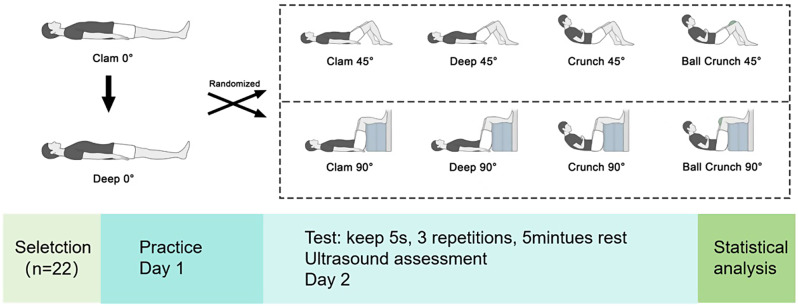
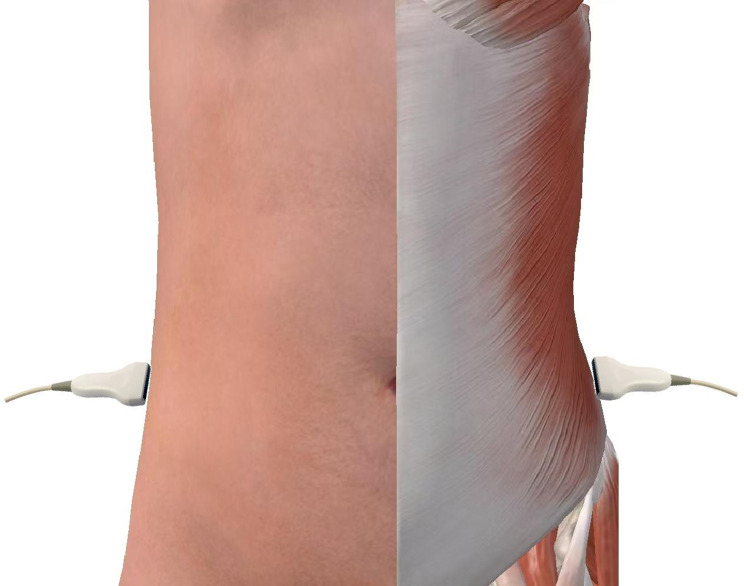
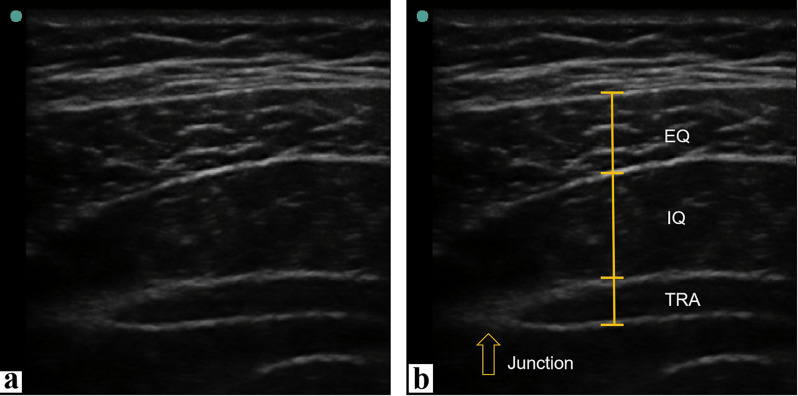
Methods: 22 healthy subjects (male 10, female 12, age 22.82 ± 0.98, BMI 20.78 ± 2.27) were included. The subjects were given the following instructions to perform breathing exercises at different positions: calm breathing and deep breathing at 0° hip flexion and 0° knee flexion; calm breathing, deep breathing, abdominal crunches and ball crunches at 45° hip flexion and 90° knee flexion; and calm breathing, deep breathing, abdominal crunches and ball crunches at 90° hip flexion and 90° knee flexion. The muscle thicknesses of the bilateral transversus abdominis (TrA), internal oblique (IO), external oblique (EO), and LAW muscles were measured using ultrasonography at the end of expiration during the above movements.
Results: (1) The action with the greatest contraction ratio of the TrA was deep exhalation, which was significantly greater than crunch and ball crunch; (2) During deep exhalation, the TrA had the greatest contraction ratio, significantly greater than the IO and EO. (3) The TrA was thinnest during deep exhalation at 90°, followed by 45° and 0°.
Conclusion: In healthy young people, deep expiration with 90° hip flexion and 90° knee flexion was the optimal action for activating the LAW, especially the TrA.
期刊介绍:
BMC Sports Science, Medicine and Rehabilitation is an open access, peer reviewed journal that considers articles on all aspects of sports medicine and the exercise sciences, including rehabilitation, traumatology, cardiology, physiology, and nutrition.



 京公网安备 11010802042870号
京ICP备2023020795号-1
京公网安备 11010802042870号
京ICP备2023020795号-1

 分享
分享
 求助内容:
求助内容: 应助结果提醒方式:
 扫码关注我们
