Chloe Zubieta, Stephanie Hutin, Jae-hoon Jung, Xuelei Lai
{"title":"Phosphorylation of phyB by GSK3s, a key mechanism that brings temperature sensors together","authors":"Chloe Zubieta, Stephanie Hutin, Jae-hoon Jung, Xuelei Lai","doi":"10.1111/nph.20232","DOIUrl":null,"url":null,"abstract":"<p>Light and temperature act from the earliest stages of seedling growth, establishing the developmental strategies of skotomorphogenesis, photomorphogenesis and thermomorphogenesis. In dark-grown plants, skotomorphogenesis is the dominant growth strategy and is characterized by the elongation of the hypocotyl, repression of leaf expansion, leaf hyponasty and inhibition of chloroplast development as the seedling searches for light. By contrast, when exposed to light, seedlings switch their development program to photomorphogenesis, characterized by shortened hypocotyls, leaf expansion and chloroplast biogenesis. Under warm conditions, particularly warm shade conditions, plants across developmental stages exhibit thermomorphogenic growth which includes some of the hallmarks of skotomorphogenesis such as elongation of hypocotyls as well as petiole elongation, changes in leaf shape, hyponasty and early flowering. Photoreceptors including phyB play key roles in regulating these developmental pathways. PhyB is essential for sensing the ratio of red to far-red light, enabling the transition from skoto- to photomorphogenesis. In addition, recent work has shown that phyB also acts as a direct thermosensor of ambient temperature, playing a key role in thermomorphogenesis (Jung <i>et al</i>., <span>2016</span>; Legris <i>et al</i>., <span>2016</span>). PhyB contains a tetrapyrrole chromophore, phytochromobilin, that is able to absorb red (660 nm) and far-red (730 nm) light. The inactive cytosolic form of phyB, Pr, is activated by the absorption of red light and undergoes a conformational change to an active state, Pfr, which likely exposes a nuclear localization signal, resulting in nuclear translocation of the Pfr form of phyB and the formation of discrete phyB puncta in the nucleus called photobodies. Upon absorption of far-red light, the Pfr active form switches back to the inactive Pr state and phyB photobodies dissociate. In addition, the transition between active and inactive states is directly affected by temperature in a process called thermal reversion, in which higher temperatures increase the transition rate from the active to the inactive form. PhyB activity and localization are also strongly affected by its phosphorylation state, with previous studies identifying FERONIA as a receptor-like kinase that phosphorylates phyB, triggering reversion from the active to inactive form and photobody dissociation (Liu <i>et al</i>., <span>2023</span>).</p><p>In the article by Yang <i>et al</i>., the authors show that phyB is a direct target of the BIN2 kinase, a key regulator of brassinosteroid signaling that phosphorylates the BRASSINAZOLE-RESISTANT1 (BZR1) transcription factors, resulting in their degradation and plant growth repression. Recent studies have also determined that BIN2 phosphorylates PHYTOCHROME INTERACTING FACTOR 4, a transcription factor involved in light and temperature response pathways and a negative regulator of photomorphogenic genes, target it for degradation (Bernardo-García <i>et al</i>., <span>2014</span>). Thus, the role of BIN2 as a negative regulator of growth is highly complex, involving not only hormone signaling pathways, but also the accumulation of PIFs and the stabilizing and/or assembly of phyB photobodies. However, under higher ambient temperature conditions, PIFs accumulate and growth repression is alleviated. The reduced enzymatic activity of BIN2 under warmer temperatures likely plays a key role in PIF accumulation.</p><p>During the day, PIFs bind phytochromes such as phyB and are concentrated into photobodies where they are subsequently phosphorylated and targeted for degradation. Phosphorylation of phyB by BIN2 stabilizes photobodies and allows phyB to more strongly interact with ELF3, another direct temperature sensor. ELF3 recruits HEMERA, a ubiquitin-binding protein, and further facilitates the formation and/or stabilization of photobodies. The phyB-ELF3-HEMERA complex negatively regulates thermomorphogenesis, likely via the degradation of the PIFs (Qiu <i>et al</i>., <span>2015</span>). During the night, when photobodies have dissociated, the repressive Evening Complex (EC), consisting of ELF3, ELF4 and LUX ARRYTHMO, represses transcription of <i>PIFs</i>, further limiting PIF protein accumulation (Ezer <i>et al</i>., <span>2017</span>). Both photobodies and the EC are destabilized by warmer temperatures, although due to different mechanisms. Whereas ELF3 forms nuclear bodies under warmer conditions (Jung <i>et al</i>., <span>2020</span>; Hutin <i>et al</i>., <span>2023</span>), and this decreases the activity of the EC, warmer temperatures dissociate phyB photobodies due, in part, to the lower activity of BIN2 and decreased levels of phyB phosphorylation. Yang <i>et al</i>. demonstrate that BIN2 forms inactive oligomers as a function of higher temperature, resulting in lower levels of phyB phosphorylation and providing a mechanistic model for photobody destabilization due to changes in phosphorylation state. This research highlights that the BIN2-mediated phosphorylation of phyB is vital for plant thermomorphogenesis and provides insights into the mechanisms of temperature sensing via changes in protein activity and structure (Fig. 1).</p><p>Further studies will reveal how temperature may induce structural changes in BIN2 to promote oligomerization and whether this is dependent on the redox state of the cell (Lu <i>et al</i>., <span>2022</span>). How temperature affects other components of photobodies, such as the thermosensor ELF3, and whether this also contributes to photobody dissociation under warmer temperatures will need to be addressed. The dynamics and changes in composition and activity of photobodies as a function of temperature is a major challenge in the field. The identification of new regulators of photobody assembly, stability and dissociation as well as potential cross-talk between photobodies and signal transduction pathways is a critical step in understanding how plants alter their growth as a function of changing environmental conditions. The work by Yang <i>et al</i>. furthers our knowledge of the complex signaling networks and overlapping players plants use to sense their environment and optimize their developmental programs under different temperature regimes.</p>","PeriodicalId":214,"journal":{"name":"New Phytologist","volume":"245 4","pages":"1335-1337"},"PeriodicalIF":8.1000,"publicationDate":"2024-10-28","publicationTypes":"Journal Article","fieldsOfStudy":null,"isOpenAccess":false,"openAccessPdf":"https://onlinelibrary.wiley.com/doi/epdf/10.1111/nph.20232","citationCount":"0","resultStr":null,"platform":"Semanticscholar","paperid":null,"PeriodicalName":"New Phytologist","FirstCategoryId":"99","ListUrlMain":"https://nph.onlinelibrary.wiley.com/doi/10.1111/nph.20232","RegionNum":1,"RegionCategory":"生物学","ArticlePicture":[],"TitleCN":null,"AbstractTextCN":null,"PMCID":null,"EPubDate":"","PubModel":"","JCR":"Q1","JCRName":"PLANT SCIENCES","Score":null,"Total":0}
引用次数: 0
Abstract
Light and temperature act from the earliest stages of seedling growth, establishing the developmental strategies of skotomorphogenesis, photomorphogenesis and thermomorphogenesis. In dark-grown plants, skotomorphogenesis is the dominant growth strategy and is characterized by the elongation of the hypocotyl, repression of leaf expansion, leaf hyponasty and inhibition of chloroplast development as the seedling searches for light. By contrast, when exposed to light, seedlings switch their development program to photomorphogenesis, characterized by shortened hypocotyls, leaf expansion and chloroplast biogenesis. Under warm conditions, particularly warm shade conditions, plants across developmental stages exhibit thermomorphogenic growth which includes some of the hallmarks of skotomorphogenesis such as elongation of hypocotyls as well as petiole elongation, changes in leaf shape, hyponasty and early flowering. Photoreceptors including phyB play key roles in regulating these developmental pathways. PhyB is essential for sensing the ratio of red to far-red light, enabling the transition from skoto- to photomorphogenesis. In addition, recent work has shown that phyB also acts as a direct thermosensor of ambient temperature, playing a key role in thermomorphogenesis (Jung et al., 2016; Legris et al., 2016). PhyB contains a tetrapyrrole chromophore, phytochromobilin, that is able to absorb red (660 nm) and far-red (730 nm) light. The inactive cytosolic form of phyB, Pr, is activated by the absorption of red light and undergoes a conformational change to an active state, Pfr, which likely exposes a nuclear localization signal, resulting in nuclear translocation of the Pfr form of phyB and the formation of discrete phyB puncta in the nucleus called photobodies. Upon absorption of far-red light, the Pfr active form switches back to the inactive Pr state and phyB photobodies dissociate. In addition, the transition between active and inactive states is directly affected by temperature in a process called thermal reversion, in which higher temperatures increase the transition rate from the active to the inactive form. PhyB activity and localization are also strongly affected by its phosphorylation state, with previous studies identifying FERONIA as a receptor-like kinase that phosphorylates phyB, triggering reversion from the active to inactive form and photobody dissociation (Liu et al., 2023).
In the article by Yang et al., the authors show that phyB is a direct target of the BIN2 kinase, a key regulator of brassinosteroid signaling that phosphorylates the BRASSINAZOLE-RESISTANT1 (BZR1) transcription factors, resulting in their degradation and plant growth repression. Recent studies have also determined that BIN2 phosphorylates PHYTOCHROME INTERACTING FACTOR 4, a transcription factor involved in light and temperature response pathways and a negative regulator of photomorphogenic genes, target it for degradation (Bernardo-García et al., 2014). Thus, the role of BIN2 as a negative regulator of growth is highly complex, involving not only hormone signaling pathways, but also the accumulation of PIFs and the stabilizing and/or assembly of phyB photobodies. However, under higher ambient temperature conditions, PIFs accumulate and growth repression is alleviated. The reduced enzymatic activity of BIN2 under warmer temperatures likely plays a key role in PIF accumulation.
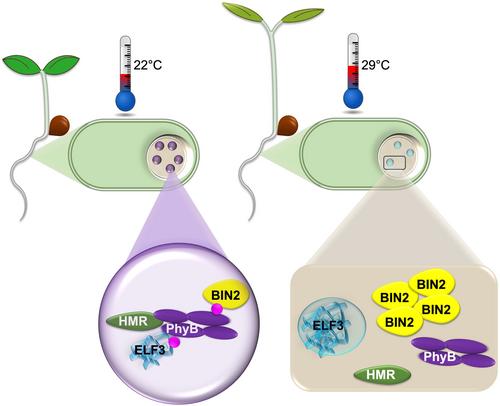
During the day, PIFs bind phytochromes such as phyB and are concentrated into photobodies where they are subsequently phosphorylated and targeted for degradation. Phosphorylation of phyB by BIN2 stabilizes photobodies and allows phyB to more strongly interact with ELF3, another direct temperature sensor. ELF3 recruits HEMERA, a ubiquitin-binding protein, and further facilitates the formation and/or stabilization of photobodies. The phyB-ELF3-HEMERA complex negatively regulates thermomorphogenesis, likely via the degradation of the PIFs (Qiu et al., 2015). During the night, when photobodies have dissociated, the repressive Evening Complex (EC), consisting of ELF3, ELF4 and LUX ARRYTHMO, represses transcription of PIFs, further limiting PIF protein accumulation (Ezer et al., 2017). Both photobodies and the EC are destabilized by warmer temperatures, although due to different mechanisms. Whereas ELF3 forms nuclear bodies under warmer conditions (Jung et al., 2020; Hutin et al., 2023), and this decreases the activity of the EC, warmer temperatures dissociate phyB photobodies due, in part, to the lower activity of BIN2 and decreased levels of phyB phosphorylation. Yang et al. demonstrate that BIN2 forms inactive oligomers as a function of higher temperature, resulting in lower levels of phyB phosphorylation and providing a mechanistic model for photobody destabilization due to changes in phosphorylation state. This research highlights that the BIN2-mediated phosphorylation of phyB is vital for plant thermomorphogenesis and provides insights into the mechanisms of temperature sensing via changes in protein activity and structure (Fig. 1).
Further studies will reveal how temperature may induce structural changes in BIN2 to promote oligomerization and whether this is dependent on the redox state of the cell (Lu et al., 2022). How temperature affects other components of photobodies, such as the thermosensor ELF3, and whether this also contributes to photobody dissociation under warmer temperatures will need to be addressed. The dynamics and changes in composition and activity of photobodies as a function of temperature is a major challenge in the field. The identification of new regulators of photobody assembly, stability and dissociation as well as potential cross-talk between photobodies and signal transduction pathways is a critical step in understanding how plants alter their growth as a function of changing environmental conditions. The work by Yang et al. furthers our knowledge of the complex signaling networks and overlapping players plants use to sense their environment and optimize their developmental programs under different temperature regimes.
光和温度从幼苗生长的最早阶段起就起作用,决定了幼苗形态发生、光形态发生和热形态发生的发育策略。在黑暗生长的植物中,种子形态形成是主要的生长策略,其特征是下胚轴的伸长,叶片扩张的抑制,叶片发育的降低和叶绿体发育的抑制。相反,当暴露在光照下时,幼苗将其发育程序转换为光形态发生,其特征是下胚轴缩短,叶片扩张和叶绿体生物发生。在温暖的条件下,特别是在温暖的荫蔽条件下,植物在各个发育阶段都表现出热形态发生的生长,其中包括一些skoomorphphogenesis的特征,如下胚轴的伸长以及叶柄的伸长,叶片形状的变化,低胚轴和早期开花。包括phyB在内的光感受器在调节这些发育途径中起关键作用。PhyB对于感知红光与远红光的比例至关重要,从而实现从光形态发生到光形态发生的转变。此外,最近的研究表明,phyB还可以作为环境温度的直接热传感器,在热形态发生中发挥关键作用(Jung et al., 2016;Legris et al., 2016)。PhyB含有一个四吡咯发色团,phytochromobilin,能够吸收红光(660 nm)和远红光(730 nm)。phyB的非活性胞质形式Pr被红光吸收激活,并经历构象变化到活性状态Pfr,这可能暴露了一个核定位信号,导致phyB的Pfr形式的核易位,并在细胞核中形成离散的phyB点,称为光体。在吸收远红光后,Pfr活性形式切换回非活性Pr状态,phyB光体解离。此外,在称为热还原的过程中,活性态和非活性态之间的转变直接受到温度的影响,在这个过程中,较高的温度增加了从活性态到非活性态的转变速率。PhyB的活性和定位也受到其磷酸化状态的强烈影响,先前的研究发现FERONIA是一种受体样激酶,可使PhyB磷酸化,引发从活性形式到非活性形式的逆转和光体解离(Liu et al., 2023)。在Yang等人的文章中,作者表明phyB是BIN2激酶的直接靶点,BIN2激酶是油菜素类固醇信号传导的关键调节因子,可磷酸化brassinazol - resistant1 (BZR1)转录因子,导致其降解和植物生长抑制。最近的研究也确定BIN2磷酸化光敏色素相互作用因子4,光敏色素相互作用因子4是一种参与光和温度响应途径的转录因子,是光形态形成基因的负调节因子,并将其靶向降解(Bernardo-García et al., 2014)。因此,BIN2作为生长负调节因子的作用非常复杂,不仅涉及激素信号通路,还涉及pif的积累和phyB光体的稳定和/或组装。然而,在较高的环境温度条件下,pif积累和生长抑制得到缓解。温度升高导致BIN2酶活性降低,可能在PIF积累中起关键作用。在白天,pif结合光敏色素,如phyB,并被浓缩到光体中,随后被磷酸化并被降解。BIN2对phyB的磷酸化稳定了光体,并允许phyB与另一种直接温度传感器ELF3更强烈地相互作用。ELF3招募HEMERA,一种泛素结合蛋白,并进一步促进光体的形成和/或稳定。phyB-ELF3-HEMERA复合物可能通过降解pif负性调节热形态发生(Qiu et al., 2015)。在夜间,当光体分离时,由ELF3、ELF4和LUX ARRYTHMO组成的抑制性夜间复合体(EC)抑制PIF的转录,进一步限制PIF蛋白的积累(Ezer等,2017)。光体和EC都因温度升高而不稳定,尽管机制不同。而ELF3在较温暖的条件下形成核体(Jung et al., 2020;Hutin et al., 2023),这降低了EC的活性,较高的温度解离phyB光体,部分原因是由于BIN2活性较低和phyB磷酸化水平降低。Yang等人证明,BIN2在高温下形成无活性低聚物,导致phyB磷酸化水平降低,并为磷酸化状态变化导致光体不稳定提供了机制模型。 该研究强调了BIN2介导的phyB磷酸化对植物热形态发生至关重要,并通过蛋白质活性和结构的变化深入了解了温度感知机制(图1)。进一步的研究将揭示温度如何诱导BIN2的结构变化以促进寡聚化,以及这是否依赖于细胞的氧化还原状态(Lu et al., 2022)。温度如何影响光体的其他组成部分,如热敏传感器ELF3,以及这是否也有助于光体在更高温度下的解离,将需要解决。光体组成和活性随温度变化的动力学和变化是该领域的主要挑战。鉴定光体组装、稳定性和解离的新调控因子以及光体和信号转导途径之间潜在的串导是理解植物如何随着环境条件的变化而改变其生长的关键一步。Yang等人的工作进一步加深了我们对复杂信号网络和重叠参与者的了解,植物利用这些信号网络来感知环境,并在不同温度下优化它们的发育程序。
期刊介绍:
New Phytologist is an international electronic journal published 24 times a year. It is owned by the New Phytologist Foundation, a non-profit-making charitable organization dedicated to promoting plant science. The journal publishes excellent, novel, rigorous, and timely research and scholarship in plant science and its applications. The articles cover topics in five sections: Physiology & Development, Environment, Interaction, Evolution, and Transformative Plant Biotechnology. These sections encompass intracellular processes, global environmental change, and encourage cross-disciplinary approaches. The journal recognizes the use of techniques from molecular and cell biology, functional genomics, modeling, and system-based approaches in plant science. Abstracting and Indexing Information for New Phytologist includes Academic Search, AgBiotech News & Information, Agroforestry Abstracts, Biochemistry & Biophysics Citation Index, Botanical Pesticides, CAB Abstracts®, Environment Index, Global Health, and Plant Breeding Abstracts, and others.







 京公网安备 11010802042870号
京ICP备2023020795号-1
京公网安备 11010802042870号
京ICP备2023020795号-1

 分享
分享
 求助内容:
求助内容: 应助结果提醒方式:
 扫码关注我们
