Straightforward solid-phase modification of TiO2 with propylphosphonic acid via manual grinding and shaker mixing: enhancing modification degree by thermal control while improving atom economy†
Kaimin Zhang , Jinxin Wang , Nick Gys , Elien Derveaux , Nahal Ghanemnia , Wouter Marchal , Peter Adriaensens , Vera Meynen
{"title":"Straightforward solid-phase modification of TiO2 with propylphosphonic acid via manual grinding and shaker mixing: enhancing modification degree by thermal control while improving atom economy†","authors":"Kaimin Zhang , Jinxin Wang , Nick Gys , Elien Derveaux , Nahal Ghanemnia , Wouter Marchal , Peter Adriaensens , Vera Meynen","doi":"10.1039/d4gc03330b","DOIUrl":null,"url":null,"abstract":"<div><div>Grafting organophosphonic acids (PAs) on metal oxides has shown to be a flexible technology to tune the surface properties of metal oxides for various applications. The solvents applied in the commonly used synthesis method have associated impeding effect on tailoring the resulting modification degree. In this work, an alternative solid-phase manual grinding method is proposed that (i) is straightforward, (ii) can achieve controllable and higher modification degree, and (iii) excludes the use of solvent during the synthesis. Specifically, propylphosphonic acid (3PA) was grafted onto titania by manual grinding, and different modification degrees were obtained by varying the duration of the post-synthetic thermal treatment. Importantly, the solid-phase method can achieve a modification degree that is 25.0% higher than the maximal modification degree reached by the liquid-phase method, while its atom utilization efficiency is 4.8 times (toluene-based) or 7.5 times (water-based) that of the liquid-phase method.</div></div>","PeriodicalId":78,"journal":{"name":"Green Chemistry","volume":"26 21","pages":"Pages 10907-10920"},"PeriodicalIF":9.2000,"publicationDate":"2024-09-18","publicationTypes":"Journal Article","fieldsOfStudy":null,"isOpenAccess":false,"openAccessPdf":"https://pubs.rsc.org/en/content/articlepdf/2024/gc/d4gc03330b?page=search","citationCount":"0","resultStr":null,"platform":"Semanticscholar","paperid":null,"PeriodicalName":"Green Chemistry","FirstCategoryId":"92","ListUrlMain":"https://www.sciencedirect.com/org/science/article/pii/S1463926224008343","RegionNum":1,"RegionCategory":"化学","ArticlePicture":[],"TitleCN":null,"AbstractTextCN":null,"PMCID":null,"EPubDate":"","PubModel":"","JCR":"Q1","JCRName":"CHEMISTRY, MULTIDISCIPLINARY","Score":null,"Total":0}
引用次数: 0
Abstract
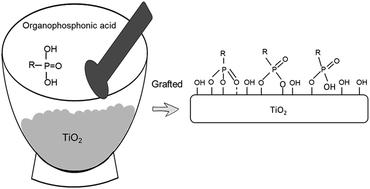
Grafting organophosphonic acids (PAs) on metal oxides has shown to be a flexible technology to tune the surface properties of metal oxides for various applications. The solvents applied in the commonly used synthesis method have associated impeding effect on tailoring the resulting modification degree. In this work, an alternative solid-phase manual grinding method is proposed that (i) is straightforward, (ii) can achieve controllable and higher modification degree, and (iii) excludes the use of solvent during the synthesis. Specifically, propylphosphonic acid (3PA) was grafted onto titania by manual grinding, and different modification degrees were obtained by varying the duration of the post-synthetic thermal treatment. Importantly, the solid-phase method can achieve a modification degree that is 25.0% higher than the maximal modification degree reached by the liquid-phase method, while its atom utilization efficiency is 4.8 times (toluene-based) or 7.5 times (water-based) that of the liquid-phase method.
期刊介绍:
Green Chemistry is a journal that provides a unique forum for the publication of innovative research on the development of alternative green and sustainable technologies. The scope of Green Chemistry is based on the definition proposed by Anastas and Warner (Green Chemistry: Theory and Practice, P T Anastas and J C Warner, Oxford University Press, Oxford, 1998), which defines green chemistry as the utilisation of a set of principles that reduces or eliminates the use or generation of hazardous substances in the design, manufacture and application of chemical products. Green Chemistry aims to reduce the environmental impact of the chemical enterprise by developing a technology base that is inherently non-toxic to living things and the environment. The journal welcomes submissions on all aspects of research relating to this endeavor and publishes original and significant cutting-edge research that is likely to be of wide general appeal. For a work to be published, it must present a significant advance in green chemistry, including a comparison with existing methods and a demonstration of advantages over those methods.



 京公网安备 11010802042870号
京ICP备2023020795号-1
京公网安备 11010802042870号
京ICP备2023020795号-1

 分享
分享
 求助内容:
求助内容: 应助结果提醒方式:
 扫码关注我们
