Ruoheng Jin , Beibei Wang , Guijian Zhang , Chunxia Cao
{"title":"AKH/AKHR signalling system induced antioxidant response mediated by entomopathogenic fungi in Nilaparvata lugens (Stål)","authors":"Ruoheng Jin , Beibei Wang , Guijian Zhang , Chunxia Cao","doi":"10.1016/j.pestbp.2024.106179","DOIUrl":null,"url":null,"abstract":"<div><div>The brown planthopper <em>Nilaparvata lugens</em> is one of the most economically important rice crop pests in Asia. Entomopathogenic fungi (EPF) have been developed as a biological control of <em>N. lugens</em>. Insect adipokinetic hormones (AKHs) are pleiotropic hormones that play a protective role in response to oxidative stress. However, the role of AKH in the anti-oxidative response of <em>N. lugens</em> to EPFs (<em>Metarhizium anisopliae</em> and <em>Beauveria bassiana</em>) infection remains largely unexplored. In this study, the results of relative enzyme activities and expression levels of antioxidant enzymes demonstrated the response of the antioxidant system of <em>N. lugens</em> to EPF infection. Additionally, the expression of AKH/adipokinetic hormone receptor (AKHR) also induced responding to the infection of EPF in <em>N. lugens</em>. Silencing <em>NlAKH</em> or <em>NlAKHR</em> significantly increased mortality in nymphs treated with fungi compared with controls, whereas the injection of AKH peptide decreased mortality. Further research indicated that the AKH/AKHR system positively influenced antioxidant enzymes, potentially involving the transcription factors forkhead-box O and Cap’ n’ collar C. These findings provide an important theoretical basis for developing new pest control agents targeting the neuropeptide AKH and offer new insights for mitigating brown planthopper resistance and promoting green control strategies.</div></div>","PeriodicalId":19828,"journal":{"name":"Pesticide Biochemistry and Physiology","volume":"206 ","pages":"Article 106179"},"PeriodicalIF":4.0000,"publicationDate":"2024-12-01","publicationTypes":"Journal Article","fieldsOfStudy":null,"isOpenAccess":false,"openAccessPdf":"","citationCount":"0","resultStr":null,"platform":"Semanticscholar","paperid":null,"PeriodicalName":"Pesticide Biochemistry and Physiology","FirstCategoryId":"97","ListUrlMain":"https://www.sciencedirect.com/science/article/pii/S0048357524004127","RegionNum":1,"RegionCategory":"农林科学","ArticlePicture":[],"TitleCN":null,"AbstractTextCN":null,"PMCID":null,"EPubDate":"2024/10/22 0:00:00","PubModel":"Epub","JCR":"Q2","JCRName":"BIOCHEMISTRY & MOLECULAR BIOLOGY","Score":null,"Total":0}
引用次数: 0
Abstract
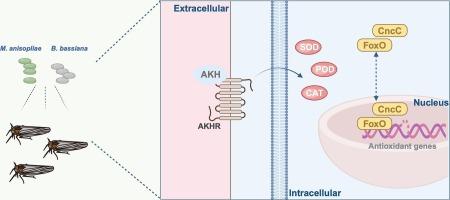
The brown planthopper Nilaparvata lugens is one of the most economically important rice crop pests in Asia. Entomopathogenic fungi (EPF) have been developed as a biological control of N. lugens. Insect adipokinetic hormones (AKHs) are pleiotropic hormones that play a protective role in response to oxidative stress. However, the role of AKH in the anti-oxidative response of N. lugens to EPFs (Metarhizium anisopliae and Beauveria bassiana) infection remains largely unexplored. In this study, the results of relative enzyme activities and expression levels of antioxidant enzymes demonstrated the response of the antioxidant system of N. lugens to EPF infection. Additionally, the expression of AKH/adipokinetic hormone receptor (AKHR) also induced responding to the infection of EPF in N. lugens. Silencing NlAKH or NlAKHR significantly increased mortality in nymphs treated with fungi compared with controls, whereas the injection of AKH peptide decreased mortality. Further research indicated that the AKH/AKHR system positively influenced antioxidant enzymes, potentially involving the transcription factors forkhead-box O and Cap’ n’ collar C. These findings provide an important theoretical basis for developing new pest control agents targeting the neuropeptide AKH and offer new insights for mitigating brown planthopper resistance and promoting green control strategies.
期刊介绍:
Pesticide Biochemistry and Physiology publishes original scientific articles pertaining to the mode of action of plant protection agents such as insecticides, fungicides, herbicides, and similar compounds, including nonlethal pest control agents, biosynthesis of pheromones, hormones, and plant resistance agents. Manuscripts may include a biochemical, physiological, or molecular study for an understanding of comparative toxicology or selective toxicity of both target and nontarget organisms. Particular interest will be given to studies on the molecular biology of pest control, toxicology, and pesticide resistance.
Research Areas Emphasized Include the Biochemistry and Physiology of:
• Comparative toxicity
• Mode of action
• Pathophysiology
• Plant growth regulators
• Resistance
• Other effects of pesticides on both parasites and hosts.



 京公网安备 11010802042870号
京ICP备2023020795号-1
京公网安备 11010802042870号
京ICP备2023020795号-1

 分享
分享
 求助内容:
求助内容: 应助结果提醒方式:
 扫码关注我们
