{"title":"Sennosides A and B could contribute to the antimicrobial efficiency of Senna alexandrina Mill. against pathogenic bacteria in vitro and in vivo models","authors":"Kumaraguru Gowtham , Govindhan Thiruppathi , Muthusamy Balasubramanian , Malaiyandi Jayanthi , Palanisamy Sundararaj , Shanmugam Girija","doi":"10.1016/j.sajb.2024.10.029","DOIUrl":null,"url":null,"abstract":"<div><div>The search of new antimicrobial compounds is increasing in due with increasing bacterial infections. Discovering effective antibacterial medications is crucial for improving healthcare and combating bacterial infections. <em>Senna alexandrina</em> Mill. known as Tinnevelly senna, used as herbal extract in traditional medicine and found be rich in anthraquinone glycosides like sennoside A (SA) and sennoside B (SB), shows significant biological activity as a potential therapeutic agent. This study assessed the antibacterial effects of senna extracts on Gram-negative <em>Pseudomonas aeruginosa</em> and Gram-positive <em>Staphylococcus aureus</em> bacteria, both <em>in vitro</em> and <em>in vivo</em>. HPLC analysis identified sennosides as the major compounds in senna extracts, with the highest concentration found in the leaves, followed by the pods, flowers, stems, and roots. The leaf extract showed the highest sennoside content (SA 27.21 mg/g and SB 29.1 mg/g) compared to other plant parts. FT-IR analysis confirmed the presence of sennosides through the detection of carboxylic acids and OH functional groups in <em>S. alexandrina</em> extracts. Extracts rich in sennosides displayed potent <em>in vitro</em> antibacterial activity (1000 µg/mL) by generating ROS, penetrating and becoming disruptive to bacterial functions. Similarly, in <em>Caenorhabditis elegans</em> model, they inhibited bacterial growth and colonization and enhanced physiological functions in the worms. Senna extract (1000 µg/mL) improved intestinal barrier's structural stability in <em>C. elegans</em> by outcompeting pathogenic bacteria and prolonged survival rates of those infected with <em>P. aeruginosa</em> and <em>S. aureus</em> to 56.6 % and 62.4 %, respectively, confirming the potent antibacterial efficacy of senna leaf methanolic extracts due to their high sennoside content in both <em>in vitro</em> and <em>in vivo</em> models.</div></div>","PeriodicalId":21919,"journal":{"name":"South African Journal of Botany","volume":"175 ","pages":"Pages 281-294"},"PeriodicalIF":2.7000,"publicationDate":"2024-12-01","publicationTypes":"Journal Article","fieldsOfStudy":null,"isOpenAccess":false,"openAccessPdf":"","citationCount":"0","resultStr":null,"platform":"Semanticscholar","paperid":null,"PeriodicalName":"South African Journal of Botany","FirstCategoryId":"99","ListUrlMain":"https://www.sciencedirect.com/science/article/pii/S0254629924006604","RegionNum":3,"RegionCategory":"生物学","ArticlePicture":[],"TitleCN":null,"AbstractTextCN":null,"PMCID":null,"EPubDate":"2024/10/21 0:00:00","PubModel":"Epub","JCR":"Q2","JCRName":"PLANT SCIENCES","Score":null,"Total":0}
引用次数: 0
Abstract
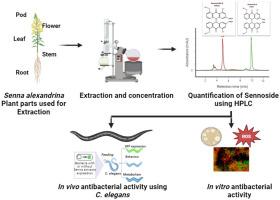
The search of new antimicrobial compounds is increasing in due with increasing bacterial infections. Discovering effective antibacterial medications is crucial for improving healthcare and combating bacterial infections. Senna alexandrina Mill. known as Tinnevelly senna, used as herbal extract in traditional medicine and found be rich in anthraquinone glycosides like sennoside A (SA) and sennoside B (SB), shows significant biological activity as a potential therapeutic agent. This study assessed the antibacterial effects of senna extracts on Gram-negative Pseudomonas aeruginosa and Gram-positive Staphylococcus aureus bacteria, both in vitro and in vivo. HPLC analysis identified sennosides as the major compounds in senna extracts, with the highest concentration found in the leaves, followed by the pods, flowers, stems, and roots. The leaf extract showed the highest sennoside content (SA 27.21 mg/g and SB 29.1 mg/g) compared to other plant parts. FT-IR analysis confirmed the presence of sennosides through the detection of carboxylic acids and OH functional groups in S. alexandrina extracts. Extracts rich in sennosides displayed potent in vitro antibacterial activity (1000 µg/mL) by generating ROS, penetrating and becoming disruptive to bacterial functions. Similarly, in Caenorhabditis elegans model, they inhibited bacterial growth and colonization and enhanced physiological functions in the worms. Senna extract (1000 µg/mL) improved intestinal barrier's structural stability in C. elegans by outcompeting pathogenic bacteria and prolonged survival rates of those infected with P. aeruginosa and S. aureus to 56.6 % and 62.4 %, respectively, confirming the potent antibacterial efficacy of senna leaf methanolic extracts due to their high sennoside content in both in vitro and in vivo models.
期刊介绍:
The South African Journal of Botany publishes original papers that deal with the classification, biodiversity, morphology, physiology, molecular biology, ecology, biotechnology, ethnobotany and other botanically related aspects of species that are of importance to southern Africa. Manuscripts dealing with significant new findings on other species of the world and general botanical principles will also be considered and are encouraged.



 京公网安备 11010802042870号
京ICP备2023020795号-1
京公网安备 11010802042870号
京ICP备2023020795号-1

 分享
分享
 求助内容:
求助内容: 应助结果提醒方式:
 扫码关注我们
