Chika Iwuji , Hritaal Saha , William Ghann , Dominique Dotson , Md. Anwarul Kabir Bhuiya , Md. Shahnawaz Parvez , ZMG Sarwar Jahangir , Mohammed Muzibur Rahman , Faisal Islam Chowdhury , Jamal Uddin
{"title":"Synthesis and characterization of silver nanoparticles and their promising antimicrobial effects","authors":"Chika Iwuji , Hritaal Saha , William Ghann , Dominique Dotson , Md. Anwarul Kabir Bhuiya , Md. Shahnawaz Parvez , ZMG Sarwar Jahangir , Mohammed Muzibur Rahman , Faisal Islam Chowdhury , Jamal Uddin","doi":"10.1016/j.chphi.2024.100758","DOIUrl":null,"url":null,"abstract":"<div><div>Silver nanoparticles have garnered significant interest due to their unique properties, such as small size, high specific surface area, and high reactivity, making them valuable in various industries, including medicine, healthcare, consumer products, and food. The synthesis of silver nanoparticles has been extensively studied, with numerous methods reported, including physical, chemical, and biological routes. These synthesis methods can influence the antibacterial properties of silver nanoparticles, which is critical in hospital settings where pathogen exposure and antibiotic resistance are prevalent concerns. Notably, hospital environments face high infection risks from pathogens like Staphylococcus aureus and Pseudomonas aeruginosa, necessitating new antibacterial agents. This study aims to evaluate the antibacterial effects of synthesized silver nanoparticles against the pathogenic microorganisms S. aureus, P. aeruginosa, and Escherichia coli. The Silver nanoparticles were characterized using UV–vis spectroscopy, Dynamic Light Scattering (DLS), Field Emission Scanning Electron Microscopy (FESEM), and Transmission Electron Microscopy (TEM). The nanoparticles had an average size of 52 nm and exhibited an absorption peak at 430 nm. Both S. aureus and P. aeruginosa demonstrated zones of inhibition when exposed to the silver nanoparticles, indicating their potent antibacterial activity. This study highlights the potential of silver nanoparticles as effective antibacterial agents in the healthcare industry, particularly in combating hospital-acquired infections.</div></div>","PeriodicalId":9758,"journal":{"name":"Chemical Physics Impact","volume":"9 ","pages":"Article 100758"},"PeriodicalIF":4.3000,"publicationDate":"2024-12-01","publicationTypes":"Journal Article","fieldsOfStudy":null,"isOpenAccess":false,"openAccessPdf":"","citationCount":"0","resultStr":null,"platform":"Semanticscholar","paperid":null,"PeriodicalName":"Chemical Physics Impact","FirstCategoryId":"1085","ListUrlMain":"https://www.sciencedirect.com/science/article/pii/S2667022424003025","RegionNum":0,"RegionCategory":null,"ArticlePicture":[],"TitleCN":null,"AbstractTextCN":null,"PMCID":null,"EPubDate":"2024/10/18 0:00:00","PubModel":"Epub","JCR":"Q2","JCRName":"CHEMISTRY, PHYSICAL","Score":null,"Total":0}
引用次数: 0
Abstract
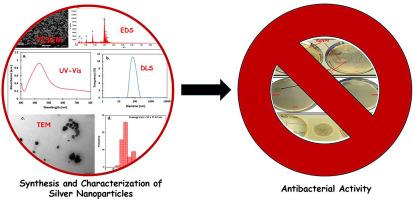
Silver nanoparticles have garnered significant interest due to their unique properties, such as small size, high specific surface area, and high reactivity, making them valuable in various industries, including medicine, healthcare, consumer products, and food. The synthesis of silver nanoparticles has been extensively studied, with numerous methods reported, including physical, chemical, and biological routes. These synthesis methods can influence the antibacterial properties of silver nanoparticles, which is critical in hospital settings where pathogen exposure and antibiotic resistance are prevalent concerns. Notably, hospital environments face high infection risks from pathogens like Staphylococcus aureus and Pseudomonas aeruginosa, necessitating new antibacterial agents. This study aims to evaluate the antibacterial effects of synthesized silver nanoparticles against the pathogenic microorganisms S. aureus, P. aeruginosa, and Escherichia coli. The Silver nanoparticles were characterized using UV–vis spectroscopy, Dynamic Light Scattering (DLS), Field Emission Scanning Electron Microscopy (FESEM), and Transmission Electron Microscopy (TEM). The nanoparticles had an average size of 52 nm and exhibited an absorption peak at 430 nm. Both S. aureus and P. aeruginosa demonstrated zones of inhibition when exposed to the silver nanoparticles, indicating their potent antibacterial activity. This study highlights the potential of silver nanoparticles as effective antibacterial agents in the healthcare industry, particularly in combating hospital-acquired infections.



 京公网安备 11010802042870号
京ICP备2023020795号-1
京公网安备 11010802042870号
京ICP备2023020795号-1

 分享
分享
 求助内容:
求助内容: 应助结果提醒方式:
 扫码关注我们
