Fang Xu, Jialin Zheng, Dai-Huo Liu, Ao Wang, Zhenjiang Li, Chunyan Xu, Mengqin Song, Beinuo Zhang, Zhengyu Bai and Zhongwei Chen
{"title":"Heterointerface synergy between a 3 × 3 tunnel τ-MnO2 cathode and Mg2(OH)3Cl·4H2O for achieving long cycle-life aqueous zinc-ion batteries†","authors":"Fang Xu, Jialin Zheng, Dai-Huo Liu, Ao Wang, Zhenjiang Li, Chunyan Xu, Mengqin Song, Beinuo Zhang, Zhengyu Bai and Zhongwei Chen","doi":"10.1039/D4QI02572E","DOIUrl":null,"url":null,"abstract":"<p >Manganese dioxide is considered an ideal cathode candidate material for aqueous zinc-ion batteries. However, its poor conductivity and nanostructural degeneration impede its further application. Herein, a 3 × 3 tunnel-structured τ-MnO<small><sub>2</sub></small> cathode material was synthesized through the addition of excessive Mg<small><sup>2+</sup></small>. During its preparation, a portion of Mg<small><sup>2+</sup></small> was embedded into the 3 × 3 tunnel of τ-MnO<small><sub>2</sub></small> to stabilize the microstructure, while another portion of Mg<small><sup>2+</sup></small> formed a new phase, <em>i.e.</em>, Mg<small><sub>2</sub></small>(OH)<small><sub>3</sub></small>Cl·4H<small><sub>2</sub></small>O, adjoining τ-MnO<small><sub>2</sub></small>, resulting in a cathode material with heterointerface synergy between τ-MnO<small><sub>2</sub></small> and Mg<small><sub>2</sub></small>(OH)<small><sub>3</sub></small>Cl·4H<small><sub>2</sub></small>O. The charge arrangement of the heterointerface between τ-MnO<small><sub>2</sub></small> and Mg<small><sub>2</sub></small>(OH)<small><sub>3</sub></small>Cl·4H<small><sub>2</sub></small>O enabled more active sites and accelerated ion-diffusion kinetics. The introduction of Mg<small><sub>2</sub></small>(OH)<small><sub>3</sub></small>Cl·4H<small><sub>2</sub></small>O increased the proportion of Mn(<small>IV</small>) and suppressed the structural instability caused by Jahn–Teller distortion, thereby improving the electrochemical performance of the τ-MnO<small><sub>2</sub></small> cathode (capacity retention of 86.7% after 1800 cycles at 1 A g<small><sup>−1</sup></small>).</p>","PeriodicalId":79,"journal":{"name":"Inorganic Chemistry Frontiers","volume":" 23","pages":" 8526-8534"},"PeriodicalIF":6.4000,"publicationDate":"2024-10-29","publicationTypes":"Journal Article","fieldsOfStudy":null,"isOpenAccess":false,"openAccessPdf":"","citationCount":"0","resultStr":null,"platform":"Semanticscholar","paperid":null,"PeriodicalName":"Inorganic Chemistry Frontiers","FirstCategoryId":"92","ListUrlMain":"https://pubs.rsc.org/en/content/articlelanding/2024/qi/d4qi02572e","RegionNum":1,"RegionCategory":"化学","ArticlePicture":[],"TitleCN":null,"AbstractTextCN":null,"PMCID":null,"EPubDate":"","PubModel":"","JCR":"Q1","JCRName":"CHEMISTRY, INORGANIC & NUCLEAR","Score":null,"Total":0}
引用次数: 0
Abstract
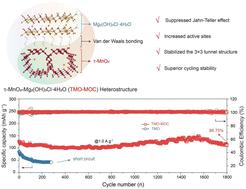
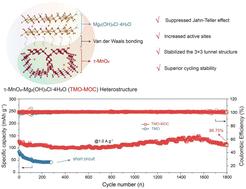
Manganese dioxide is considered an ideal cathode candidate material for aqueous zinc-ion batteries. However, its poor conductivity and nanostructural degeneration impede its further application. Herein, a 3 × 3 tunnel-structured τ-MnO2 cathode material was synthesized through the addition of excessive Mg2+. During its preparation, a portion of Mg2+ was embedded into the 3 × 3 tunnel of τ-MnO2 to stabilize the microstructure, while another portion of Mg2+ formed a new phase, i.e., Mg2(OH)3Cl·4H2O, adjoining τ-MnO2, resulting in a cathode material with heterointerface synergy between τ-MnO2 and Mg2(OH)3Cl·4H2O. The charge arrangement of the heterointerface between τ-MnO2 and Mg2(OH)3Cl·4H2O enabled more active sites and accelerated ion-diffusion kinetics. The introduction of Mg2(OH)3Cl·4H2O increased the proportion of Mn(IV) and suppressed the structural instability caused by Jahn–Teller distortion, thereby improving the electrochemical performance of the τ-MnO2 cathode (capacity retention of 86.7% after 1800 cycles at 1 A g−1).





 京公网安备 11010802042870号
京ICP备2023020795号-1
京公网安备 11010802042870号
京ICP备2023020795号-1

 分享
分享
 求助内容:
求助内容: 应助结果提醒方式:
 扫码关注我们
