Dong Li, Yu Xiao, Iana Fedorova, Weijia Xiong, Yu Wang, Xi Liu, Erin Huiting, Jie Ren, Zirui Gao, Xingyu Zhao, Xueli Cao, Yi Zhang, Joseph Bondy-Denomy, Yue Feng
{"title":"Single phage proteins sequester signals from TIR and cGAS-like enzymes","authors":"Dong Li, Yu Xiao, Iana Fedorova, Weijia Xiong, Yu Wang, Xi Liu, Erin Huiting, Jie Ren, Zirui Gao, Xingyu Zhao, Xueli Cao, Yi Zhang, Joseph Bondy-Denomy, Yue Feng","doi":"10.1038/s41586-024-08122-4","DOIUrl":null,"url":null,"abstract":"Prokaryotic anti-phage immune systems use TIR and cGAS-like enzymes to produce 1′′-3′-glycocyclic ADP-ribose (1′′-3′-gcADPR) and cyclic dinucleotide (CDN) and cyclic trinucleotide (CTN) signalling molecules, respectively, which limit phage replication1–3. However, how phages neutralize these distinct and common systems is largely unclear. Here we show that the Thoeris anti-defence proteins Tad14 and Tad25 both achieve anti-cyclic-oligonucleotide-based anti-phage signalling system (anti-CBASS) activity by simultaneously sequestering CBASS cyclic oligonucleotides. Apart from binding to the Thoeris signals 1′′-3′-gcADPR and 1′′-2′-gcADPR, Tad1 also binds to numerous CBASS CDNs and CTNs with high affinity, inhibiting CBASS systems that use these molecules in vivo and in vitro. The hexameric Tad1 has six binding sites for CDNs or gcADPR, which are independent of the two high-affinity binding sites for CTNs. Tad2 forms a tetramer that also sequesters various CDNs in addition to gcADPR molecules, using distinct binding sites to simultaneously bind to these signals. Thus, Tad1 and Tad2 are both two-pronged inhibitors that, alongside anti-CBASS protein 2 (Acb26–8), establish a paradigm of phage proteins that use distinct binding sites to flexibly sequester a considerable breadth of cyclic nucleotides. Phage Thoeris anti-defence proteins Tad1 and Tad2 both achieve anti-CBASS activity by simultaneously sequestering CBASS cyclic oligonucleotides.","PeriodicalId":18787,"journal":{"name":"Nature","volume":"635 8039","pages":"719-727"},"PeriodicalIF":48.5000,"publicationDate":"2024-10-30","publicationTypes":"Journal Article","fieldsOfStudy":null,"isOpenAccess":false,"openAccessPdf":"","citationCount":"0","resultStr":null,"platform":"Semanticscholar","paperid":null,"PeriodicalName":"Nature","FirstCategoryId":"103","ListUrlMain":"https://www.nature.com/articles/s41586-024-08122-4","RegionNum":1,"RegionCategory":"综合性期刊","ArticlePicture":[],"TitleCN":null,"AbstractTextCN":null,"PMCID":null,"EPubDate":"","PubModel":"","JCR":"Q1","JCRName":"MULTIDISCIPLINARY SCIENCES","Score":null,"Total":0}
引用次数: 0
Abstract
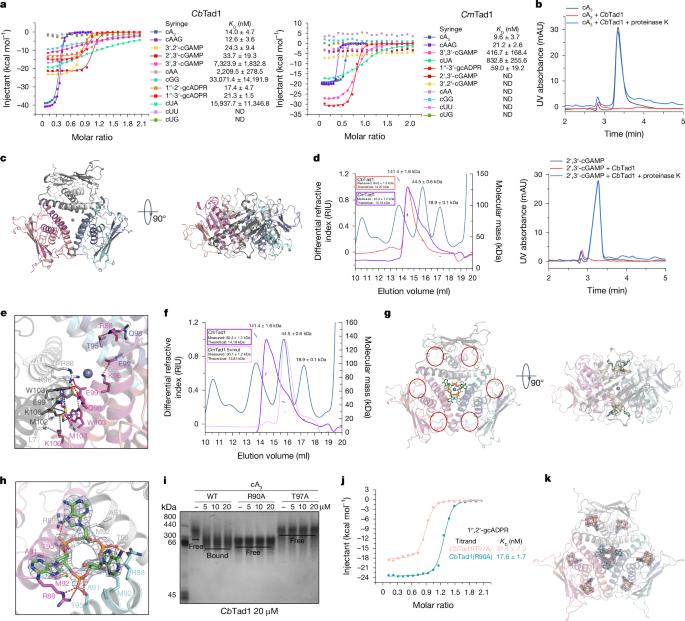
Prokaryotic anti-phage immune systems use TIR and cGAS-like enzymes to produce 1′′-3′-glycocyclic ADP-ribose (1′′-3′-gcADPR) and cyclic dinucleotide (CDN) and cyclic trinucleotide (CTN) signalling molecules, respectively, which limit phage replication1–3. However, how phages neutralize these distinct and common systems is largely unclear. Here we show that the Thoeris anti-defence proteins Tad14 and Tad25 both achieve anti-cyclic-oligonucleotide-based anti-phage signalling system (anti-CBASS) activity by simultaneously sequestering CBASS cyclic oligonucleotides. Apart from binding to the Thoeris signals 1′′-3′-gcADPR and 1′′-2′-gcADPR, Tad1 also binds to numerous CBASS CDNs and CTNs with high affinity, inhibiting CBASS systems that use these molecules in vivo and in vitro. The hexameric Tad1 has six binding sites for CDNs or gcADPR, which are independent of the two high-affinity binding sites for CTNs. Tad2 forms a tetramer that also sequesters various CDNs in addition to gcADPR molecules, using distinct binding sites to simultaneously bind to these signals. Thus, Tad1 and Tad2 are both two-pronged inhibitors that, alongside anti-CBASS protein 2 (Acb26–8), establish a paradigm of phage proteins that use distinct binding sites to flexibly sequester a considerable breadth of cyclic nucleotides. Phage Thoeris anti-defence proteins Tad1 and Tad2 both achieve anti-CBASS activity by simultaneously sequestering CBASS cyclic oligonucleotides.
期刊介绍:
Nature is a prestigious international journal that publishes peer-reviewed research in various scientific and technological fields. The selection of articles is based on criteria such as originality, importance, interdisciplinary relevance, timeliness, accessibility, elegance, and surprising conclusions. In addition to showcasing significant scientific advances, Nature delivers rapid, authoritative, insightful news, and interpretation of current and upcoming trends impacting science, scientists, and the broader public. The journal serves a dual purpose: firstly, to promptly share noteworthy scientific advances and foster discussions among scientists, and secondly, to ensure the swift dissemination of scientific results globally, emphasizing their significance for knowledge, culture, and daily life.



 京公网安备 11010802042870号
京ICP备2023020795号-1
京公网安备 11010802042870号
京ICP备2023020795号-1

 分享
分享
 求助内容:
求助内容: 应助结果提醒方式:
 扫码关注我们
