{"title":"Emerging Frontiers in <i>In Situ</i> Forming Hydrogels for Enhanced Hemostasis and Accelerated Wound Healing.","authors":"Sanchita Sarkhel, Amit Jaiswal","doi":"10.1021/acsami.4c07108","DOIUrl":null,"url":null,"abstract":"<p><p>With a surge in the number of accidents and chronic wounds worldwide, there is a growing need for advanced hemostatic and wound care solutions. In this regard, in situ forming hydrogels have emerged as a revolutionary biomaterial due to their inherent properties, which include biocompatibility, biodegradability, porosity, and extracellular matrix (ECM)-like mechanical strength, that render them ideal for biomedical applications. This review demonstrates the advancements of <i>in situ</i> forming hydrogels, tracing their evolution from injectable to more sophisticated forms, such as sprayable and 3-D printed hydrogels. These hydrogels are designed to modulate the pathophysiology of wounds, enhancing hemostasis and facilitating wound repair. The review presents different methodologies for in situ forming hydrogel synthesis, spanning a spectrum of physical and chemical cross-linking techniques. Furthermore, it showcases the adaptability of hydrogels to the dynamic requirements of wound healing processes. Through a detailed discussion, this article sheds light on the multifunctional capabilities of these hydrogels such as their antibacterial, anti-inflammatory, and antioxidant properties. This review aims to inform and inspire continued advancement in the field, ultimately contributing to the development of sophisticated wound care solutions that meet the complexity of clinical needs.</p>","PeriodicalId":5,"journal":{"name":"ACS Applied Materials & Interfaces","volume":" ","pages":"61503-61529"},"PeriodicalIF":8.2000,"publicationDate":"2024-11-13","publicationTypes":"Journal Article","fieldsOfStudy":null,"isOpenAccess":false,"openAccessPdf":"","citationCount":"0","resultStr":null,"platform":"Semanticscholar","paperid":null,"PeriodicalName":"ACS Applied Materials & Interfaces","FirstCategoryId":"88","ListUrlMain":"https://doi.org/10.1021/acsami.4c07108","RegionNum":2,"RegionCategory":"材料科学","ArticlePicture":[],"TitleCN":null,"AbstractTextCN":null,"PMCID":null,"EPubDate":"2024/10/31 0:00:00","PubModel":"Epub","JCR":"Q1","JCRName":"MATERIALS SCIENCE, MULTIDISCIPLINARY","Score":null,"Total":0}
引用次数: 0
Abstract
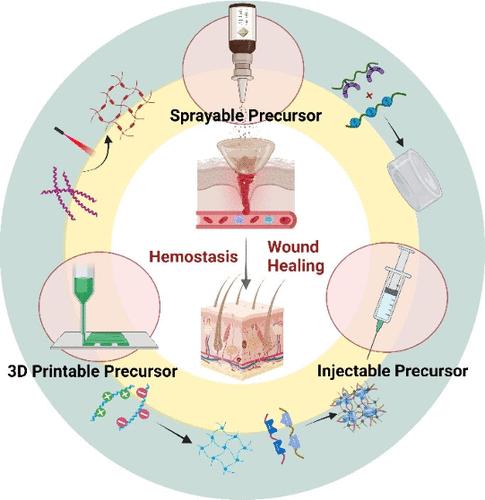
With a surge in the number of accidents and chronic wounds worldwide, there is a growing need for advanced hemostatic and wound care solutions. In this regard, in situ forming hydrogels have emerged as a revolutionary biomaterial due to their inherent properties, which include biocompatibility, biodegradability, porosity, and extracellular matrix (ECM)-like mechanical strength, that render them ideal for biomedical applications. This review demonstrates the advancements of in situ forming hydrogels, tracing their evolution from injectable to more sophisticated forms, such as sprayable and 3-D printed hydrogels. These hydrogels are designed to modulate the pathophysiology of wounds, enhancing hemostasis and facilitating wound repair. The review presents different methodologies for in situ forming hydrogel synthesis, spanning a spectrum of physical and chemical cross-linking techniques. Furthermore, it showcases the adaptability of hydrogels to the dynamic requirements of wound healing processes. Through a detailed discussion, this article sheds light on the multifunctional capabilities of these hydrogels such as their antibacterial, anti-inflammatory, and antioxidant properties. This review aims to inform and inspire continued advancement in the field, ultimately contributing to the development of sophisticated wound care solutions that meet the complexity of clinical needs.
期刊介绍:
ACS Applied Materials & Interfaces is a leading interdisciplinary journal that brings together chemists, engineers, physicists, and biologists to explore the development and utilization of newly-discovered materials and interfacial processes for specific applications. Our journal has experienced remarkable growth since its establishment in 2009, both in terms of the number of articles published and the impact of the research showcased. We are proud to foster a truly global community, with the majority of published articles originating from outside the United States, reflecting the rapid growth of applied research worldwide.



 京公网安备 11010802042870号
京ICP备2023020795号-1
京公网安备 11010802042870号
京ICP备2023020795号-1

 分享
分享
 求助内容:
求助内容: 应助结果提醒方式:
 扫码关注我们
