Gulzhan Zhumadil, Menghua Cao, Yu Han, Vladimir Pavlenko, Gaukhar Nigmetova, Zhuldyz Yelzhanova, Hryhorii P Parkhomenko, Zhazira Ergasheva, Damir Aidarkhanov, Mannix P Balanay, Askhat N Jumabekov, Gang Li, Zhiwei Ren, Annie Ng
{"title":"Ionic Liquid-Assisted Strategy for Morphology Engineering of Inorganic Cesium-Based Perovskite Thin Films Toward High-Performance Solar Cells.","authors":"Gulzhan Zhumadil, Menghua Cao, Yu Han, Vladimir Pavlenko, Gaukhar Nigmetova, Zhuldyz Yelzhanova, Hryhorii P Parkhomenko, Zhazira Ergasheva, Damir Aidarkhanov, Mannix P Balanay, Askhat N Jumabekov, Gang Li, Zhiwei Ren, Annie Ng","doi":"10.1021/acsami.4c15880","DOIUrl":null,"url":null,"abstract":"<p><p>The wide bandgap CsPbI<sub>2</sub>Br perovskite materials have attracted significant attention due to their high thermal stability and compatibility with narrow bandgap materials in tandem devices. The performance of perovskite solar cells (PSCs) is highly dependent on the quality of the perovskite layer, which is governed by the crystallization process during solution processing. However, the crystallization dynamics of CsPbI<sub>2</sub>Br thin films remain less explored compared to conventional organic-inorganic perovskites. Achieving high-quality CsPbI<sub>2</sub>Br films with uniform morphology and large perovskite grains remains challenging with standard solution techniques. This study applies the ionic liquid (IL) [EMIM]<sup>+</sup>[PF<sub>6</sub>]<sup>-</sup> as an additive within the bulk CsPbI<sub>2</sub>Br absorber layer. Within our experimental regime, [EMIM]<sup>+</sup>[PF<sub>6</sub>]<sup>-</sup> accelerates the crystallization process while promoting the formation of large perovskite grains, a feature not commonly observed in previous studies. Our experimental results suggest that the IL acts as heterogeneous nucleation sites, and varying IL incorporation amount significantly impacts the morphology of CsPbI<sub>2</sub>Br perovskite films. Consistent UV-vis and photoluminescence (PL) red-shifts are observed in the IL-incorporated CsPbI<sub>2</sub>Br films, with X-ray diffraction (XRD) data projecting an influence on the perovskite crystal structure. These findings provide new insights into the role of ILs in controlling crystallization and morphology that have been minimally discussed in the literature. The incorporation of an optimized amount of [EMIM]<sup>+</sup>[PF<sub>6</sub>]<sup>-</sup> promotes the formation of highly crystalline perovskite thin films with excellent morphology, reducing defect density, enhancing carrier transport, and yielding large grain sizes. As a result, PSCs fabricated with [EMIM]<sup>+</sup>[PF<sub>6</sub>]<sup>-</sup> achieved a power conversion efficiency (PCE) of 17.11% (stabilized at 15.87%) and an open-circuit voltage (<i>V</i><sub>OC</sub>) of 1.39 V, along with improved stability compared to control devices. This work provides a straightforward approach for producing high-quality CsPbI<sub>2</sub>Br thin films with high reproducibility, contributing valuable advancements to Cs-based PSCs.</p>","PeriodicalId":5,"journal":{"name":"ACS Applied Materials & Interfaces","volume":" ","pages":"63059-63072"},"PeriodicalIF":8.2000,"publicationDate":"2024-11-13","publicationTypes":"Journal Article","fieldsOfStudy":null,"isOpenAccess":false,"openAccessPdf":"","citationCount":"0","resultStr":null,"platform":"Semanticscholar","paperid":null,"PeriodicalName":"ACS Applied Materials & Interfaces","FirstCategoryId":"88","ListUrlMain":"https://doi.org/10.1021/acsami.4c15880","RegionNum":2,"RegionCategory":"材料科学","ArticlePicture":[],"TitleCN":null,"AbstractTextCN":null,"PMCID":null,"EPubDate":"2024/10/31 0:00:00","PubModel":"Epub","JCR":"Q1","JCRName":"MATERIALS SCIENCE, MULTIDISCIPLINARY","Score":null,"Total":0}
引用次数: 0
Abstract
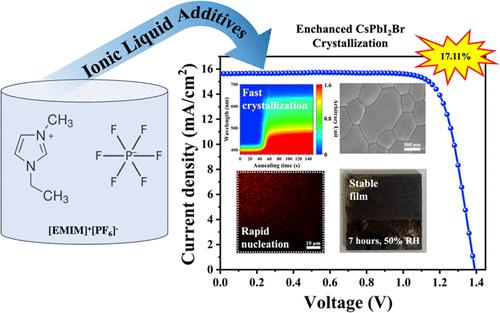
The wide bandgap CsPbI2Br perovskite materials have attracted significant attention due to their high thermal stability and compatibility with narrow bandgap materials in tandem devices. The performance of perovskite solar cells (PSCs) is highly dependent on the quality of the perovskite layer, which is governed by the crystallization process during solution processing. However, the crystallization dynamics of CsPbI2Br thin films remain less explored compared to conventional organic-inorganic perovskites. Achieving high-quality CsPbI2Br films with uniform morphology and large perovskite grains remains challenging with standard solution techniques. This study applies the ionic liquid (IL) [EMIM]+[PF6]- as an additive within the bulk CsPbI2Br absorber layer. Within our experimental regime, [EMIM]+[PF6]- accelerates the crystallization process while promoting the formation of large perovskite grains, a feature not commonly observed in previous studies. Our experimental results suggest that the IL acts as heterogeneous nucleation sites, and varying IL incorporation amount significantly impacts the morphology of CsPbI2Br perovskite films. Consistent UV-vis and photoluminescence (PL) red-shifts are observed in the IL-incorporated CsPbI2Br films, with X-ray diffraction (XRD) data projecting an influence on the perovskite crystal structure. These findings provide new insights into the role of ILs in controlling crystallization and morphology that have been minimally discussed in the literature. The incorporation of an optimized amount of [EMIM]+[PF6]- promotes the formation of highly crystalline perovskite thin films with excellent morphology, reducing defect density, enhancing carrier transport, and yielding large grain sizes. As a result, PSCs fabricated with [EMIM]+[PF6]- achieved a power conversion efficiency (PCE) of 17.11% (stabilized at 15.87%) and an open-circuit voltage (VOC) of 1.39 V, along with improved stability compared to control devices. This work provides a straightforward approach for producing high-quality CsPbI2Br thin films with high reproducibility, contributing valuable advancements to Cs-based PSCs.
期刊介绍:
ACS Applied Materials & Interfaces is a leading interdisciplinary journal that brings together chemists, engineers, physicists, and biologists to explore the development and utilization of newly-discovered materials and interfacial processes for specific applications. Our journal has experienced remarkable growth since its establishment in 2009, both in terms of the number of articles published and the impact of the research showcased. We are proud to foster a truly global community, with the majority of published articles originating from outside the United States, reflecting the rapid growth of applied research worldwide.



 京公网安备 11010802042870号
京ICP备2023020795号-1
京公网安备 11010802042870号
京ICP备2023020795号-1

 分享
分享
 求助内容:
求助内容: 应助结果提醒方式:
 扫码关注我们
