David Megson , Daniel Niepsch , Jonathan Spencer , Claudio dos Santos , Hannah Florance , Cecilia L. MacLeod , Ian Ross
{"title":"Non-targeted analysis reveals hundreds of per- and polyfluoroalkyl substances (PFAS) in UK freshwater in the vicinity of a fluorochemical plant","authors":"David Megson , Daniel Niepsch , Jonathan Spencer , Claudio dos Santos , Hannah Florance , Cecilia L. MacLeod , Ian Ross","doi":"10.1016/j.chemosphere.2024.143645","DOIUrl":null,"url":null,"abstract":"<div><div>There are now over 7 million recognised per- and polyfluoroalkyl substances (PFAS), however the majority of routine monitoring programmes and policy decisions are based on just a handful of these. There is need for a shift towards gaining a better understanding of the total PFAS present in a sample rather than relying on targeted analysis alone. Total PFAS methods help us to understand if targeted methods are missing a mass of PFAS, but they do not identify which PFAS are missing. Non-targeted methods fill this knowledge gap by using high resolution mass spectrometry to identify the PFAS present in a sample. In this manuscript we use complimentary targeted and non-targeted analysis (NTA) to detect hundreds of PFAS in five freshwater samples obtained from the Northwest of the UK. Targeted analysis revealed PFOA at a maximum concentration of 12,100 ng L<sup>−1</sup>, over three orders of magnitude greater than the proposed environmental quality standard (EQS) of 100 ng L<sup>−1</sup>. A conservative assessment calculated an average total PFAS concentration of approximately 40 μg L<sup>−1</sup> across all samples. A suspect screening approach identified between 1175 (least conservative) to 89 (most conservative) PFAS at confidence level 4. Exploratory data analysis was used to identify 33 PFAS at confidence level 3 and 10 PFAS at a confidence level of 2. Only 8 of these 43 PFAS (representing 17% of the total PFAS peak area) are regularly monitored in the UK as part of the UK DWI 47 PFAS. Our results suggested the presence of a novel group of unsaturated perfluoroalkyl ether carboxylic acids (U-PFECAs) related to EEA-NH<sub>4,</sub> a perfluoroalkyl ether carboxylic acid (PFECA), providing an example of the benefits of non-targeted screening. This study highlights the merits of non-targeted methods and demonstrates that future monitoring programmes and regulations would benefit from incorporating a non-targeted element.</div></div>","PeriodicalId":276,"journal":{"name":"Chemosphere","volume":"367 ","pages":"Article 143645"},"PeriodicalIF":8.1000,"publicationDate":"2024-11-01","publicationTypes":"Journal Article","fieldsOfStudy":null,"isOpenAccess":false,"openAccessPdf":"","citationCount":"0","resultStr":null,"platform":"Semanticscholar","paperid":null,"PeriodicalName":"Chemosphere","FirstCategoryId":"93","ListUrlMain":"https://www.sciencedirect.com/science/article/pii/S0045653524025451","RegionNum":2,"RegionCategory":"环境科学与生态学","ArticlePicture":[],"TitleCN":null,"AbstractTextCN":null,"PMCID":null,"EPubDate":"2024/11/6 0:00:00","PubModel":"Epub","JCR":"Q1","JCRName":"ENVIRONMENTAL SCIENCES","Score":null,"Total":0}
引用次数: 0
Abstract
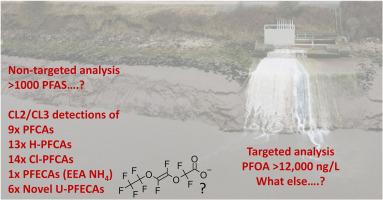
There are now over 7 million recognised per- and polyfluoroalkyl substances (PFAS), however the majority of routine monitoring programmes and policy decisions are based on just a handful of these. There is need for a shift towards gaining a better understanding of the total PFAS present in a sample rather than relying on targeted analysis alone. Total PFAS methods help us to understand if targeted methods are missing a mass of PFAS, but they do not identify which PFAS are missing. Non-targeted methods fill this knowledge gap by using high resolution mass spectrometry to identify the PFAS present in a sample. In this manuscript we use complimentary targeted and non-targeted analysis (NTA) to detect hundreds of PFAS in five freshwater samples obtained from the Northwest of the UK. Targeted analysis revealed PFOA at a maximum concentration of 12,100 ng L−1, over three orders of magnitude greater than the proposed environmental quality standard (EQS) of 100 ng L−1. A conservative assessment calculated an average total PFAS concentration of approximately 40 μg L−1 across all samples. A suspect screening approach identified between 1175 (least conservative) to 89 (most conservative) PFAS at confidence level 4. Exploratory data analysis was used to identify 33 PFAS at confidence level 3 and 10 PFAS at a confidence level of 2. Only 8 of these 43 PFAS (representing 17% of the total PFAS peak area) are regularly monitored in the UK as part of the UK DWI 47 PFAS. Our results suggested the presence of a novel group of unsaturated perfluoroalkyl ether carboxylic acids (U-PFECAs) related to EEA-NH4, a perfluoroalkyl ether carboxylic acid (PFECA), providing an example of the benefits of non-targeted screening. This study highlights the merits of non-targeted methods and demonstrates that future monitoring programmes and regulations would benefit from incorporating a non-targeted element.
期刊介绍:
Chemosphere, being an international multidisciplinary journal, is dedicated to publishing original communications and review articles on chemicals in the environment. The scope covers a wide range of topics, including the identification, quantification, behavior, fate, toxicology, treatment, and remediation of chemicals in the bio-, hydro-, litho-, and atmosphere, ensuring the broad dissemination of research in this field.



 京公网安备 11010802042870号
京ICP备2023020795号-1
京公网安备 11010802042870号
京ICP备2023020795号-1

 分享
分享
 求助内容:
求助内容: 应助结果提醒方式:
 扫码关注我们
