Yuan Zhou , Zeyi Li , Xiao Cheng , Yanxiao He , Nianbing Zhong , Xuefeng He , Qiao Lan
{"title":"Carbon fiber with superhydrophilic interface as metal-free air electrode for all-solid-state Zn-air batteries","authors":"Yuan Zhou , Zeyi Li , Xiao Cheng , Yanxiao He , Nianbing Zhong , Xuefeng He , Qiao Lan","doi":"10.1016/j.surfin.2024.105310","DOIUrl":null,"url":null,"abstract":"<div><div>The burgeoning interest in all-solid-state Zn-air batteries as next-generation power sources for portable electronics is conspicuous. A pivotal aspect of their advancement lies in developing cost-effective, metal-free air electrodes with high-activity bifunctional oxygen electrocatalysts. This study introduces a superhydrophilic carbon fiber modified with oxygen functional groups (CF-O), achieved through a straightforward one-step activation treatment. Comparative analyses reveal that the CF-O electrode surpasses pristine CF in oxygen reduction and evolution reaction (OER and ORR) activity due to enhanced active sites and expedited ion transport. Notably, the OER/ORR performance depends on the type and quantity of oxygen functional groups. The optimal CF-O electrode displays an OER overpotential of 365.6 mV at 10 mA cm<sup>-2</sup> and an ORR peak potential of 0.683 V. Utilizing the CF-O sample as the air electrode in all-solid-state Zn-air batteries yields an open-circuit voltage of 1.28 V and a peak volume power density of 82.8 mW cm<sup>-3</sup>. Furthermore, endurance testing reveals a charge/discharge voltage gap of 1.07 V at a current density of 1.0 mA cm<sup>-2</sup> after 30 cycles. This facile and economical fabrication approach for metal-free air electrodes holds promise for advancing high-performance metal-air batteries compared to various existing techniques.</div></div>","PeriodicalId":22081,"journal":{"name":"Surfaces and Interfaces","volume":"55 ","pages":"Article 105310"},"PeriodicalIF":6.3000,"publicationDate":"2024-12-01","publicationTypes":"Journal Article","fieldsOfStudy":null,"isOpenAccess":false,"openAccessPdf":"","citationCount":"0","resultStr":null,"platform":"Semanticscholar","paperid":null,"PeriodicalName":"Surfaces and Interfaces","FirstCategoryId":"88","ListUrlMain":"https://www.sciencedirect.com/science/article/pii/S2468023024014664","RegionNum":2,"RegionCategory":"材料科学","ArticlePicture":[],"TitleCN":null,"AbstractTextCN":null,"PMCID":null,"EPubDate":"2024/10/22 0:00:00","PubModel":"Epub","JCR":"Q2","JCRName":"CHEMISTRY, PHYSICAL","Score":null,"Total":0}
引用次数: 0
Abstract
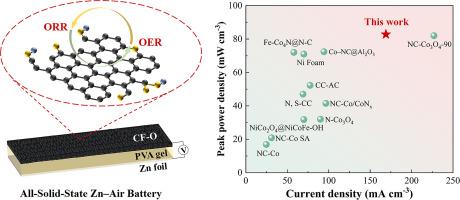
The burgeoning interest in all-solid-state Zn-air batteries as next-generation power sources for portable electronics is conspicuous. A pivotal aspect of their advancement lies in developing cost-effective, metal-free air electrodes with high-activity bifunctional oxygen electrocatalysts. This study introduces a superhydrophilic carbon fiber modified with oxygen functional groups (CF-O), achieved through a straightforward one-step activation treatment. Comparative analyses reveal that the CF-O electrode surpasses pristine CF in oxygen reduction and evolution reaction (OER and ORR) activity due to enhanced active sites and expedited ion transport. Notably, the OER/ORR performance depends on the type and quantity of oxygen functional groups. The optimal CF-O electrode displays an OER overpotential of 365.6 mV at 10 mA cm-2 and an ORR peak potential of 0.683 V. Utilizing the CF-O sample as the air electrode in all-solid-state Zn-air batteries yields an open-circuit voltage of 1.28 V and a peak volume power density of 82.8 mW cm-3. Furthermore, endurance testing reveals a charge/discharge voltage gap of 1.07 V at a current density of 1.0 mA cm-2 after 30 cycles. This facile and economical fabrication approach for metal-free air electrodes holds promise for advancing high-performance metal-air batteries compared to various existing techniques.
期刊介绍:
The aim of the journal is to provide a respectful outlet for ''sound science'' papers in all research areas on surfaces and interfaces. We define sound science papers as papers that describe new and well-executed research, but that do not necessarily provide brand new insights or are merely a description of research results.
Surfaces and Interfaces publishes research papers in all fields of surface science which may not always find the right home on first submission to our Elsevier sister journals (Applied Surface, Surface and Coatings Technology, Thin Solid Films)



 京公网安备 11010802042870号
京ICP备2023020795号-1
京公网安备 11010802042870号
京ICP备2023020795号-1

 分享
分享
 求助内容:
求助内容: 应助结果提醒方式:
 扫码关注我们
