Jae Elise L. Payong, Nadia G. Léonard, Lauren M. Anderson-Sanchez, Joseph W. Ziller and Jenny Y. Yang
{"title":"Synthesis and anion binding properties of (thio)urea functionalized Ni(ii)-salen complexes†","authors":"Jae Elise L. Payong, Nadia G. Léonard, Lauren M. Anderson-Sanchez, Joseph W. Ziller and Jenny Y. Yang","doi":"10.1039/D4DT02683G","DOIUrl":null,"url":null,"abstract":"<p >Salen ligands (salen = <em>N</em>,<em>N</em>′-ethylenebis(salicylimine)) are well-known for their versatility and widespread utility in chelating metal complexes. However, installation of hydrogen-bonding units on the salen framework, particularly functional groups that require amine-based precursors such as (thio)ureas, is difficult to achieve without the use of protecting group strategies. In this report, we show that the phenylketone analog of salicyladehyde is a stable alternative that enables the facile installation of hydrogen bonding (thio)urea groups on the salen scaffold, thus imparting anion binding abilities to a metal salen complex. Synthesis of symmetric <em>N</em>-phenyl(thio)urea salen ligands functionalized at the 3,3′-position and an unsymmetric salen ligand with <em>N</em>-phenylurea at the 5-position was achieved. Subsequent metalation with nickel(<small>II</small>) acetate afforded the nickel(<small>II</small>) complexes that were investigated for their anion binding properties towards F<small><sup>−</sup></small>, Cl<small><sup>−</sup></small>, Br<small><sup>−</sup></small>, CH<small><sub>3</sub></small>COO<small><sup>−</sup></small>, and H<small><sub>2</sub></small>PO<small><sub>4</sub></small><small><sup>−</sup></small>. Solid-state structures of the nickel(<small>II</small>) complexes as well as the Cl<small><sup>−</sup></small> bound dimer of the symmetric urea complex were obtained. The unusual acidity of the (thio)urea groups is reflected in the p<em>K</em><small><sub>a</sub></small>-dependent anion binding behavior of the nickel(<small>II</small>) complexes, as elucidated by <small><sup>1</sup></small>H and <small><sup>19</sup></small>F Nuclear Magnetic Resonance (NMR) spectroscopy and Diffusion Ordered Spectroscopy (DOSY) experiments.</p>","PeriodicalId":71,"journal":{"name":"Dalton Transactions","volume":" 3","pages":" 934-941"},"PeriodicalIF":3.3000,"publicationDate":"2024-11-01","publicationTypes":"Journal Article","fieldsOfStudy":null,"isOpenAccess":false,"openAccessPdf":"","citationCount":"0","resultStr":null,"platform":"Semanticscholar","paperid":null,"PeriodicalName":"Dalton Transactions","FirstCategoryId":"92","ListUrlMain":"https://pubs.rsc.org/en/content/articlelanding/2025/dt/d4dt02683g","RegionNum":3,"RegionCategory":"化学","ArticlePicture":[],"TitleCN":null,"AbstractTextCN":null,"PMCID":null,"EPubDate":"","PubModel":"","JCR":"Q2","JCRName":"CHEMISTRY, INORGANIC & NUCLEAR","Score":null,"Total":0}
引用次数: 0
Abstract
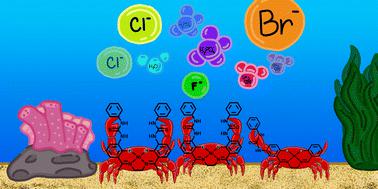
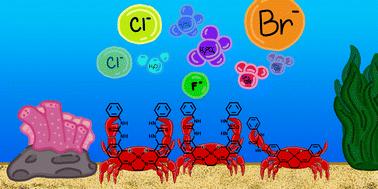
Salen ligands (salen = N,N′-ethylenebis(salicylimine)) are well-known for their versatility and widespread utility in chelating metal complexes. However, installation of hydrogen-bonding units on the salen framework, particularly functional groups that require amine-based precursors such as (thio)ureas, is difficult to achieve without the use of protecting group strategies. In this report, we show that the phenylketone analog of salicyladehyde is a stable alternative that enables the facile installation of hydrogen bonding (thio)urea groups on the salen scaffold, thus imparting anion binding abilities to a metal salen complex. Synthesis of symmetric N-phenyl(thio)urea salen ligands functionalized at the 3,3′-position and an unsymmetric salen ligand with N-phenylurea at the 5-position was achieved. Subsequent metalation with nickel(II) acetate afforded the nickel(II) complexes that were investigated for their anion binding properties towards F−, Cl−, Br−, CH3COO−, and H2PO4−. Solid-state structures of the nickel(II) complexes as well as the Cl− bound dimer of the symmetric urea complex were obtained. The unusual acidity of the (thio)urea groups is reflected in the pKa-dependent anion binding behavior of the nickel(II) complexes, as elucidated by 1H and 19F Nuclear Magnetic Resonance (NMR) spectroscopy and Diffusion Ordered Spectroscopy (DOSY) experiments.
期刊介绍:
Dalton Transactions is a journal for all areas of inorganic chemistry, which encompasses the organometallic, bioinorganic and materials chemistry of the elements, with applications including synthesis, catalysis, energy conversion/storage, electrical devices and medicine. Dalton Transactions welcomes high-quality, original submissions in all of these areas and more, where the advancement of knowledge in inorganic chemistry is significant.



 京公网安备 11010802042870号
京ICP备2023020795号-1
京公网安备 11010802042870号
京ICP备2023020795号-1

 分享
分享
 求助内容:
求助内容: 应助结果提醒方式:
 扫码关注我们
