{"title":"Bio-Based Polyurethane Composites with Adjustable Fluorescence and Ultraviolet Shielding for Anti-Counterfeiting and Ultraviolet Protection.","authors":"Mengyao Zhai, Tao Shou, Dexian Yin, Zhi Chen, Yaowen Wu, Yue Liu, Xiuying Zhao, Shikai Hu, Liqun Zhang","doi":"10.1021/acsami.4c12183","DOIUrl":null,"url":null,"abstract":"<p><p>Polyurethane and its composites play an important role in innovative packing materials including anticounterfeiting and ultraviolet protection, however, they are mainly derived from petroleum resources that are not sustainable. In this study, a 100% biobased thermoplastic polyurethane (Bio-TPU) was synthesized using biobased poly(trimethylene ether) glycol, pentamethylene disocyanate, and 1,4-butanediol. Subsequently, biobased tannic acid (TA) was employed to prepare biobased composites. The structures and properties of Bio-TPU and its composites were systematically evaluated. The results showed that the Bio-TPU/TA composite films had excellent and controllable fluorescence and UV-shielding properties. The fluorescence colors of the Bio-TPU/TA composite films could be adjusted to blue, green, and yellow by varying the TA content and adding coupling agents. Moreover, the UV transmittance of the Bio-TPU/TA composites decreased from 79.25 to 5.43% below 400 nm with an increasing TA content, indicating an excellent ultraviolet-barrier performance. Consequently, biobased TPU/TA composite films can be utilized as innovative anticounterfeiting materials and UV-shielding protection films. This study is expected to facilitate sustainable development in the polyurethane industry and broaden the high-end applications of polyurethane such as fashion, electronics, food manufacturing, pharmaceuticals, and finance.</p>","PeriodicalId":5,"journal":{"name":"ACS Applied Materials & Interfaces","volume":" ","pages":"62606-62616"},"PeriodicalIF":8.2000,"publicationDate":"2024-11-13","publicationTypes":"Journal Article","fieldsOfStudy":null,"isOpenAccess":false,"openAccessPdf":"","citationCount":"0","resultStr":null,"platform":"Semanticscholar","paperid":null,"PeriodicalName":"ACS Applied Materials & Interfaces","FirstCategoryId":"88","ListUrlMain":"https://doi.org/10.1021/acsami.4c12183","RegionNum":2,"RegionCategory":"材料科学","ArticlePicture":[],"TitleCN":null,"AbstractTextCN":null,"PMCID":null,"EPubDate":"2024/11/1 0:00:00","PubModel":"Epub","JCR":"Q1","JCRName":"MATERIALS SCIENCE, MULTIDISCIPLINARY","Score":null,"Total":0}
引用次数: 0
Abstract
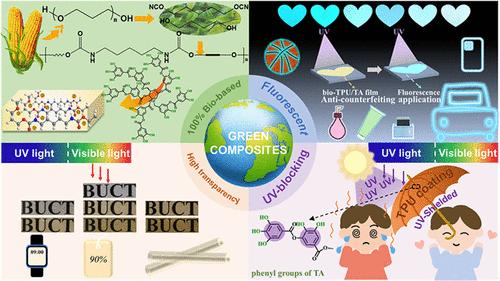
Polyurethane and its composites play an important role in innovative packing materials including anticounterfeiting and ultraviolet protection, however, they are mainly derived from petroleum resources that are not sustainable. In this study, a 100% biobased thermoplastic polyurethane (Bio-TPU) was synthesized using biobased poly(trimethylene ether) glycol, pentamethylene disocyanate, and 1,4-butanediol. Subsequently, biobased tannic acid (TA) was employed to prepare biobased composites. The structures and properties of Bio-TPU and its composites were systematically evaluated. The results showed that the Bio-TPU/TA composite films had excellent and controllable fluorescence and UV-shielding properties. The fluorescence colors of the Bio-TPU/TA composite films could be adjusted to blue, green, and yellow by varying the TA content and adding coupling agents. Moreover, the UV transmittance of the Bio-TPU/TA composites decreased from 79.25 to 5.43% below 400 nm with an increasing TA content, indicating an excellent ultraviolet-barrier performance. Consequently, biobased TPU/TA composite films can be utilized as innovative anticounterfeiting materials and UV-shielding protection films. This study is expected to facilitate sustainable development in the polyurethane industry and broaden the high-end applications of polyurethane such as fashion, electronics, food manufacturing, pharmaceuticals, and finance.
期刊介绍:
ACS Applied Materials & Interfaces is a leading interdisciplinary journal that brings together chemists, engineers, physicists, and biologists to explore the development and utilization of newly-discovered materials and interfacial processes for specific applications. Our journal has experienced remarkable growth since its establishment in 2009, both in terms of the number of articles published and the impact of the research showcased. We are proud to foster a truly global community, with the majority of published articles originating from outside the United States, reflecting the rapid growth of applied research worldwide.



 京公网安备 11010802042870号
京ICP备2023020795号-1
京公网安备 11010802042870号
京ICP备2023020795号-1

 分享
分享
 求助内容:
求助内容: 应助结果提醒方式:
 扫码关注我们
