{"title":"Transitioning positive energy buildings towards positive energy Communities: Leveraging performance indicators for site planning assessments","authors":"Senhong Cai, Zhonghua Gou","doi":"10.1016/j.enbuild.2024.114976","DOIUrl":null,"url":null,"abstract":"<div><div>Harnessing energy surpluses and technological advances from positive energy buildings (PEBs) within a community offers a logical transition pathway from PEBs to positive energy communities (PECs). This study proposes a set of reasonable performance indicators (KPIs) for streamlining site planning assessments based on existing PEBs, aiming to transition to PECs for achieving energy autonomy in off-grid states. The proposed KPIs include energy surplus ratio, PEB area coverage ratio, community energy difference, shared energy matching ratio, and PEB impact coefficient. A sample of 81 PEBs provided by a real database in North America was selected for testifying these KPIs, and relevant geographic analyses and simulations were performed. Four PV installation scenarios and three radius ranges were considered for building energy generation and energy consumption. The results show that the establishment of a PEC through a PEB is promising. In existing communities, the physical boundary of the transition from PEB to PEC can be determined to be between 150 and 250 m. The study also found that educational buildings should be closely integrated with residential buildings in the energy resilience planning process. KPIs offer crucial insights for initial PEC site selection, offering practical guidance for PEC development and informing strategic decisions in planning PECs through PEBs. This study’s findings serve as actionable guidance for stakeholders, such as urban planners, policymakers, developers, and researchers, facilitating the creation of sustainable and energy-positive communities.</div></div>","PeriodicalId":11641,"journal":{"name":"Energy and Buildings","volume":"325 ","pages":"Article 114976"},"PeriodicalIF":7.1000,"publicationDate":"2024-12-15","publicationTypes":"Journal Article","fieldsOfStudy":null,"isOpenAccess":false,"openAccessPdf":"","citationCount":"0","resultStr":null,"platform":"Semanticscholar","paperid":null,"PeriodicalName":"Energy and Buildings","FirstCategoryId":"5","ListUrlMain":"https://www.sciencedirect.com/science/article/pii/S0378778824010922","RegionNum":2,"RegionCategory":"工程技术","ArticlePicture":[],"TitleCN":null,"AbstractTextCN":null,"PMCID":null,"EPubDate":"2024/10/29 0:00:00","PubModel":"Epub","JCR":"Q1","JCRName":"CONSTRUCTION & BUILDING TECHNOLOGY","Score":null,"Total":0}
引用次数: 0
Abstract
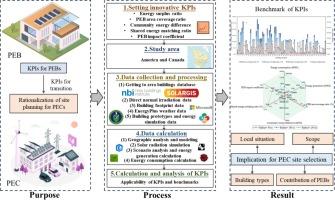
Harnessing energy surpluses and technological advances from positive energy buildings (PEBs) within a community offers a logical transition pathway from PEBs to positive energy communities (PECs). This study proposes a set of reasonable performance indicators (KPIs) for streamlining site planning assessments based on existing PEBs, aiming to transition to PECs for achieving energy autonomy in off-grid states. The proposed KPIs include energy surplus ratio, PEB area coverage ratio, community energy difference, shared energy matching ratio, and PEB impact coefficient. A sample of 81 PEBs provided by a real database in North America was selected for testifying these KPIs, and relevant geographic analyses and simulations were performed. Four PV installation scenarios and three radius ranges were considered for building energy generation and energy consumption. The results show that the establishment of a PEC through a PEB is promising. In existing communities, the physical boundary of the transition from PEB to PEC can be determined to be between 150 and 250 m. The study also found that educational buildings should be closely integrated with residential buildings in the energy resilience planning process. KPIs offer crucial insights for initial PEC site selection, offering practical guidance for PEC development and informing strategic decisions in planning PECs through PEBs. This study’s findings serve as actionable guidance for stakeholders, such as urban planners, policymakers, developers, and researchers, facilitating the creation of sustainable and energy-positive communities.
期刊介绍:
An international journal devoted to investigations of energy use and efficiency in buildings
Energy and Buildings is an international journal publishing articles with explicit links to energy use in buildings. The aim is to present new research results, and new proven practice aimed at reducing the energy needs of a building and improving indoor environment quality.



 京公网安备 11010802042870号
京ICP备2023020795号-1
京公网安备 11010802042870号
京ICP备2023020795号-1

 分享
分享
 求助内容:
求助内容: 应助结果提醒方式:
 扫码关注我们
