{"title":"Chemistry of organometallic nucleic acid components: personal perspectives and prospects for the future","authors":"Mateusz Klarek and Konrad Kowalski","doi":"10.1039/D4DT02634A","DOIUrl":null,"url":null,"abstract":"<p >Organometallic modifications of biologically important compounds such as drugs, secondary natural products, peptides, and nucleic acids, to name just a few, represent a well-established strategy for the development of new anticancer and antimicrobial agents. Supported by these reasons, over 12 years ago, we initiated a research program into organometallic modifications of nucleic acid components. This account summarizes key results regarding the synthetic chemistry and biological activities of the obtained compounds. As synthetic chemists, our main goal over the last 12 years has been to develop new strategies that allow for the exploration of the chemical space of organometallic nucleic acid components. Accordingly, we have developed a Michael addition reaction-based methodology that enabled the synthesis of an entirely new class of glycol nucleic acid (GNA) constituents. Concerning GNA chemistry, we also reported the synthesis of the first-ever ferrocenyl GNA-RNA “mixed” dinucleoside phosphate analog. Recently, we developed a Cu(<small>I</small>)-catalyzed Huisgen azide-alkyne 1,3-dipolar cycloaddition reaction-based approach for the synthesis of novel 1,2,3-triazole-linked (“click”) nucleosides. The high value of this approach is because it allows for the introduction of functional (<em>e.g.</em>, luminescent and redox-active) groups that protrude from the main oligomer sequence. With respect to biological activity studies, we identified several promising anticancer and antimicrobial compounds. Furthermore, we found that simple ferrocenyl-nucleobase conjugates have potential as modulators of Aβ<small><sub>21–40</sub></small> amyloid aggregation. The final section of this article serves as a guide for future studies, as it presents some challenging goals yet to be achieved within the rapidly growing field of nucleic acid chemistry.</p>","PeriodicalId":71,"journal":{"name":"Dalton Transactions","volume":" 46","pages":" 18420-18439"},"PeriodicalIF":3.3000,"publicationDate":"2024-11-01","publicationTypes":"Journal Article","fieldsOfStudy":null,"isOpenAccess":false,"openAccessPdf":"","citationCount":"0","resultStr":null,"platform":"Semanticscholar","paperid":null,"PeriodicalName":"Dalton Transactions","FirstCategoryId":"92","ListUrlMain":"https://pubs.rsc.org/en/content/articlelanding/2024/dt/d4dt02634a","RegionNum":3,"RegionCategory":"化学","ArticlePicture":[],"TitleCN":null,"AbstractTextCN":null,"PMCID":null,"EPubDate":"","PubModel":"","JCR":"Q2","JCRName":"CHEMISTRY, INORGANIC & NUCLEAR","Score":null,"Total":0}
引用次数: 0
Abstract
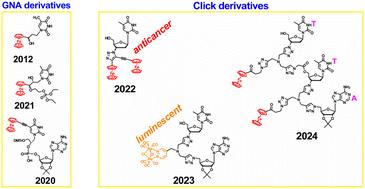
Organometallic modifications of biologically important compounds such as drugs, secondary natural products, peptides, and nucleic acids, to name just a few, represent a well-established strategy for the development of new anticancer and antimicrobial agents. Supported by these reasons, over 12 years ago, we initiated a research program into organometallic modifications of nucleic acid components. This account summarizes key results regarding the synthetic chemistry and biological activities of the obtained compounds. As synthetic chemists, our main goal over the last 12 years has been to develop new strategies that allow for the exploration of the chemical space of organometallic nucleic acid components. Accordingly, we have developed a Michael addition reaction-based methodology that enabled the synthesis of an entirely new class of glycol nucleic acid (GNA) constituents. Concerning GNA chemistry, we also reported the synthesis of the first-ever ferrocenyl GNA-RNA “mixed” dinucleoside phosphate analog. Recently, we developed a Cu(I)-catalyzed Huisgen azide-alkyne 1,3-dipolar cycloaddition reaction-based approach for the synthesis of novel 1,2,3-triazole-linked (“click”) nucleosides. The high value of this approach is because it allows for the introduction of functional (e.g., luminescent and redox-active) groups that protrude from the main oligomer sequence. With respect to biological activity studies, we identified several promising anticancer and antimicrobial compounds. Furthermore, we found that simple ferrocenyl-nucleobase conjugates have potential as modulators of Aβ21–40 amyloid aggregation. The final section of this article serves as a guide for future studies, as it presents some challenging goals yet to be achieved within the rapidly growing field of nucleic acid chemistry.
期刊介绍:
Dalton Transactions is a journal for all areas of inorganic chemistry, which encompasses the organometallic, bioinorganic and materials chemistry of the elements, with applications including synthesis, catalysis, energy conversion/storage, electrical devices and medicine. Dalton Transactions welcomes high-quality, original submissions in all of these areas and more, where the advancement of knowledge in inorganic chemistry is significant.



 京公网安备 11010802042870号
京ICP备2023020795号-1
京公网安备 11010802042870号
京ICP备2023020795号-1

 分享
分享
 求助内容:
求助内容: 应助结果提醒方式:
 扫码关注我们
