Bin Yang;Sicheng Zhou;Jindou Jia;Ziqi Yang;Kexin Guo;Yi Yang;Xiang Yu;Youmin Zhang
{"title":"Distributed Cooperative Framework for Multiple UAVs Safety: A Capability-Triggered Mechanism","authors":"Bin Yang;Sicheng Zhou;Jindou Jia;Ziqi Yang;Kexin Guo;Yi Yang;Xiang Yu;Youmin Zhang","doi":"10.1109/TASE.2024.3483932","DOIUrl":null,"url":null,"abstract":"This article develops a safety-driven distributed cooperative framework (SDDCF) for multiple unmanned aerial vehicles (UAVs) subject to actuator faults in the application of emergency search-and-rescue mission. A capability-triggered decision mechanism is proposed to conquer the challenging situation that the system redundancy cannot satisfy the requirement of fault-tolerant control. By quantitatively analyzing the capability of UAV, a safety threshold is provided, which can be updated adaptively in the light of performance requirement and real-time system capability estimated by a fixed-time fault observer. When the safety threshold is violated, the active performance degradation of the faulty UAVs and communication topology reconfiguration of the multiple UAVs are performed. By virtue of the SDDCF with capability-triggered mechanism, the safety of multiple UAVs system suffering from severe actuator faults is ensured for mission completion. The efficacy of the presented framework is demonstrated by a proof-of-concept emergency search-and-rescue mission in real-world flight experiments. Note to Practitioners—The proposed SDDCF is devoted to reduce the safety risk of multiple UAVs with severe actuator faults in emergency missions, where the mobility and reliability must be balanced carefully. Compared with the existing fault-tolerant control schemes, the SDDCF can ensure the safety even if the actuator faults exceed the system redundancy in a specific mission. Moreover, the practicability of the SDDCF, which can be extended to diverse task scenarios, has been verified in real-world flight experiments. In the future, the abilities of cooperative perception and risk avoidance should be improved to further enhance the safety of multiple UAVs in uncertain environments.","PeriodicalId":51060,"journal":{"name":"IEEE Transactions on Automation Science and Engineering","volume":"22 ","pages":"8303-8316"},"PeriodicalIF":6.4000,"publicationDate":"2024-10-31","publicationTypes":"Journal Article","fieldsOfStudy":null,"isOpenAccess":false,"openAccessPdf":"","citationCount":"0","resultStr":null,"platform":"Semanticscholar","paperid":null,"PeriodicalName":"IEEE Transactions on Automation Science and Engineering","FirstCategoryId":"94","ListUrlMain":"https://ieeexplore.ieee.org/document/10740489/","RegionNum":2,"RegionCategory":"计算机科学","ArticlePicture":[],"TitleCN":null,"AbstractTextCN":null,"PMCID":null,"EPubDate":"","PubModel":"","JCR":"Q1","JCRName":"AUTOMATION & CONTROL SYSTEMS","Score":null,"Total":0}
引用次数: 0
Abstract
This article develops a safety-driven distributed cooperative framework (SDDCF) for multiple unmanned aerial vehicles (UAVs) subject to actuator faults in the application of emergency search-and-rescue mission. A capability-triggered decision mechanism is proposed to conquer the challenging situation that the system redundancy cannot satisfy the requirement of fault-tolerant control. By quantitatively analyzing the capability of UAV, a safety threshold is provided, which can be updated adaptively in the light of performance requirement and real-time system capability estimated by a fixed-time fault observer. When the safety threshold is violated, the active performance degradation of the faulty UAVs and communication topology reconfiguration of the multiple UAVs are performed. By virtue of the SDDCF with capability-triggered mechanism, the safety of multiple UAVs system suffering from severe actuator faults is ensured for mission completion. The efficacy of the presented framework is demonstrated by a proof-of-concept emergency search-and-rescue mission in real-world flight experiments. Note to Practitioners—The proposed SDDCF is devoted to reduce the safety risk of multiple UAVs with severe actuator faults in emergency missions, where the mobility and reliability must be balanced carefully. Compared with the existing fault-tolerant control schemes, the SDDCF can ensure the safety even if the actuator faults exceed the system redundancy in a specific mission. Moreover, the practicability of the SDDCF, which can be extended to diverse task scenarios, has been verified in real-world flight experiments. In the future, the abilities of cooperative perception and risk avoidance should be improved to further enhance the safety of multiple UAVs in uncertain environments.
期刊介绍:
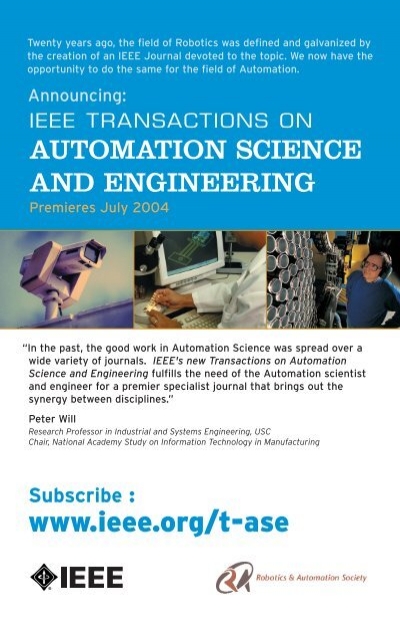
The IEEE Transactions on Automation Science and Engineering (T-ASE) publishes fundamental papers on Automation, emphasizing scientific results that advance efficiency, quality, productivity, and reliability. T-ASE encourages interdisciplinary approaches from computer science, control systems, electrical engineering, mathematics, mechanical engineering, operations research, and other fields. T-ASE welcomes results relevant to industries such as agriculture, biotechnology, healthcare, home automation, maintenance, manufacturing, pharmaceuticals, retail, security, service, supply chains, and transportation. T-ASE addresses a research community willing to integrate knowledge across disciplines and industries. For this purpose, each paper includes a Note to Practitioners that summarizes how its results can be applied or how they might be extended to apply in practice.



 京公网安备 11010802042870号
京ICP备2023020795号-1
京公网安备 11010802042870号
京ICP备2023020795号-1

 分享
分享
 求助内容:
求助内容: 应助结果提醒方式:
 扫码关注我们
