Cyprien Pecalvel, Aurélie Mougel, Edouard Leveque, Katia Lemdani, Vincent Serra, Laurent Guilleminault, Laurent L. Reber
{"title":"Assessing IgE and basophil activity in blood samples from nonhuman primates","authors":"Cyprien Pecalvel, Aurélie Mougel, Edouard Leveque, Katia Lemdani, Vincent Serra, Laurent Guilleminault, Laurent L. Reber","doi":"10.1111/all.16367","DOIUrl":null,"url":null,"abstract":"<p>The dramatic rise in the prevalence of allergies observed in recent decades requires developing and testing new drugs to fight this major public health problem. Nonhuman primates (NHPs) such as cynomolgus monkeys (<i>Macaca fascicularis</i>) are often used in preclinical drug development for dose-range finding studies, and to assess the safety of new pharmaceuticals prior to initiation of clinical trials. IgE antibodies play a key role in allergic diseases, as best exemplified by the efficacy of the anti-IgE Omalizumab in allergic asthma.<span><sup>1</sup></span> However, the extent to which NHP IgE biology reflects that of human is not fully understood, and further knowledge on this is required to ensure clinical relevance of toxicological and functional studies of novel therapies targeting IgE.</p><p>We performed a sequence alignment of the heavy chain constant region (Cε1-4) of human and cynomolgus IgE, which revealed 84.3% identity and 91.6% similarity (Figure S1). Seven putative N-linked glycosylation sites have been described in human IgE heavy chain. Among these, N394-linked oligomannose glycans in the Cε3 domain are required for binding to the high-affinity IgE receptor FcεRI, and sialylations at several sites fine-tune IgE biological activity.<span><sup>2</sup></span> Interestingly, all these putative N-linked glycosylation sites are conserved in cynomolgus with the exception of N383, which was found to be unoccupied by glycans in human IgE in a recent study<span><sup>2</sup></span> (Figure S1).</p><p>Human IgE binds to the alpha chain of FcεRI through contacts with distinct epitopes forming surface loops in Cε3 and in the Cε2–Cε3 linker region,<span><sup>3</sup></span> all of which are conserved in cynomolgus IgE (Figure 1A). In line with this observation, we performed surface plasmon resonance (SPR) measurements to demonstrate that recombinant human and cynomolgus IgE bind human FcεRIα with similar subnanomolar affinities (<i>K</i><sub>D</sub> of 8.39 and 6.73 pM, respectively) (Figure 1B). We performed similar SPR experiments with sensor chips coated with recombinant cynomolgus FcεRIα, and observed nanomolar affinities for both human and cynomolgus IgE (<i>K</i><sub>D</sub> of 1 and 1.4 nM, respectively) (Figure 1C). Overall, these results demonstrate a strong cross-reactivity of both human and cynomolgus IgE for FcεRI from both species.</p><p>To further analyze the ability of cynomolgus IgE to bind and engage human FcεRI, we derived primary human mast cells (MCs) from peripheral blood CD34<sup>+</sup> progenitors from healthy donors. We then sensitized these cells overnight with plasma from naïve cynomolgus monkeys prior to stimulation with polyclonal antihuman IgE antibodies to crosslink surface IgE (Figure 1D,E). MC degranulation was measured by flow cytometry using fluorescent avidin which binds heparin contained in MC granules.<span><sup>4</sup></span> We observed potent degranulation of MCs sensitized with all plasma samples (Figure 1E). However, more variable degranulation was observed with higher plasma dilutions, likely reflecting differences in total IgE levels between samples. To verify this, we quantified total plasma IgE levels by LuLISA, a highly sensitive bioluminescent method which uses a high affinity anti-IgE nanobody (sdAb026) fused to a luciferase for IgE detection.<span><sup>5</sup></span> Indeed, all key residues forming the sdAb026 epitope in the Cε3 domain of IgE are conserved in cynomolgus, which results in the same detection efficacy by LuLISA for human and cynomolgus IgE (Figure S2A,B). We observed a positive correlation between total cynomolgus IgE levels and the extent of MC degranulation in our assay (Figure 1F), confirming that this MC activation test (MAT) is a sensitive method to follow NHP IgE activity.</p><p>The anti-IgE Omalizumab is approved for more than 20 years for the treatment of allergic asthma, and since 2018 for chronic spontaneous urticaria (CSU). Ligelizumab, a more recent anti-IgE monoclonal antibody (mAb), is now in clinical development for food allergy.<span><sup>1</sup></span> Both drugs target different key epitopes in Cε3,<span><sup>6</sup></span> and several novel anti-IgE therapies at various stages of clinical development use a similar strategy to block binding of IgE to FcεRI.<span><sup>1</sup></span> It is therefore important to verify that these key epitopes are conserved between human and cynomolgus monkeys. Indeed, we observed that all key residues that were reported to form Omalizumab and Ligelizumab epitopes<span><sup>6</sup></span> are conserved in cynomolgus monkey, with the exception of N430 (V430 in cynomolgus) (Figure S3A,B). In line with this observation, both Omalizumab and Ligelizumab inhibited human MC degranulation in a dose-dependent manner in our MATs, when these mAbs were preincubated with plasma from cynomolgus monkeys (to block free IgE prior to its binding to FcεRI) (Figure 1G). A previous report indicates that Ligelizumab has ~ 88-fold higher affinity for human IgE, and inhibits binding of human IgE to FcεRI with a 20-fold higher potency than Omalizumab.<span><sup>6</sup></span> In agreement with these results, we also observed that Ligelizumab is ~34-fold more potent than Omalizumab at inhibiting cynomolgus IgE-mediated human MC degranulation (IC<sub>50</sub> of 11 and 370 ng/mL for Ligelizumab and Omalizumab, respectively) (Figure 1G).</p><p>To compare IgE activity in cynomolgus versus human plasma, we sensitized human MCs with plasma from healthy donors, allergic subjects, or cynomolgus monkeys (Figure 1H). Stimulation with anti-IgE antibodies induced MC degranulation in a dose-dependent manner in all three groups. We found a similar degranulation profile after sensitization with plasma from healthy donors or cynomolgus monkey, and increased degranulation with plasma from allergic subjects (Figure 1I). In line with this, similar total IgE levels were detected in plasma samples from healthy donors and cynomolgus monkeys, but unsurprisingly higher total IgE were present in plasma samples from allergic subjects (Figure 1J).</p><p>Basophil activation tests (BATs) are used to measure IgE-mediated basophil degranulation following allergen stimulation in blood samples from allergic subjects.<span><sup>4</sup></span> We assessed whether BATs could also be used to follow IgE and basophil activity in blood samples from cynomolgus monkeys (Figure 2A). We first verified that cynomolgus basophils can be identified by flow cytometry using the same antibody clones and gating strategy as in human.<span><sup>4</sup></span> Indeed, we could identify cynomolgus blood basophils as CD123<sup>+</sup>HLA-DR<sup>−</sup> cells (Figure 2B). As expected, cynomolgus basophils expressed high levels of FcεRI (Figure 2C). We then stimulated blood samples with polyclonal anti-IgE antibodies to induce crosslinking of IgE at the surface of basophils. We assessed basophil degranulation using both the classical CD63 marker and fluorescent avidin. As observed previously in human,<span><sup>4</sup></span> both markers were detected at high level at the cell surface after anti-IgE stimulation, which indicates that the two markers can be used to follow the activation status of cynomolgus basophils, and quantify basophil degranulation (Figure 2D–G). However, in contrast with the MATs, we observed no correlation between the extent of degranulation in these BATs and total plasma IgE levels (Figure S4A,B). To verify that this lack of correlation was not due to excess of free IgE in BATs performed in whole blood samples, we performed additional BATs on purified blood cells (to wash away free IgE) (Figure S4C,D), or using whole blood samples preincubated with Omalizumab or Ligelizumab (Figure S4E,F). Slight increase in basophil degranulation was observed upon blockade of free IgE with Omalizumab or Ligelizumab. However, complete removal of free IgE did not significantly alter the extent of basophil degranulation. Thus, we think that the lack of correlation between free IgE and the extent of degranulation in BATs rather reflects basophil heterogeneity between cynomolgus blood samples.</p><p>Altogether, these results demonstrate that the key IgE epitopes involved in FcεRI binding are fully conserved between cynomolgus monkeys and human, which demonstrates that cynomolgus monkeys represent a highly relevant model to test novel anti-IgE therapies. We think that MATs could be used to verify that novel anti-IgE drugs can neutralize cynomolgus IgE prior to performing any in vivo experiment in cynomolgus monkeys. If cynomolgus is determined to be a relevant species on the basis of these ex vivo data, MATs and BATs could then be used to follow residual IgE activity in monkeys injected with anti-IgE biologics.</p><p>Experimental design: C.P, A.M, E.Le, and L.L.R; Conducting experiments: C.P, A.M, and E.Le; Statistical analysis: C.P, A.M, E.Le, and L.L.R; Writing (original draft): C.P, A.M, E.Le, and L.L.R; Writing (review and editing): all authors.</p><p>This work was funded by NEOVACS, the Institut National de la Santé et de la Recherche Médicale (INSERM), the French National Research Agency (ANR) grant ANR-18-CE18-0023 “AllergyVACS”, and the European Research Council ERC-2021-CoG #101043749 (to L.L.R).</p><p>L.L.R is or recently was a speaker and/or advisor for and/or has received research funding from Argenx, Novartis and Ceva, and is inventor on patents issued or pending relating to IgE detection (WO2021/219544) and anti-IgE therapies (WO2019/197607). V.S and L.L.R are inventors on a patent relating to anti-IgE therapy (WO2022/058571); A.M, K.L, V.S, and L.L.R are currently or were previously employees of NEOVACS and/or company stock owners. L.G. has been an investigator in clinical trials for AstraZeneca, Bayer, GlaxoSmithKline, MSD, and Novartis, reports grants or fees for consulting from AstraZeneca, GlaxoSmithKline, Novartis, and Sanofi-Regeneron, and fees for consulting from ALK, Bayer, Chiesi, MSD, not related to the submitted work. The rest of the authors declare no competing interests.</p>","PeriodicalId":122,"journal":{"name":"Allergy","volume":"80 1","pages":"338-341"},"PeriodicalIF":12.0000,"publicationDate":"2024-11-04","publicationTypes":"Journal Article","fieldsOfStudy":null,"isOpenAccess":false,"openAccessPdf":"https://www.ncbi.nlm.nih.gov/pmc/articles/PMC11724247/pdf/","citationCount":"0","resultStr":null,"platform":"Semanticscholar","paperid":null,"PeriodicalName":"Allergy","FirstCategoryId":"3","ListUrlMain":"https://onlinelibrary.wiley.com/doi/10.1111/all.16367","RegionNum":1,"RegionCategory":"医学","ArticlePicture":[],"TitleCN":null,"AbstractTextCN":null,"PMCID":null,"EPubDate":"","PubModel":"","JCR":"Q1","JCRName":"ALLERGY","Score":null,"Total":0}
引用次数: 0
Abstract
The dramatic rise in the prevalence of allergies observed in recent decades requires developing and testing new drugs to fight this major public health problem. Nonhuman primates (NHPs) such as cynomolgus monkeys (Macaca fascicularis) are often used in preclinical drug development for dose-range finding studies, and to assess the safety of new pharmaceuticals prior to initiation of clinical trials. IgE antibodies play a key role in allergic diseases, as best exemplified by the efficacy of the anti-IgE Omalizumab in allergic asthma.1 However, the extent to which NHP IgE biology reflects that of human is not fully understood, and further knowledge on this is required to ensure clinical relevance of toxicological and functional studies of novel therapies targeting IgE.
We performed a sequence alignment of the heavy chain constant region (Cε1-4) of human and cynomolgus IgE, which revealed 84.3% identity and 91.6% similarity (Figure S1). Seven putative N-linked glycosylation sites have been described in human IgE heavy chain. Among these, N394-linked oligomannose glycans in the Cε3 domain are required for binding to the high-affinity IgE receptor FcεRI, and sialylations at several sites fine-tune IgE biological activity.2 Interestingly, all these putative N-linked glycosylation sites are conserved in cynomolgus with the exception of N383, which was found to be unoccupied by glycans in human IgE in a recent study2 (Figure S1).
Human IgE binds to the alpha chain of FcεRI through contacts with distinct epitopes forming surface loops in Cε3 and in the Cε2–Cε3 linker region,3 all of which are conserved in cynomolgus IgE (Figure 1A). In line with this observation, we performed surface plasmon resonance (SPR) measurements to demonstrate that recombinant human and cynomolgus IgE bind human FcεRIα with similar subnanomolar affinities (KD of 8.39 and 6.73 pM, respectively) (Figure 1B). We performed similar SPR experiments with sensor chips coated with recombinant cynomolgus FcεRIα, and observed nanomolar affinities for both human and cynomolgus IgE (KD of 1 and 1.4 nM, respectively) (Figure 1C). Overall, these results demonstrate a strong cross-reactivity of both human and cynomolgus IgE for FcεRI from both species.
To further analyze the ability of cynomolgus IgE to bind and engage human FcεRI, we derived primary human mast cells (MCs) from peripheral blood CD34+ progenitors from healthy donors. We then sensitized these cells overnight with plasma from naïve cynomolgus monkeys prior to stimulation with polyclonal antihuman IgE antibodies to crosslink surface IgE (Figure 1D,E). MC degranulation was measured by flow cytometry using fluorescent avidin which binds heparin contained in MC granules.4 We observed potent degranulation of MCs sensitized with all plasma samples (Figure 1E). However, more variable degranulation was observed with higher plasma dilutions, likely reflecting differences in total IgE levels between samples. To verify this, we quantified total plasma IgE levels by LuLISA, a highly sensitive bioluminescent method which uses a high affinity anti-IgE nanobody (sdAb026) fused to a luciferase for IgE detection.5 Indeed, all key residues forming the sdAb026 epitope in the Cε3 domain of IgE are conserved in cynomolgus, which results in the same detection efficacy by LuLISA for human and cynomolgus IgE (Figure S2A,B). We observed a positive correlation between total cynomolgus IgE levels and the extent of MC degranulation in our assay (Figure 1F), confirming that this MC activation test (MAT) is a sensitive method to follow NHP IgE activity.
The anti-IgE Omalizumab is approved for more than 20 years for the treatment of allergic asthma, and since 2018 for chronic spontaneous urticaria (CSU). Ligelizumab, a more recent anti-IgE monoclonal antibody (mAb), is now in clinical development for food allergy.1 Both drugs target different key epitopes in Cε3,6 and several novel anti-IgE therapies at various stages of clinical development use a similar strategy to block binding of IgE to FcεRI.1 It is therefore important to verify that these key epitopes are conserved between human and cynomolgus monkeys. Indeed, we observed that all key residues that were reported to form Omalizumab and Ligelizumab epitopes6 are conserved in cynomolgus monkey, with the exception of N430 (V430 in cynomolgus) (Figure S3A,B). In line with this observation, both Omalizumab and Ligelizumab inhibited human MC degranulation in a dose-dependent manner in our MATs, when these mAbs were preincubated with plasma from cynomolgus monkeys (to block free IgE prior to its binding to FcεRI) (Figure 1G). A previous report indicates that Ligelizumab has ~ 88-fold higher affinity for human IgE, and inhibits binding of human IgE to FcεRI with a 20-fold higher potency than Omalizumab.6 In agreement with these results, we also observed that Ligelizumab is ~34-fold more potent than Omalizumab at inhibiting cynomolgus IgE-mediated human MC degranulation (IC50 of 11 and 370 ng/mL for Ligelizumab and Omalizumab, respectively) (Figure 1G).
To compare IgE activity in cynomolgus versus human plasma, we sensitized human MCs with plasma from healthy donors, allergic subjects, or cynomolgus monkeys (Figure 1H). Stimulation with anti-IgE antibodies induced MC degranulation in a dose-dependent manner in all three groups. We found a similar degranulation profile after sensitization with plasma from healthy donors or cynomolgus monkey, and increased degranulation with plasma from allergic subjects (Figure 1I). In line with this, similar total IgE levels were detected in plasma samples from healthy donors and cynomolgus monkeys, but unsurprisingly higher total IgE were present in plasma samples from allergic subjects (Figure 1J).
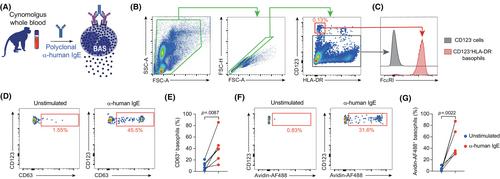
Basophil activation tests (BATs) are used to measure IgE-mediated basophil degranulation following allergen stimulation in blood samples from allergic subjects.4 We assessed whether BATs could also be used to follow IgE and basophil activity in blood samples from cynomolgus monkeys (Figure 2A). We first verified that cynomolgus basophils can be identified by flow cytometry using the same antibody clones and gating strategy as in human.4 Indeed, we could identify cynomolgus blood basophils as CD123+HLA-DR− cells (Figure 2B). As expected, cynomolgus basophils expressed high levels of FcεRI (Figure 2C). We then stimulated blood samples with polyclonal anti-IgE antibodies to induce crosslinking of IgE at the surface of basophils. We assessed basophil degranulation using both the classical CD63 marker and fluorescent avidin. As observed previously in human,4 both markers were detected at high level at the cell surface after anti-IgE stimulation, which indicates that the two markers can be used to follow the activation status of cynomolgus basophils, and quantify basophil degranulation (Figure 2D–G). However, in contrast with the MATs, we observed no correlation between the extent of degranulation in these BATs and total plasma IgE levels (Figure S4A,B). To verify that this lack of correlation was not due to excess of free IgE in BATs performed in whole blood samples, we performed additional BATs on purified blood cells (to wash away free IgE) (Figure S4C,D), or using whole blood samples preincubated with Omalizumab or Ligelizumab (Figure S4E,F). Slight increase in basophil degranulation was observed upon blockade of free IgE with Omalizumab or Ligelizumab. However, complete removal of free IgE did not significantly alter the extent of basophil degranulation. Thus, we think that the lack of correlation between free IgE and the extent of degranulation in BATs rather reflects basophil heterogeneity between cynomolgus blood samples.
Altogether, these results demonstrate that the key IgE epitopes involved in FcεRI binding are fully conserved between cynomolgus monkeys and human, which demonstrates that cynomolgus monkeys represent a highly relevant model to test novel anti-IgE therapies. We think that MATs could be used to verify that novel anti-IgE drugs can neutralize cynomolgus IgE prior to performing any in vivo experiment in cynomolgus monkeys. If cynomolgus is determined to be a relevant species on the basis of these ex vivo data, MATs and BATs could then be used to follow residual IgE activity in monkeys injected with anti-IgE biologics.
Experimental design: C.P, A.M, E.Le, and L.L.R; Conducting experiments: C.P, A.M, and E.Le; Statistical analysis: C.P, A.M, E.Le, and L.L.R; Writing (original draft): C.P, A.M, E.Le, and L.L.R; Writing (review and editing): all authors.
This work was funded by NEOVACS, the Institut National de la Santé et de la Recherche Médicale (INSERM), the French National Research Agency (ANR) grant ANR-18-CE18-0023 “AllergyVACS”, and the European Research Council ERC-2021-CoG #101043749 (to L.L.R).
L.L.R is or recently was a speaker and/or advisor for and/or has received research funding from Argenx, Novartis and Ceva, and is inventor on patents issued or pending relating to IgE detection (WO2021/219544) and anti-IgE therapies (WO2019/197607). V.S and L.L.R are inventors on a patent relating to anti-IgE therapy (WO2022/058571); A.M, K.L, V.S, and L.L.R are currently or were previously employees of NEOVACS and/or company stock owners. L.G. has been an investigator in clinical trials for AstraZeneca, Bayer, GlaxoSmithKline, MSD, and Novartis, reports grants or fees for consulting from AstraZeneca, GlaxoSmithKline, Novartis, and Sanofi-Regeneron, and fees for consulting from ALK, Bayer, Chiesi, MSD, not related to the submitted work. The rest of the authors declare no competing interests.
期刊介绍:
Allergy is an international and multidisciplinary journal that aims to advance, impact, and communicate all aspects of the discipline of Allergy/Immunology. It publishes original articles, reviews, position papers, guidelines, editorials, news and commentaries, letters to the editors, and correspondences. The journal accepts articles based on their scientific merit and quality.
Allergy seeks to maintain contact between basic and clinical Allergy/Immunology and encourages contributions from contributors and readers from all countries. In addition to its publication, Allergy also provides abstracting and indexing information. Some of the databases that include Allergy abstracts are Abstracts on Hygiene & Communicable Disease, Academic Search Alumni Edition, AgBiotech News & Information, AGRICOLA Database, Biological Abstracts, PubMed Dietary Supplement Subset, and Global Health, among others.



 京公网安备 11010802042870号
京ICP备2023020795号-1
京公网安备 11010802042870号
京ICP备2023020795号-1

 分享
分享
 求助内容:
求助内容: 应助结果提醒方式:
 扫码关注我们
