Survival Outcomes of Radiofrequency Ablation for Intrahepatic Cholangiocarcinoma from the Surveillance, Epidemiology, and End Results (SEER) Database: Comparison with Radiotherapy and Resection
Qian Yu MD , Amar Mahbubani BA , Daniel Kwak MD , Chih-Yi Liao MD , Anjana Pillai MD , Mikin Patel MD , Rakesh Navuluri MD , Brian Funaki MD , Osman Ahmed MD
{"title":"Survival Outcomes of Radiofrequency Ablation for Intrahepatic Cholangiocarcinoma from the Surveillance, Epidemiology, and End Results (SEER) Database: Comparison with Radiotherapy and Resection","authors":"Qian Yu MD , Amar Mahbubani BA , Daniel Kwak MD , Chih-Yi Liao MD , Anjana Pillai MD , Mikin Patel MD , Rakesh Navuluri MD , Brian Funaki MD , Osman Ahmed MD","doi":"10.1016/j.jvir.2024.10.028","DOIUrl":null,"url":null,"abstract":"<div><h3>Purpose</h3><div>To determine effectiveness of radiofrequency ablation for treatment of intrahepatic cholangiocarcinoma (iCCA) using a population-based database.</div></div><div><h3>Materials and Methods</h3><div>Data were extracted from Surveillance, Epidemiology, and End Results (SEER) database from 2000 to 2020 to include 194 patients who underwent ablation for iCCA. Data on patient demographics, overall survival (OS), and cancer-specific survival were retrieved. Factors associated with survival were evaluated. Comparison between ablation and surgical resection (n = 2,653) or external beam radiotherapy (n = 1,068) was performed.</div></div><div><h3>Results</h3><div>In the ablation group, patients diagnosed and treated after 2010 demonstrated improved OS than that in the 2000–2009 subgroup (median OS, 32 vs 21 months; hazard ratio, 0.50; 95% CI, 0.33–0.75; <em>P</em> = .001). Additional factors associated with OS included tumor size (≤3 cm vs >3 cm; <em>P</em> = .049) and tumor stage (<em>P</em> < .001). For patients diagnosed after 2010, the 1-, 3-, and 5-year OS were 82.8% (95% CI, 74.8%–88.4%), 43.5% (95% CI, 33.5%–53.1%), and 23.7% (95% CI, 15.3%–33.5%), respectively. Patients with local disease (1-year OS, 87.8%; 95% CI, 78.6%–93.3%) demonstrated improved OS compared with patients with regional (1-year OS, 81.3%; 95% CI, 52.5%–93.5%) and distant disease (50.2%; 95% CI, 34.0%–78.8%; <em>P</em> < .001). For tumors ≤3 cm, ablation and surgical resection offered comparable survival benefits (<em>P</em> = .561), although both were better than radiotherapy (<em>P</em> < .0001).</div></div><div><h3>Conclusions</h3><div>Survival of patients with iCCA who underwent thermal ablation has improved over the last 10 years. For tumors ≤3 cm, ablation could be as effective as resection with careful candidate selection, and may be considered front-line compared with radiotherapy in certain patient populations. Patient selection based on tumor size and disease stage could improve survival outcomes.</div></div>","PeriodicalId":49962,"journal":{"name":"Journal of Vascular and Interventional Radiology","volume":"36 3","pages":"Pages 489-498.e3"},"PeriodicalIF":3.1000,"publicationDate":"2025-03-01","publicationTypes":"Journal Article","fieldsOfStudy":null,"isOpenAccess":false,"openAccessPdf":"","citationCount":"0","resultStr":null,"platform":"Semanticscholar","paperid":null,"PeriodicalName":"Journal of Vascular and Interventional Radiology","FirstCategoryId":"3","ListUrlMain":"https://www.sciencedirect.com/science/article/pii/S1051044324006882","RegionNum":3,"RegionCategory":"医学","ArticlePicture":[],"TitleCN":null,"AbstractTextCN":null,"PMCID":null,"EPubDate":"2024/11/2 0:00:00","PubModel":"Epub","JCR":"Q2","JCRName":"PERIPHERAL VASCULAR DISEASE","Score":null,"Total":0}
引用次数: 0
Abstract
Purpose
To determine effectiveness of radiofrequency ablation for treatment of intrahepatic cholangiocarcinoma (iCCA) using a population-based database.
Materials and Methods
Data were extracted from Surveillance, Epidemiology, and End Results (SEER) database from 2000 to 2020 to include 194 patients who underwent ablation for iCCA. Data on patient demographics, overall survival (OS), and cancer-specific survival were retrieved. Factors associated with survival were evaluated. Comparison between ablation and surgical resection (n = 2,653) or external beam radiotherapy (n = 1,068) was performed.
Results
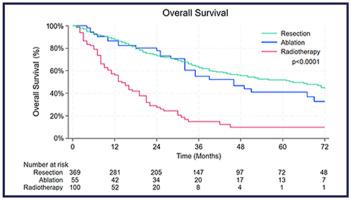
In the ablation group, patients diagnosed and treated after 2010 demonstrated improved OS than that in the 2000–2009 subgroup (median OS, 32 vs 21 months; hazard ratio, 0.50; 95% CI, 0.33–0.75; P = .001). Additional factors associated with OS included tumor size (≤3 cm vs >3 cm; P = .049) and tumor stage (P < .001). For patients diagnosed after 2010, the 1-, 3-, and 5-year OS were 82.8% (95% CI, 74.8%–88.4%), 43.5% (95% CI, 33.5%–53.1%), and 23.7% (95% CI, 15.3%–33.5%), respectively. Patients with local disease (1-year OS, 87.8%; 95% CI, 78.6%–93.3%) demonstrated improved OS compared with patients with regional (1-year OS, 81.3%; 95% CI, 52.5%–93.5%) and distant disease (50.2%; 95% CI, 34.0%–78.8%; P < .001). For tumors ≤3 cm, ablation and surgical resection offered comparable survival benefits (P = .561), although both were better than radiotherapy (P < .0001).
Conclusions
Survival of patients with iCCA who underwent thermal ablation has improved over the last 10 years. For tumors ≤3 cm, ablation could be as effective as resection with careful candidate selection, and may be considered front-line compared with radiotherapy in certain patient populations. Patient selection based on tumor size and disease stage could improve survival outcomes.
期刊介绍:
JVIR, published continuously since 1990, is an international, monthly peer-reviewed interventional radiology journal. As the official journal of the Society of Interventional Radiology, JVIR is the peer-reviewed journal of choice for interventional radiologists, radiologists, cardiologists, vascular surgeons, neurosurgeons, and other clinicians who seek current and reliable information on every aspect of vascular and interventional radiology. Each issue of JVIR covers critical and cutting-edge medical minimally invasive, clinical, basic research, radiological, pathological, and socioeconomic issues of importance to the field.




 京公网安备 11010802042870号
京ICP备2023020795号-1
京公网安备 11010802042870号
京ICP备2023020795号-1

 分享
分享

 求助内容:
求助内容: 应助结果提醒方式:
 扫码关注我们
