Cheng-Juan Wu, Ming-Zhen Shao, Jing-Lan Kan, Wen-Jing Liang, Ting-Rui Li, Li-Jing Niu, Hao-Jia Wang, Yan Geng* and Yu-Bin Dong*,
{"title":"Photocatalytic Synthesis of Quinoline-Linked Covalent Organic Frameworks via Three-Component Povarov Reaction","authors":"Cheng-Juan Wu, Ming-Zhen Shao, Jing-Lan Kan, Wen-Jing Liang, Ting-Rui Li, Li-Jing Niu, Hao-Jia Wang, Yan Geng* and Yu-Bin Dong*, ","doi":"10.1021/acsmaterialslett.4c01665","DOIUrl":null,"url":null,"abstract":"<p >Visible-light-mediated photocatalysis has been widely utilized to produce various organic products due to its clean, efficient, and green characteristics. However, examples involving photocatalytic reactions to synthesize covalent organic frameworks (COFs) have been rarely reported thus far. Herein, we report for the first time the photocatalytic synthesis of a series of quinoline-linked COFs with high crystallinity and permanent porosity via the photocatalytic three-component one-pot Povarov reaction between different aldehydes, amines, and phenyl vinyl sulfone. Furthermore, the obtained quinoline-linked COFs are stable and can be employed as efficient photocatalysts to promote the photocatalytic oxidative hydroxylation of arylboronic acids to phenols in excellent yields. This photocatalytic polymerization strategy opens a new avenue for the construction of stable quinoline-linked COFs in a green and facile way.</p>","PeriodicalId":19,"journal":{"name":"ACS Materials Letters","volume":"6 11","pages":"5016–5022 5016–5022"},"PeriodicalIF":8.7000,"publicationDate":"2024-10-08","publicationTypes":"Journal Article","fieldsOfStudy":null,"isOpenAccess":false,"openAccessPdf":"","citationCount":"0","resultStr":null,"platform":"Semanticscholar","paperid":null,"PeriodicalName":"ACS Materials Letters","FirstCategoryId":"92","ListUrlMain":"https://pubs.acs.org/doi/10.1021/acsmaterialslett.4c01665","RegionNum":1,"RegionCategory":"化学","ArticlePicture":[],"TitleCN":null,"AbstractTextCN":null,"PMCID":null,"EPubDate":"","PubModel":"","JCR":"Q1","JCRName":"MATERIALS SCIENCE, MULTIDISCIPLINARY","Score":null,"Total":0}
引用次数: 0
Abstract
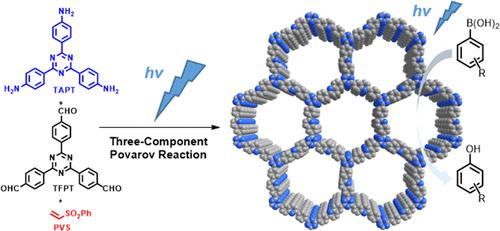
Visible-light-mediated photocatalysis has been widely utilized to produce various organic products due to its clean, efficient, and green characteristics. However, examples involving photocatalytic reactions to synthesize covalent organic frameworks (COFs) have been rarely reported thus far. Herein, we report for the first time the photocatalytic synthesis of a series of quinoline-linked COFs with high crystallinity and permanent porosity via the photocatalytic three-component one-pot Povarov reaction between different aldehydes, amines, and phenyl vinyl sulfone. Furthermore, the obtained quinoline-linked COFs are stable and can be employed as efficient photocatalysts to promote the photocatalytic oxidative hydroxylation of arylboronic acids to phenols in excellent yields. This photocatalytic polymerization strategy opens a new avenue for the construction of stable quinoline-linked COFs in a green and facile way.
期刊介绍:
ACS Materials Letters is a journal that publishes high-quality and urgent papers at the forefront of fundamental and applied research in the field of materials science. It aims to bridge the gap between materials and other disciplines such as chemistry, engineering, and biology. The journal encourages multidisciplinary and innovative research that addresses global challenges. Papers submitted to ACS Materials Letters should clearly demonstrate the need for rapid disclosure of key results. The journal is interested in various areas including the design, synthesis, characterization, and evaluation of emerging materials, understanding the relationships between structure, property, and performance, as well as developing materials for applications in energy, environment, biomedical, electronics, and catalysis. The journal has a 2-year impact factor of 11.4 and is dedicated to publishing transformative materials research with fast processing times. The editors and staff of ACS Materials Letters actively participate in major scientific conferences and engage closely with readers and authors. The journal also maintains an active presence on social media to provide authors with greater visibility.




 京公网安备 11010802042870号
京ICP备2023020795号-1
京公网安备 11010802042870号
京ICP备2023020795号-1

 分享
分享
 求助内容:
求助内容: 应助结果提醒方式:
 扫码关注我们
