Regulating Energy Transfer Pathways to Construct Multicolor Luminescent Lanthanide Metal–Organic Frameworks and Their Multiorder Anticounterfeiting Barcodes and Antibiotic Sensing
{"title":"Regulating Energy Transfer Pathways to Construct Multicolor Luminescent Lanthanide Metal–Organic Frameworks and Their Multiorder Anticounterfeiting Barcodes and Antibiotic Sensing","authors":"Wen-Wen Qin, Hai-Ling Wang, Yun-Lan Li, Fu-Pei Liang, Zhong-Hong Zhu* and Hua-Hong Zou*, ","doi":"10.1021/acsmaterialslett.4c01728","DOIUrl":null,"url":null,"abstract":"<p >We present the development of “all-in-one” layered Ln-MOFs (<b>Ln-OXAL</b> and <b>Ln-GLYC</b>; Ln = Tb, Eu) with efficient multicolor emission, multiple anticounterfeiting, and smart photoresponsive antibiotic properties. By controlling the energy transfer pathways, a series of multicolor emissions from chartreuse to red light were successfully achieved in Ln-MOFs. Furthermore, the typical fingerprint emission spectrum of Ln-MOFs with multicolor emission characteristics was utilized and further integrated into a high-capacity photonic barcode encoding library, and by employing an effective encoding strategy, a multilayered anticounterfeiting material with advanced information encryption capabilities was developed. Both <b>Tb-OXAL</b> and <b>Tb-GLYC</b> exhibit highly sensitive optical sensing abilities for detecting low concentrations of oxytetracycline, achieving limit of detection values as low as 1.35 and 7.44 μM, respectively. The integration of various applications in a specific material remains considerably challenging, primarily due to the inherent complexities in coordinating and ensuring compatibility among these varied properties.</p>","PeriodicalId":19,"journal":{"name":"ACS Materials Letters","volume":"6 11","pages":"4911–4921 4911–4921"},"PeriodicalIF":8.6000,"publicationDate":"2024-10-02","publicationTypes":"Journal Article","fieldsOfStudy":null,"isOpenAccess":false,"openAccessPdf":"","citationCount":"0","resultStr":null,"platform":"Semanticscholar","paperid":null,"PeriodicalName":"ACS Materials Letters","FirstCategoryId":"92","ListUrlMain":"https://pubs.acs.org/doi/10.1021/acsmaterialslett.4c01728","RegionNum":1,"RegionCategory":"化学","ArticlePicture":[],"TitleCN":null,"AbstractTextCN":null,"PMCID":null,"EPubDate":"","PubModel":"","JCR":"Q1","JCRName":"MATERIALS SCIENCE, MULTIDISCIPLINARY","Score":null,"Total":0}
引用次数: 0
Abstract
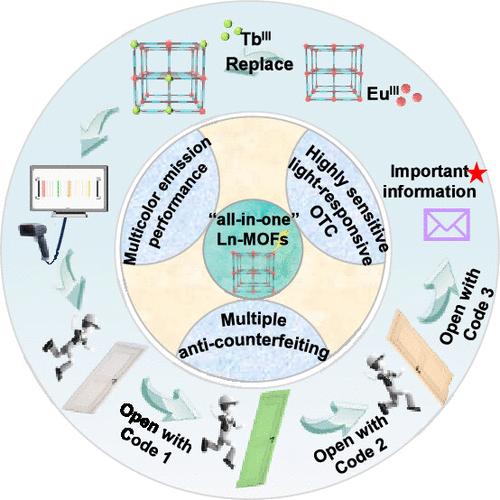
We present the development of “all-in-one” layered Ln-MOFs (Ln-OXAL and Ln-GLYC; Ln = Tb, Eu) with efficient multicolor emission, multiple anticounterfeiting, and smart photoresponsive antibiotic properties. By controlling the energy transfer pathways, a series of multicolor emissions from chartreuse to red light were successfully achieved in Ln-MOFs. Furthermore, the typical fingerprint emission spectrum of Ln-MOFs with multicolor emission characteristics was utilized and further integrated into a high-capacity photonic barcode encoding library, and by employing an effective encoding strategy, a multilayered anticounterfeiting material with advanced information encryption capabilities was developed. Both Tb-OXAL and Tb-GLYC exhibit highly sensitive optical sensing abilities for detecting low concentrations of oxytetracycline, achieving limit of detection values as low as 1.35 and 7.44 μM, respectively. The integration of various applications in a specific material remains considerably challenging, primarily due to the inherent complexities in coordinating and ensuring compatibility among these varied properties.
期刊介绍:
ACS Materials Letters is a journal that publishes high-quality and urgent papers at the forefront of fundamental and applied research in the field of materials science. It aims to bridge the gap between materials and other disciplines such as chemistry, engineering, and biology. The journal encourages multidisciplinary and innovative research that addresses global challenges. Papers submitted to ACS Materials Letters should clearly demonstrate the need for rapid disclosure of key results. The journal is interested in various areas including the design, synthesis, characterization, and evaluation of emerging materials, understanding the relationships between structure, property, and performance, as well as developing materials for applications in energy, environment, biomedical, electronics, and catalysis. The journal has a 2-year impact factor of 11.4 and is dedicated to publishing transformative materials research with fast processing times. The editors and staff of ACS Materials Letters actively participate in major scientific conferences and engage closely with readers and authors. The journal also maintains an active presence on social media to provide authors with greater visibility.




 京公网安备 11010802042870号
京ICP备2023020795号-1
京公网安备 11010802042870号
京ICP备2023020795号-1

 分享
分享
 求助内容:
求助内容: 应助结果提醒方式:
 扫码关注我们
