Zhao Wang, Lin Liu, Ergang Liu*, Rongli Chen, Yongzhuo Huang* and Qianbin Li*,
{"title":"Carrier Polymer-Free Dissolvable Microneedles Enable Superhigh Drug Payload for Percutaneous Protein Delivery","authors":"Zhao Wang, Lin Liu, Ergang Liu*, Rongli Chen, Yongzhuo Huang* and Qianbin Li*, ","doi":"10.1021/acsmaterialslett.4c01164","DOIUrl":null,"url":null,"abstract":"<p >Microneedle (MN) patches present a painless alternative for transdermal delivery of monoclonal antibodies (mAbs), yet existing dissolvable MNs are hindered by a low drug-loading capacity (DLC). This study introduces a carrier-free approach for fabricating mAb MNs by a solution-casting method, providing a superhigh drug-payload MN platform (DLC around 70%). Additionally, the use of concentrated proteins prevents interpenetration between the backing layer and the tip, assuring the dosage accuracy of the therapeutic antibodies. Physicochemical characteristics, including mechanical strength, dissolvability, and skin permeability, were evaluated and compared with conventional PVP K17 (poly(vinylpyrrolidone), K17) microneedles. Finally, the transdermal performance of protein dMNs was assessed using IL-17A (Iinterleukin-17A) antibody as a model protein drug, with in vivo therapeutic efficacy evaluated in a psoriatic mouse model. The results demonstrate the feasibility and effectiveness of excipient-free dMNs for mAb delivery, significantly improving the drug-loading capacity, while mitigating safety concerns associated with carrier polymers.</p>","PeriodicalId":19,"journal":{"name":"ACS Materials Letters","volume":"6 11","pages":"4980–4987 4980–4987"},"PeriodicalIF":8.7000,"publicationDate":"2024-10-07","publicationTypes":"Journal Article","fieldsOfStudy":null,"isOpenAccess":false,"openAccessPdf":"","citationCount":"0","resultStr":null,"platform":"Semanticscholar","paperid":null,"PeriodicalName":"ACS Materials Letters","FirstCategoryId":"92","ListUrlMain":"https://pubs.acs.org/doi/10.1021/acsmaterialslett.4c01164","RegionNum":1,"RegionCategory":"化学","ArticlePicture":[],"TitleCN":null,"AbstractTextCN":null,"PMCID":null,"EPubDate":"","PubModel":"","JCR":"Q1","JCRName":"MATERIALS SCIENCE, MULTIDISCIPLINARY","Score":null,"Total":0}
引用次数: 0
Abstract
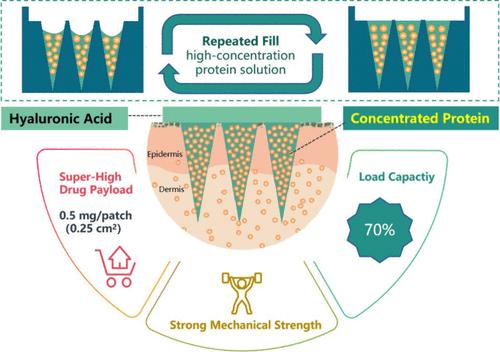
Microneedle (MN) patches present a painless alternative for transdermal delivery of monoclonal antibodies (mAbs), yet existing dissolvable MNs are hindered by a low drug-loading capacity (DLC). This study introduces a carrier-free approach for fabricating mAb MNs by a solution-casting method, providing a superhigh drug-payload MN platform (DLC around 70%). Additionally, the use of concentrated proteins prevents interpenetration between the backing layer and the tip, assuring the dosage accuracy of the therapeutic antibodies. Physicochemical characteristics, including mechanical strength, dissolvability, and skin permeability, were evaluated and compared with conventional PVP K17 (poly(vinylpyrrolidone), K17) microneedles. Finally, the transdermal performance of protein dMNs was assessed using IL-17A (Iinterleukin-17A) antibody as a model protein drug, with in vivo therapeutic efficacy evaluated in a psoriatic mouse model. The results demonstrate the feasibility and effectiveness of excipient-free dMNs for mAb delivery, significantly improving the drug-loading capacity, while mitigating safety concerns associated with carrier polymers.
期刊介绍:
ACS Materials Letters is a journal that publishes high-quality and urgent papers at the forefront of fundamental and applied research in the field of materials science. It aims to bridge the gap between materials and other disciplines such as chemistry, engineering, and biology. The journal encourages multidisciplinary and innovative research that addresses global challenges. Papers submitted to ACS Materials Letters should clearly demonstrate the need for rapid disclosure of key results. The journal is interested in various areas including the design, synthesis, characterization, and evaluation of emerging materials, understanding the relationships between structure, property, and performance, as well as developing materials for applications in energy, environment, biomedical, electronics, and catalysis. The journal has a 2-year impact factor of 11.4 and is dedicated to publishing transformative materials research with fast processing times. The editors and staff of ACS Materials Letters actively participate in major scientific conferences and engage closely with readers and authors. The journal also maintains an active presence on social media to provide authors with greater visibility.



 京公网安备 11010802042870号
京ICP备2023020795号-1
京公网安备 11010802042870号
京ICP备2023020795号-1

 分享
分享
 求助内容:
求助内容: 应助结果提醒方式:
 扫码关注我们
