Halogenated Polycyclic Aromatic Hydrocarbon for Hole Selective Layer/Perovskite Interface Modification and Passivation for Efficient Perovskite-Organic Tandem Solar Cells with Record Fill Factor
Md Arafat Mahmud, Jianghui Zheng, Jia-Fu Chang, Guoliang Wang, Chwenhaw Liao, Md Habibur Rahman, Walia Binte Tarique, Shi Tang, Jueming Bing, Christopher G. Bailey, Zhuofeng Li, Limei Yang, Nina Novikova, Tik Lun Leung, Hongjun Chen, Jianpeng Yi, Runmin Tao, Marko Jankovec, Stephen P. Bremner, Julie Cairney, Ashraf Uddin, Hieu T. Nguyen, Trevor Smith, Chu-Chen Chueh, Anita W. Y. Ho-Baillie
{"title":"Halogenated Polycyclic Aromatic Hydrocarbon for Hole Selective Layer/Perovskite Interface Modification and Passivation for Efficient Perovskite-Organic Tandem Solar Cells with Record Fill Factor","authors":"Md Arafat Mahmud, Jianghui Zheng, Jia-Fu Chang, Guoliang Wang, Chwenhaw Liao, Md Habibur Rahman, Walia Binte Tarique, Shi Tang, Jueming Bing, Christopher G. Bailey, Zhuofeng Li, Limei Yang, Nina Novikova, Tik Lun Leung, Hongjun Chen, Jianpeng Yi, Runmin Tao, Marko Jankovec, Stephen P. Bremner, Julie Cairney, Ashraf Uddin, Hieu T. Nguyen, Trevor Smith, Chu-Chen Chueh, Anita W. Y. Ho-Baillie","doi":"10.1002/aenm.202400691","DOIUrl":null,"url":null,"abstract":"<p>Perovskite whentandemed with organic photovoltaics (OPV) for double-junctions have efficiencypotentials over 40%. However, there is still room for improvement suchas better current matching, higher fill factor, as well as lower voltage and fill factor losses in the top perovskite cell. Here weaddress the issue associated with the top perovskite cell by utilising anovel halogenated polycyclic aromatic hydrocarbon compound, 1-naphthylammoniumchloride (NA─Cl) playing dual roles of surface modification for the hole selectivelayer (HSL) and passivation of HSL/perovskiteinterface. Results of X-ray photoelectron spectroscopy and density functionaltheory calculations reveal that NA─Cl retains self-assembly property for the HSLwhile demonstrating high dipole moment and polarizability. This induces asurface dipole at the HSL/perovskite interface reducing the energetic barrierfor hole extraction by 210 meV thereby enhancing voltage output and fill factorof the device. Such scheme when implemented in a high bandgap (1.78 eV)perovskite solar cell, results in a respectable efficiency of 19.7% and thehighest fill factor of 85.4% amongst those of 1.78 eV perovskite cells reported.We have also achieved 23% cell efficient monolithic perovskite-OPV tandem withan impressive fill factor of 84%, which is the highest for perovskite-OPVtandem cells reported to-date.</p>","PeriodicalId":111,"journal":{"name":"Advanced Energy Materials","volume":"14 45","pages":""},"PeriodicalIF":26.0000,"publicationDate":"2024-11-03","publicationTypes":"Journal Article","fieldsOfStudy":null,"isOpenAccess":false,"openAccessPdf":"https://onlinelibrary.wiley.com/doi/epdf/10.1002/aenm.202400691","citationCount":"0","resultStr":null,"platform":"Semanticscholar","paperid":null,"PeriodicalName":"Advanced Energy Materials","FirstCategoryId":"88","ListUrlMain":"https://advanced.onlinelibrary.wiley.com/doi/10.1002/aenm.202400691","RegionNum":1,"RegionCategory":"材料科学","ArticlePicture":[],"TitleCN":null,"AbstractTextCN":null,"PMCID":null,"EPubDate":"","PubModel":"","JCR":"Q1","JCRName":"CHEMISTRY, PHYSICAL","Score":null,"Total":0}
引用次数: 0
Abstract
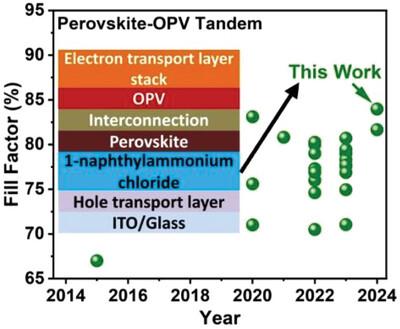
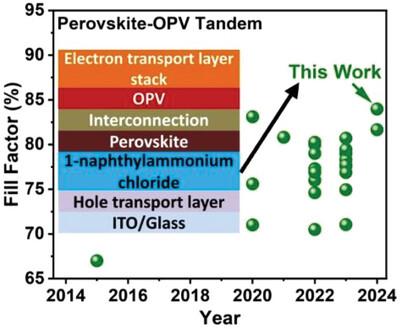
Perovskite whentandemed with organic photovoltaics (OPV) for double-junctions have efficiencypotentials over 40%. However, there is still room for improvement suchas better current matching, higher fill factor, as well as lower voltage and fill factor losses in the top perovskite cell. Here weaddress the issue associated with the top perovskite cell by utilising anovel halogenated polycyclic aromatic hydrocarbon compound, 1-naphthylammoniumchloride (NA─Cl) playing dual roles of surface modification for the hole selectivelayer (HSL) and passivation of HSL/perovskiteinterface. Results of X-ray photoelectron spectroscopy and density functionaltheory calculations reveal that NA─Cl retains self-assembly property for the HSLwhile demonstrating high dipole moment and polarizability. This induces asurface dipole at the HSL/perovskite interface reducing the energetic barrierfor hole extraction by 210 meV thereby enhancing voltage output and fill factorof the device. Such scheme when implemented in a high bandgap (1.78 eV)perovskite solar cell, results in a respectable efficiency of 19.7% and thehighest fill factor of 85.4% amongst those of 1.78 eV perovskite cells reported.We have also achieved 23% cell efficient monolithic perovskite-OPV tandem withan impressive fill factor of 84%, which is the highest for perovskite-OPVtandem cells reported to-date.
期刊介绍:
Established in 2011, Advanced Energy Materials is an international, interdisciplinary, English-language journal that focuses on materials used in energy harvesting, conversion, and storage. It is regarded as a top-quality journal alongside Advanced Materials, Advanced Functional Materials, and Small.
With a 2022 Impact Factor of 27.8, Advanced Energy Materials is considered a prime source for the best energy-related research. The journal covers a wide range of topics in energy-related research, including organic and inorganic photovoltaics, batteries and supercapacitors, fuel cells, hydrogen generation and storage, thermoelectrics, water splitting and photocatalysis, solar fuels and thermosolar power, magnetocalorics, and piezoelectronics.
The readership of Advanced Energy Materials includes materials scientists, chemists, physicists, and engineers in both academia and industry. The journal is indexed in various databases and collections, such as Advanced Technologies & Aerospace Database, FIZ Karlsruhe, INSPEC (IET), Science Citation Index Expanded, Technology Collection, and Web of Science, among others.





 京公网安备 11010802042870号
京ICP备2023020795号-1
京公网安备 11010802042870号
京ICP备2023020795号-1

 分享
分享
 求助内容:
求助内容: 应助结果提醒方式:
 扫码关注我们
