Poorandokht Ilani-Kashkouli , Jamieson Brechtl , Keju An , Michelle Kidder , Costas Tsouris , Christopher Janke , Stephen Kowalski , Cheng-Min Yang , M. Muneeshwaran , Meghan Lamm , Katie Copenhaver , Brian Fricke , Xin Sun , Kai Li , Kashif Nawaz
{"title":"Demonstration of the carbon capture with building make-up air unit","authors":"Poorandokht Ilani-Kashkouli , Jamieson Brechtl , Keju An , Michelle Kidder , Costas Tsouris , Christopher Janke , Stephen Kowalski , Cheng-Min Yang , M. Muneeshwaran , Meghan Lamm , Katie Copenhaver , Brian Fricke , Xin Sun , Kai Li , Kashif Nawaz","doi":"10.1016/j.enbuild.2024.114966","DOIUrl":null,"url":null,"abstract":"<div><div>Building-integrated carbon capture technology has the potential to reduce the cost of CO<sub>2</sub> capture while improving indoor air quality (IAQ). To promote the adoption of CO<sub>2</sub> capture in a building environment, this study investigated the possibility of integrating carbon capture technology with an existing rooftop make-up air unit (MAU) system to trap CO<sub>2</sub>. Here, a modular compact CO<sub>2</sub> capture system containing amine-functionalized polymer fibers was examined. The system, which was installed at the exhaust of the MAU, captures CO<sub>2</sub> before it leaves the building to enter the atmosphere as a greenhouse gas. The demonstrated average amount of CO<sub>2</sub> captured was 1.1–1.4 mmol/g of adsorbent material. Techno-economic analysis (TEA) was further performed on the CO<sub>2</sub> capture system, considering material costs, energy costs, as well as transportation and regeneration costs. These results were then used to estimate the levelized cost per ton CO<sub>2</sub> captured (LCOC). To achieve LCOC below $100/t-CO<sub>2</sub>, adsorbents should have working capacities of 4.9 t and 3 t-CO<sub>2</sub>/year for 5 years and 10 years of operation, respectively. In summary, this study highlights a viable path toward the decarbonization of the commercial buildings sector and provides quantitative performance and economic insight on the suitability of building-integrated carbon capture technology.</div></div>","PeriodicalId":11641,"journal":{"name":"Energy and Buildings","volume":"325 ","pages":"Article 114966"},"PeriodicalIF":7.1000,"publicationDate":"2024-12-15","publicationTypes":"Journal Article","fieldsOfStudy":null,"isOpenAccess":false,"openAccessPdf":"","citationCount":"0","resultStr":null,"platform":"Semanticscholar","paperid":null,"PeriodicalName":"Energy and Buildings","FirstCategoryId":"5","ListUrlMain":"https://www.sciencedirect.com/science/article/pii/S037877882401082X","RegionNum":2,"RegionCategory":"工程技术","ArticlePicture":[],"TitleCN":null,"AbstractTextCN":null,"PMCID":null,"EPubDate":"2024/10/28 0:00:00","PubModel":"Epub","JCR":"Q1","JCRName":"CONSTRUCTION & BUILDING TECHNOLOGY","Score":null,"Total":0}
引用次数: 0
Abstract
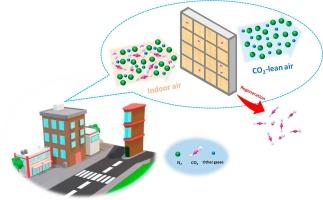
Building-integrated carbon capture technology has the potential to reduce the cost of CO2 capture while improving indoor air quality (IAQ). To promote the adoption of CO2 capture in a building environment, this study investigated the possibility of integrating carbon capture technology with an existing rooftop make-up air unit (MAU) system to trap CO2. Here, a modular compact CO2 capture system containing amine-functionalized polymer fibers was examined. The system, which was installed at the exhaust of the MAU, captures CO2 before it leaves the building to enter the atmosphere as a greenhouse gas. The demonstrated average amount of CO2 captured was 1.1–1.4 mmol/g of adsorbent material. Techno-economic analysis (TEA) was further performed on the CO2 capture system, considering material costs, energy costs, as well as transportation and regeneration costs. These results were then used to estimate the levelized cost per ton CO2 captured (LCOC). To achieve LCOC below $100/t-CO2, adsorbents should have working capacities of 4.9 t and 3 t-CO2/year for 5 years and 10 years of operation, respectively. In summary, this study highlights a viable path toward the decarbonization of the commercial buildings sector and provides quantitative performance and economic insight on the suitability of building-integrated carbon capture technology.
期刊介绍:
An international journal devoted to investigations of energy use and efficiency in buildings
Energy and Buildings is an international journal publishing articles with explicit links to energy use in buildings. The aim is to present new research results, and new proven practice aimed at reducing the energy needs of a building and improving indoor environment quality.




 京公网安备 11010802042870号
京ICP备2023020795号-1
京公网安备 11010802042870号
京ICP备2023020795号-1

 分享
分享
 求助内容:
求助内容: 应助结果提醒方式:
 扫码关注我们
