Giovanna Ferraro, Renato Passaro, Ivana Quinto, Antonio Thomas
{"title":"The process supporting the emergence of the environmental innovation capabilities within small businesses: An empirical investigation","authors":"Giovanna Ferraro, Renato Passaro, Ivana Quinto, Antonio Thomas","doi":"10.1002/bse.4015","DOIUrl":null,"url":null,"abstract":"<p>For several years, companies have made strategic changes to align with sustainable development principles by developing eco-innovations. While research consistently highlights the positive impact of eco-innovations on organisational performance, the factors driving these initiatives—particularly within small and medium-sized enterprises (SMEs)—remain less clear. This inconsistency is due to the heterogeneity of SMEs and their high sensitivity to external contexts. To address this issue, our study delves into the role of competencies, technological factors and networking in shaping the environmental innovation capabilities of a homogeneous SME population in terms of sector, age, size, legal status, geographical location and orientation towards innovation. Using the partial least squares approach, we find that competencies and technological factors are the key drivers of eco-innovation, while networking shows no significant effect. These findings contribute to the existing literature by underlining the fundamental importance of internal skills and technological adoption for fostering eco-innovation. They also suggest that networking becomes essential in environments lacking robust public and private support mechanisms for SME growth. Considering the rapid and turbulent changes, driven by the dual needs of sustainability and competitiveness, our results offer useful and critical advice for policymakers to define more appropriate and effective policies.</p>","PeriodicalId":9518,"journal":{"name":"Business Strategy and The Environment","volume":"34 1","pages":"1027-1042"},"PeriodicalIF":13.3000,"publicationDate":"2024-11-04","publicationTypes":"Journal Article","fieldsOfStudy":null,"isOpenAccess":false,"openAccessPdf":"https://onlinelibrary.wiley.com/doi/epdf/10.1002/bse.4015","citationCount":"0","resultStr":null,"platform":"Semanticscholar","paperid":null,"PeriodicalName":"Business Strategy and The Environment","FirstCategoryId":"91","ListUrlMain":"https://onlinelibrary.wiley.com/doi/10.1002/bse.4015","RegionNum":1,"RegionCategory":"管理学","ArticlePicture":[],"TitleCN":null,"AbstractTextCN":null,"PMCID":null,"EPubDate":"","PubModel":"","JCR":"Q1","JCRName":"BUSINESS","Score":null,"Total":0}
引用次数: 0
Abstract
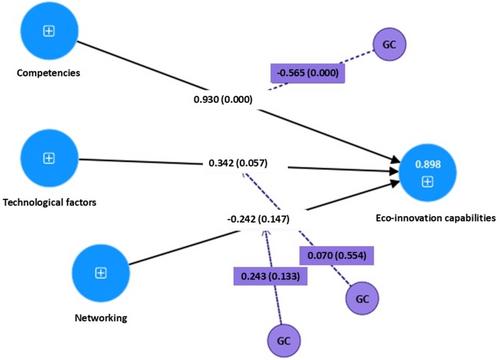
For several years, companies have made strategic changes to align with sustainable development principles by developing eco-innovations. While research consistently highlights the positive impact of eco-innovations on organisational performance, the factors driving these initiatives—particularly within small and medium-sized enterprises (SMEs)—remain less clear. This inconsistency is due to the heterogeneity of SMEs and their high sensitivity to external contexts. To address this issue, our study delves into the role of competencies, technological factors and networking in shaping the environmental innovation capabilities of a homogeneous SME population in terms of sector, age, size, legal status, geographical location and orientation towards innovation. Using the partial least squares approach, we find that competencies and technological factors are the key drivers of eco-innovation, while networking shows no significant effect. These findings contribute to the existing literature by underlining the fundamental importance of internal skills and technological adoption for fostering eco-innovation. They also suggest that networking becomes essential in environments lacking robust public and private support mechanisms for SME growth. Considering the rapid and turbulent changes, driven by the dual needs of sustainability and competitiveness, our results offer useful and critical advice for policymakers to define more appropriate and effective policies.
期刊介绍:
Business Strategy and the Environment (BSE) is a leading academic journal focused on business strategies for improving the natural environment. It publishes peer-reviewed research on various topics such as systems and standards, environmental performance, disclosure, eco-innovation, corporate environmental management tools, organizations and management, supply chains, circular economy, governance, green finance, industry sectors, and responses to climate change and other contemporary environmental issues. The journal aims to provide original contributions that enhance the understanding of sustainability in business. Its target audience includes academics, practitioners, business managers, and consultants. However, BSE does not accept papers on corporate social responsibility (CSR), as this topic is covered by its sibling journal Corporate Social Responsibility and Environmental Management. The journal is indexed in several databases and collections such as ABI/INFORM Collection, Agricultural & Environmental Science Database, BIOBASE, Emerald Management Reviews, GeoArchive, Environment Index, GEOBASE, INSPEC, Technology Collection, and Web of Science.



 京公网安备 11010802042870号
京ICP备2023020795号-1
京公网安备 11010802042870号
京ICP备2023020795号-1

 分享
分享
 求助内容:
求助内容: 应助结果提醒方式:
 扫码关注我们
