Qizhong Zhang, Linjing Chen, Xuanlin Li, Borui Hou, Xuanxuan Wu, Xiaoyu Gui, Dianliang Cao, Jiande Liu, Junshuai Li, Jinglai Duan, Dan Mo, Jie Liu, Huijun Yao
{"title":"Robust, High-Temperature-Resistant Polyimide Separators with Vertically Aligned Uniform Nanochannels for High-Performance Lithium-Ion Batteries","authors":"Qizhong Zhang, Linjing Chen, Xuanlin Li, Borui Hou, Xuanxuan Wu, Xiaoyu Gui, Dianliang Cao, Jiande Liu, Junshuai Li, Jinglai Duan, Dan Mo, Jie Liu, Huijun Yao","doi":"10.1021/acsnano.4c11217","DOIUrl":null,"url":null,"abstract":"Separator is an essential component of lithium-ion batteries (LIBs), playing a pivotal role in battery safety and electrochemical performance. However, conventional polyolefin separators suffer from poor thermal stability and nonuniform pore structures, hindering their effectiveness in preventing thermal shrinkage and inhibiting lithium (Li) dendrites. Herein, we present a robust, high-temperature-resistant polyimide (PI) separator with vertically aligned uniform nanochannels, fabricated via ion track-etching technology. The resultant PI track-etched membranes (PITEMs) effectively homogenize Li-ion distribution, demonstrating enhanced ionic conductivity (0.57 mS cm<sup>–1</sup>) and a high Li<sup>+</sup> transfer number (0.61). PITEMs significantly prolong the cycle life of Li/Li cells to 1200 h at 3 mA cm<sup>–2</sup>. For Li/LiFePO<sub>4</sub> cells, this approach enables a specific capacity of 143 mAh g<sup>–1</sup> and retains 83.88% capacity after 300 cycles at room temperature. At 80 °C, the capacity retention remains at 85.92% after 200 cycles. Additionally, graphite/LiFePO<sub>4</sub> pouch cells with PITEMs display enhanced cycling stability, retaining 73.25% capacity after 1000 cycles at room temperature and 78.41% after 100 cycles at 80 °C. Finally, PITEMs-based pouch cells can operate at 150 °C. This separator not only addresses the limitations of traditional separators, but also holds promise for mass production via roll-to-roll methods. We expect this work to offer insights into designing and manufacturing of functional separators for high-safety LIBs.","PeriodicalId":21,"journal":{"name":"ACS Nano","volume":"242 1","pages":""},"PeriodicalIF":16.0000,"publicationDate":"2024-11-05","publicationTypes":"Journal Article","fieldsOfStudy":null,"isOpenAccess":false,"openAccessPdf":"","citationCount":"0","resultStr":null,"platform":"Semanticscholar","paperid":null,"PeriodicalName":"ACS Nano","FirstCategoryId":"88","ListUrlMain":"https://doi.org/10.1021/acsnano.4c11217","RegionNum":1,"RegionCategory":"材料科学","ArticlePicture":[],"TitleCN":null,"AbstractTextCN":null,"PMCID":null,"EPubDate":"","PubModel":"","JCR":"Q1","JCRName":"CHEMISTRY, MULTIDISCIPLINARY","Score":null,"Total":0}
引用次数: 0
Abstract
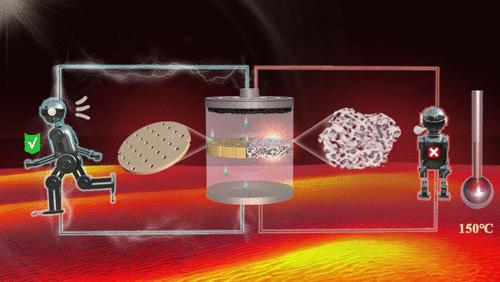
Separator is an essential component of lithium-ion batteries (LIBs), playing a pivotal role in battery safety and electrochemical performance. However, conventional polyolefin separators suffer from poor thermal stability and nonuniform pore structures, hindering their effectiveness in preventing thermal shrinkage and inhibiting lithium (Li) dendrites. Herein, we present a robust, high-temperature-resistant polyimide (PI) separator with vertically aligned uniform nanochannels, fabricated via ion track-etching technology. The resultant PI track-etched membranes (PITEMs) effectively homogenize Li-ion distribution, demonstrating enhanced ionic conductivity (0.57 mS cm–1) and a high Li+ transfer number (0.61). PITEMs significantly prolong the cycle life of Li/Li cells to 1200 h at 3 mA cm–2. For Li/LiFePO4 cells, this approach enables a specific capacity of 143 mAh g–1 and retains 83.88% capacity after 300 cycles at room temperature. At 80 °C, the capacity retention remains at 85.92% after 200 cycles. Additionally, graphite/LiFePO4 pouch cells with PITEMs display enhanced cycling stability, retaining 73.25% capacity after 1000 cycles at room temperature and 78.41% after 100 cycles at 80 °C. Finally, PITEMs-based pouch cells can operate at 150 °C. This separator not only addresses the limitations of traditional separators, but also holds promise for mass production via roll-to-roll methods. We expect this work to offer insights into designing and manufacturing of functional separators for high-safety LIBs.
期刊介绍:
ACS Nano, published monthly, serves as an international forum for comprehensive articles on nanoscience and nanotechnology research at the intersections of chemistry, biology, materials science, physics, and engineering. The journal fosters communication among scientists in these communities, facilitating collaboration, new research opportunities, and advancements through discoveries. ACS Nano covers synthesis, assembly, characterization, theory, and simulation of nanostructures, nanobiotechnology, nanofabrication, methods and tools for nanoscience and nanotechnology, and self- and directed-assembly. Alongside original research articles, it offers thorough reviews, perspectives on cutting-edge research, and discussions envisioning the future of nanoscience and nanotechnology.




 京公网安备 11010802042870号
京ICP备2023020795号-1
京公网安备 11010802042870号
京ICP备2023020795号-1

 分享
分享
 求助内容:
求助内容: 应助结果提醒方式:
 扫码关注我们
