Lucas Prost-Boxoen, Quinten Bafort, Antoine Van de Vloet, Fabricio Almeida-Silva, Yunn Thet Paing, Griet Casteleyn, Sofie D'hondt, Olivier De Clerck, Yves Van de Peer
{"title":"Asymmetric genome merging leads to gene expression novelty through nucleo-cytoplasmic disruptions and transcriptomic shock in Chlamydomonas triploids","authors":"Lucas Prost-Boxoen, Quinten Bafort, Antoine Van de Vloet, Fabricio Almeida-Silva, Yunn Thet Paing, Griet Casteleyn, Sofie D'hondt, Olivier De Clerck, Yves Van de Peer","doi":"10.1111/nph.20249","DOIUrl":null,"url":null,"abstract":"<div>\n \n <p>\n </p><ul>\n \n <li>Genome merging is a common phenomenon causing a wide range of consequences on phenotype, adaptation, and gene expression, yet its broader implications are not well-understood. Two consequences of genome merging on gene expression remain particularly poorly understood: dosage effects and evolution of expression.</li>\n \n <li>We employed <i>Chlamydomonas reinhardtii</i> as a model to investigate the effects of asymmetric genome merging by crossing a diploid with a haploid strain to create a novel triploid line. Five independent clonal lineages derived from this triploid line were evolved for 425 asexual generations in a laboratory natural selection experiment.</li>\n \n <li>Utilizing fitness assays, flow cytometry, and RNA-Seq, we assessed the immediate consequences of genome merging and subsequent evolution. Our findings reveal substantial alterations in genome size, gene expression, protein homeostasis, and cytonuclear stoichiometry. Gene expression exhibited expression-level dominance and transgressivity (i.e. expression level higher or lower than either parent). Ongoing expression-level dominance and a pattern of ‘functional dominance’ from the haploid parent was observed.</li>\n \n <li>Despite major genomic and nucleo-cytoplasmic disruptions, enhanced fitness was detected in the triploid strain. By comparing gene expression across generations, our results indicate that proteostasis restoration is a critical component of rapid adaptation following genome merging in <i>Chlamydomonas reinhardtii</i> and possibly other systems.</li>\n </ul>\n </div>","PeriodicalId":214,"journal":{"name":"New Phytologist","volume":"245 2","pages":"869-884"},"PeriodicalIF":8.1000,"publicationDate":"2024-11-05","publicationTypes":"Journal Article","fieldsOfStudy":null,"isOpenAccess":false,"openAccessPdf":"","citationCount":"0","resultStr":null,"platform":"Semanticscholar","paperid":null,"PeriodicalName":"New Phytologist","FirstCategoryId":"99","ListUrlMain":"https://nph.onlinelibrary.wiley.com/doi/10.1111/nph.20249","RegionNum":1,"RegionCategory":"生物学","ArticlePicture":[],"TitleCN":null,"AbstractTextCN":null,"PMCID":null,"EPubDate":"","PubModel":"","JCR":"Q1","JCRName":"PLANT SCIENCES","Score":null,"Total":0}
引用次数: 0
Abstract
Genome merging is a common phenomenon causing a wide range of consequences on phenotype, adaptation, and gene expression, yet its broader implications are not well-understood. Two consequences of genome merging on gene expression remain particularly poorly understood: dosage effects and evolution of expression.
We employed Chlamydomonas reinhardtii as a model to investigate the effects of asymmetric genome merging by crossing a diploid with a haploid strain to create a novel triploid line. Five independent clonal lineages derived from this triploid line were evolved for 425 asexual generations in a laboratory natural selection experiment.
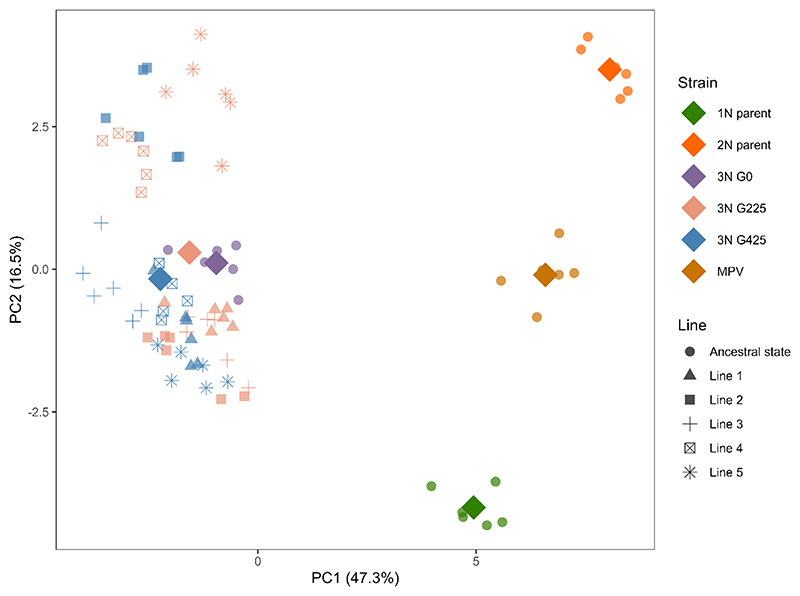
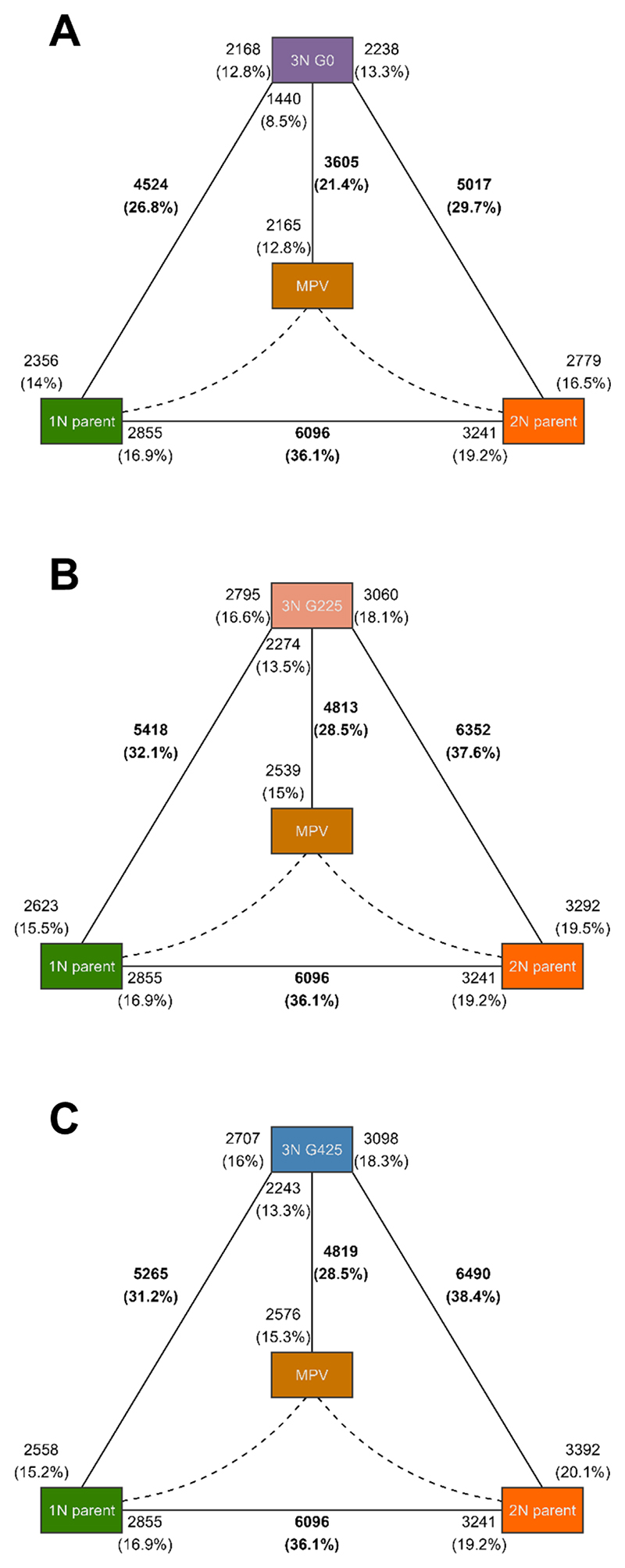
Utilizing fitness assays, flow cytometry, and RNA-Seq, we assessed the immediate consequences of genome merging and subsequent evolution. Our findings reveal substantial alterations in genome size, gene expression, protein homeostasis, and cytonuclear stoichiometry. Gene expression exhibited expression-level dominance and transgressivity (i.e. expression level higher or lower than either parent). Ongoing expression-level dominance and a pattern of ‘functional dominance’ from the haploid parent was observed.
Despite major genomic and nucleo-cytoplasmic disruptions, enhanced fitness was detected in the triploid strain. By comparing gene expression across generations, our results indicate that proteostasis restoration is a critical component of rapid adaptation following genome merging in Chlamydomonas reinhardtii and possibly other systems.
期刊介绍:
New Phytologist is an international electronic journal published 24 times a year. It is owned by the New Phytologist Foundation, a non-profit-making charitable organization dedicated to promoting plant science. The journal publishes excellent, novel, rigorous, and timely research and scholarship in plant science and its applications. The articles cover topics in five sections: Physiology & Development, Environment, Interaction, Evolution, and Transformative Plant Biotechnology. These sections encompass intracellular processes, global environmental change, and encourage cross-disciplinary approaches. The journal recognizes the use of techniques from molecular and cell biology, functional genomics, modeling, and system-based approaches in plant science. Abstracting and Indexing Information for New Phytologist includes Academic Search, AgBiotech News & Information, Agroforestry Abstracts, Biochemistry & Biophysics Citation Index, Botanical Pesticides, CAB Abstracts®, Environment Index, Global Health, and Plant Breeding Abstracts, and others.




 京公网安备 11010802042870号
京ICP备2023020795号-1
京公网安备 11010802042870号
京ICP备2023020795号-1

 分享
分享
 求助内容:
求助内容: 应助结果提醒方式:
 扫码关注我们
