Wenbo Zhou, Shengbo Yuan, Wenming Ding, Yue Cao, Yang Yang, Yan He, Yongqing Yang, Xiaoman Li, Min Luo
{"title":"Organic-inorganic hybrids cathode with Hydrogen Bonding Network for highly efficient zinc-ion batteries","authors":"Wenbo Zhou, Shengbo Yuan, Wenming Ding, Yue Cao, Yang Yang, Yan He, Yongqing Yang, Xiaoman Li, Min Luo","doi":"10.1016/j.est.2024.114448","DOIUrl":null,"url":null,"abstract":"<div><div>Organic-inorganic hybridization has been explored to improve the electrochemical performance of electrodes for aqueous zinc-ion batteries. In this work, 4,4′-diamino-2,2′-bipyridine (DB) and 2,6-diaminoanthraquinone (DAAQ) intercalated vanadium pentoxide (HVO-DB and HVO-DAAQ) are prepared by pre-intercalation techniques. The incorporation of DAAQ and DB play a pivotal role in not merely enhancing the interlayer spacing of VO<sub>x</sub> slabs substantially, which consequently elevates the efficiency of ion diffusion processes, but also in reinforcing the overall structural stability through promoting the establishment of a robust hydrogen bond network. Moreover, the abundant C<img>O redox-active sites present in DAAQ actively coordinate with Zn<sup>2+</sup> during the insertion process, leading to a notable enhancement in specific capacity. HVO-DAAQ demonstrates an exceptional specific capacity of 395 mA h g<sup>−1</sup> when charged at 0.1 A g<sup>−1</sup>, coupled with remarkable cycling stability, retaining 87.8 % of its capacity even after enduring 2000 cycles at a high rate of 5 A g<sup>−1</sup>, and superior rate performance. Ex-situ characterization reveals the exceptional reversibility of Zn<sup>2+</sup> insertion, alongside the remarkable capacity of hydrogen bond networks to undergo disruption and subsequent reconstruction, showcasing a dynamic and resilient structural adaptability. Furthermore, this work provides insights into the synergistic energy storage mechanism in the organic-inorganic hybrids cathode for aqueous zinc-ion batteries.</div></div>","PeriodicalId":15942,"journal":{"name":"Journal of energy storage","volume":"104 ","pages":"Article 114448"},"PeriodicalIF":8.9000,"publicationDate":"2024-11-06","publicationTypes":"Journal Article","fieldsOfStudy":null,"isOpenAccess":false,"openAccessPdf":"","citationCount":"0","resultStr":null,"platform":"Semanticscholar","paperid":null,"PeriodicalName":"Journal of energy storage","FirstCategoryId":"5","ListUrlMain":"https://www.sciencedirect.com/science/article/pii/S2352152X24040349","RegionNum":2,"RegionCategory":"工程技术","ArticlePicture":[],"TitleCN":null,"AbstractTextCN":null,"PMCID":null,"EPubDate":"","PubModel":"","JCR":"Q1","JCRName":"ENERGY & FUELS","Score":null,"Total":0}
引用次数: 0
Abstract
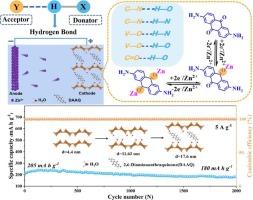
Organic-inorganic hybridization has been explored to improve the electrochemical performance of electrodes for aqueous zinc-ion batteries. In this work, 4,4′-diamino-2,2′-bipyridine (DB) and 2,6-diaminoanthraquinone (DAAQ) intercalated vanadium pentoxide (HVO-DB and HVO-DAAQ) are prepared by pre-intercalation techniques. The incorporation of DAAQ and DB play a pivotal role in not merely enhancing the interlayer spacing of VOx slabs substantially, which consequently elevates the efficiency of ion diffusion processes, but also in reinforcing the overall structural stability through promoting the establishment of a robust hydrogen bond network. Moreover, the abundant CO redox-active sites present in DAAQ actively coordinate with Zn2+ during the insertion process, leading to a notable enhancement in specific capacity. HVO-DAAQ demonstrates an exceptional specific capacity of 395 mA h g−1 when charged at 0.1 A g−1, coupled with remarkable cycling stability, retaining 87.8 % of its capacity even after enduring 2000 cycles at a high rate of 5 A g−1, and superior rate performance. Ex-situ characterization reveals the exceptional reversibility of Zn2+ insertion, alongside the remarkable capacity of hydrogen bond networks to undergo disruption and subsequent reconstruction, showcasing a dynamic and resilient structural adaptability. Furthermore, this work provides insights into the synergistic energy storage mechanism in the organic-inorganic hybrids cathode for aqueous zinc-ion batteries.
期刊介绍:
Journal of energy storage focusses on all aspects of energy storage, in particular systems integration, electric grid integration, modelling and analysis, novel energy storage technologies, sizing and management strategies, business models for operation of storage systems and energy storage developments worldwide.



 京公网安备 11010802042870号
京ICP备2023020795号-1
京公网安备 11010802042870号
京ICP备2023020795号-1

 分享
分享
 求助内容:
求助内容: 应助结果提醒方式:
 扫码关注我们
