J.X. Zhao , R. Zhong , G.Y. Lu , D.X. Xia , J.H. Cong , C.J. Shang
{"title":"Exploring variations in toughness contributions across different types of high-angle grain boundaries in bainitic steels","authors":"J.X. Zhao , R. Zhong , G.Y. Lu , D.X. Xia , J.H. Cong , C.J. Shang","doi":"10.1016/j.matlet.2024.137632","DOIUrl":null,"url":null,"abstract":"<div><div>Generally, the toughness of steel is greatly influenced by the density of high-angle grain boundaries (HAGBs). However, in bainitic steel, various types of boundaries can exhibit high angles, potentially leading to differences in their contributions to toughness. In this research, two steel samples with same chemical composition, similar strength and elongation, and comparable HAGBs densities demonstrated varying absorption energies in Charpy impact tests conducted at 20 °C and −40 °C. Crystallographic analysis revealed that although both samples have similar density of HAGBs, prior austenite boundaries and packet boundaries contribute more to impact absorption energy by enhancing plasticity compared to block boundaries. The discrepancy was particularly notable due to the high proportion of V1/V2 variant boundaries within the block boundaries. The findings underscore the significance of understanding the nuanced contributions of different HAGB types to the toughness of bainitic steels.</div></div>","PeriodicalId":384,"journal":{"name":"Materials Letters","volume":"379 ","pages":"Article 137632"},"PeriodicalIF":2.7000,"publicationDate":"2025-01-15","publicationTypes":"Journal Article","fieldsOfStudy":null,"isOpenAccess":false,"openAccessPdf":"","citationCount":"0","resultStr":null,"platform":"Semanticscholar","paperid":null,"PeriodicalName":"Materials Letters","FirstCategoryId":"88","ListUrlMain":"https://www.sciencedirect.com/science/article/pii/S0167577X24017725","RegionNum":4,"RegionCategory":"材料科学","ArticlePicture":[],"TitleCN":null,"AbstractTextCN":null,"PMCID":null,"EPubDate":"2024/10/29 0:00:00","PubModel":"Epub","JCR":"Q3","JCRName":"MATERIALS SCIENCE, MULTIDISCIPLINARY","Score":null,"Total":0}
引用次数: 0
Abstract
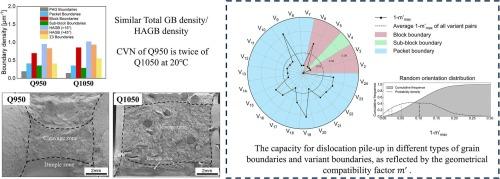
Generally, the toughness of steel is greatly influenced by the density of high-angle grain boundaries (HAGBs). However, in bainitic steel, various types of boundaries can exhibit high angles, potentially leading to differences in their contributions to toughness. In this research, two steel samples with same chemical composition, similar strength and elongation, and comparable HAGBs densities demonstrated varying absorption energies in Charpy impact tests conducted at 20 °C and −40 °C. Crystallographic analysis revealed that although both samples have similar density of HAGBs, prior austenite boundaries and packet boundaries contribute more to impact absorption energy by enhancing plasticity compared to block boundaries. The discrepancy was particularly notable due to the high proportion of V1/V2 variant boundaries within the block boundaries. The findings underscore the significance of understanding the nuanced contributions of different HAGB types to the toughness of bainitic steels.
期刊介绍:
Materials Letters has an open access mirror journal Materials Letters: X, sharing the same aims and scope, editorial team, submission system and rigorous peer review.
Materials Letters is dedicated to publishing novel, cutting edge reports of broad interest to the materials community. The journal provides a forum for materials scientists and engineers, physicists, and chemists to rapidly communicate on the most important topics in the field of materials.
Contributions include, but are not limited to, a variety of topics such as:
• Materials - Metals and alloys, amorphous solids, ceramics, composites, polymers, semiconductors
• Applications - Structural, opto-electronic, magnetic, medical, MEMS, sensors, smart
• Characterization - Analytical, microscopy, scanning probes, nanoscopic, optical, electrical, magnetic, acoustic, spectroscopic, diffraction
• Novel Materials - Micro and nanostructures (nanowires, nanotubes, nanoparticles), nanocomposites, thin films, superlattices, quantum dots.
• Processing - Crystal growth, thin film processing, sol-gel processing, mechanical processing, assembly, nanocrystalline processing.
• Properties - Mechanical, magnetic, optical, electrical, ferroelectric, thermal, interfacial, transport, thermodynamic
• Synthesis - Quenching, solid state, solidification, solution synthesis, vapor deposition, high pressure, explosive



 京公网安备 11010802042870号
京ICP备2023020795号-1
京公网安备 11010802042870号
京ICP备2023020795号-1

 分享
分享
 求助内容:
求助内容: 应助结果提醒方式:
 扫码关注我们
