Junyao Shen , Ze Yang , Yiyong Yang , Bo Yang , Yuning Song , Xiangrong Cheng , Zhemin Lai , Haohan Zhao , Linhong Ji , Zhao Zhu , Jia Cheng
{"title":"A remote monitoring system for wind speed and direction based on non-contact triboelectric nanogenerator","authors":"Junyao Shen , Ze Yang , Yiyong Yang , Bo Yang , Yuning Song , Xiangrong Cheng , Zhemin Lai , Haohan Zhao , Linhong Ji , Zhao Zhu , Jia Cheng","doi":"10.1016/j.nanoen.2024.110453","DOIUrl":null,"url":null,"abstract":"<div><div>Wind speed and wind direction sensors are crucial sensor categories in the Internet of Things (IoT), particularly vital in fields such as meteorological monitoring, construction engineering, transportation engineering, and ocean engineering. However, power supply remains a key limiting factor for the widespread application of these sensors in large-scale sensor networks. In this paper, a self-powered, non-contact wind speed and direction sensor based on the triboelectric nanogenerator (SD-TENG) is proposed. The optimized wind speed measurement structure has a start-up wind speed as low as 0.2 m/s and exhibits good linearity in the range of 0.2–29 m/s. Additionally, the sensor demonstrates high temperature and humidity resistance, with a voltage attenuation of 2.4 % at 45°C ambient temperature and 9.8 % at 95 % relative humidity. For wind direction measurement, the design of non-uniform electrodes enhances the recognition capability of different channels. To meet the demands of remote monitoring, we have designed an advanced signal processing circuit that can directly convert the raw output of a wind speed sensor into wind speed information and upload it to a cloud platform via a host. This system not only records and displays wind speed data in real-time but also features historical data storage and alarm functionalities, enhancing the intelligence and automation levels of wind speed monitoring. Additionally, users can access and analyze wind speed data through both computer and mobile devices, ensuring the system's efficiency and reliability. This work provides crucial technical support for the advancement of smart cities, clean energy, and environmental monitoring, thereby promoting the application and dissemination of IoT technology in the environmental field.</div></div>","PeriodicalId":394,"journal":{"name":"Nano Energy","volume":"133 ","pages":"Article 110453"},"PeriodicalIF":17.1000,"publicationDate":"2025-01-01","publicationTypes":"Journal Article","fieldsOfStudy":null,"isOpenAccess":false,"openAccessPdf":"","citationCount":"0","resultStr":null,"platform":"Semanticscholar","paperid":null,"PeriodicalName":"Nano Energy","FirstCategoryId":"88","ListUrlMain":"https://www.sciencedirect.com/science/article/pii/S2211285524012059","RegionNum":1,"RegionCategory":"材料科学","ArticlePicture":[],"TitleCN":null,"AbstractTextCN":null,"PMCID":null,"EPubDate":"2024/11/6 0:00:00","PubModel":"Epub","JCR":"Q1","JCRName":"CHEMISTRY, PHYSICAL","Score":null,"Total":0}
引用次数: 0
Abstract
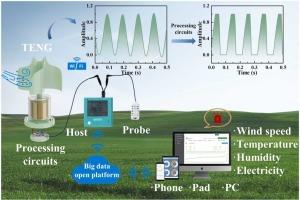
Wind speed and wind direction sensors are crucial sensor categories in the Internet of Things (IoT), particularly vital in fields such as meteorological monitoring, construction engineering, transportation engineering, and ocean engineering. However, power supply remains a key limiting factor for the widespread application of these sensors in large-scale sensor networks. In this paper, a self-powered, non-contact wind speed and direction sensor based on the triboelectric nanogenerator (SD-TENG) is proposed. The optimized wind speed measurement structure has a start-up wind speed as low as 0.2 m/s and exhibits good linearity in the range of 0.2–29 m/s. Additionally, the sensor demonstrates high temperature and humidity resistance, with a voltage attenuation of 2.4 % at 45°C ambient temperature and 9.8 % at 95 % relative humidity. For wind direction measurement, the design of non-uniform electrodes enhances the recognition capability of different channels. To meet the demands of remote monitoring, we have designed an advanced signal processing circuit that can directly convert the raw output of a wind speed sensor into wind speed information and upload it to a cloud platform via a host. This system not only records and displays wind speed data in real-time but also features historical data storage and alarm functionalities, enhancing the intelligence and automation levels of wind speed monitoring. Additionally, users can access and analyze wind speed data through both computer and mobile devices, ensuring the system's efficiency and reliability. This work provides crucial technical support for the advancement of smart cities, clean energy, and environmental monitoring, thereby promoting the application and dissemination of IoT technology in the environmental field.
期刊介绍:
Nano Energy is a multidisciplinary, rapid-publication forum of original peer-reviewed contributions on the science and engineering of nanomaterials and nanodevices used in all forms of energy harvesting, conversion, storage, utilization and policy. Through its mixture of articles, reviews, communications, research news, and information on key developments, Nano Energy provides a comprehensive coverage of this exciting and dynamic field which joins nanoscience and nanotechnology with energy science. The journal is relevant to all those who are interested in nanomaterials solutions to the energy problem.
Nano Energy publishes original experimental and theoretical research on all aspects of energy-related research which utilizes nanomaterials and nanotechnology. Manuscripts of four types are considered: review articles which inform readers of the latest research and advances in energy science; rapid communications which feature exciting research breakthroughs in the field; full-length articles which report comprehensive research developments; and news and opinions which comment on topical issues or express views on the developments in related fields.




 京公网安备 11010802042870号
京ICP备2023020795号-1
京公网安备 11010802042870号
京ICP备2023020795号-1

 分享
分享
 求助内容:
求助内容: 应助结果提醒方式:
 扫码关注我们
