Justin G. Terhorst, Theodore A. Corcovilos, Samuel J. Lenze and Michael J. van Stipdonk
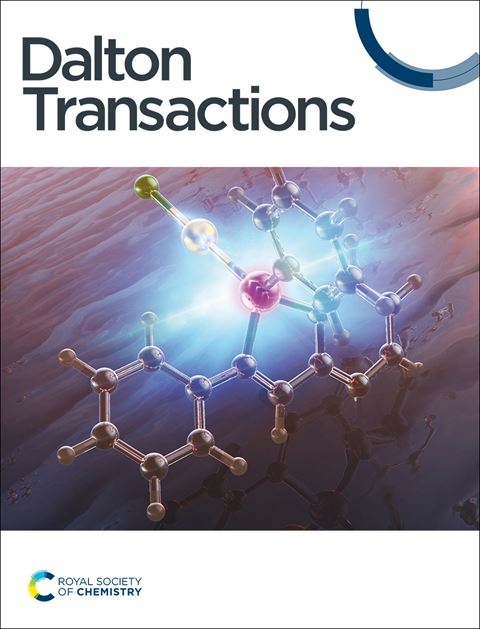
{"title":"Synthesis of organo-uranium(ii) species in the gas-phase using reactions between [UH]+ and nitriles†","authors":"Justin G. Terhorst, Theodore A. Corcovilos, Samuel J. Lenze and Michael J. van Stipdonk","doi":"10.1039/D4DT02508C","DOIUrl":null,"url":null,"abstract":"<p >One challenge in the quest to map the intrinsic reactivity of model actinide species has been the controlled synthesis of organo-actinide ions in the gas phase. We report here evidence that a series of gas-phase, σ-bonded [U–R]<small><sup>+</sup></small> species (where R = CH<small><sub>3</sub></small>, C<small><sub>2</sub></small>H<small><sub>3</sub></small>, C<small><sub>2</sub></small>H<small><sub>5</sub></small>, C<small><sub>3</sub></small>H<small><sub>7</sub></small>, or C<small><sub>5</sub></small>H<small><sub>6</sub></small>) can be generated for subsequent study of ion-molecule chemistry by using preparative tandem mass spectrometry (PTMS<small><sup><em>n</em></sup></small>) <em>via</em> ion-molecule reactions between [UH]<small><sup>+</sup></small> and a series of nitriles. Density functional theory calculations support the hypothesis that the [U–R]<small><sup>+</sup></small> ions are created in a pathway that involves intramolecular hydride attack and the elimination of neutral HCN. Subsequent reactivity experiments revealed that the [UCH<small><sub>3</sub></small>]<small><sup>+</sup></small> readily undergoes hydrolysis, yielding cationic uranium hydroxide ([UOH]<small><sup>+</sup></small>) and methane (CH<small><sub>4</sub></small>). Other possible reaction pathways, such as the spontaneous rearrangement to [HU<img>CH<small><sub>2</sub></small>]<small><sup>+</sup></small>, are shown by theoretical calculations to have energy barriers, strengthening the evidence for the formation of a σ-bonded [U–CH<small><sub>3</sub></small>]<small><sup>+</sup></small> complex in the gas-phase.</p>","PeriodicalId":71,"journal":{"name":"Dalton Transactions","volume":" 1","pages":" 231-238"},"PeriodicalIF":3.3000,"publicationDate":"2024-11-07","publicationTypes":"Journal Article","fieldsOfStudy":null,"isOpenAccess":false,"openAccessPdf":"","citationCount":"0","resultStr":null,"platform":"Semanticscholar","paperid":null,"PeriodicalName":"Dalton Transactions","FirstCategoryId":"92","ListUrlMain":"https://pubs.rsc.org/en/content/articlelanding/2025/dt/d4dt02508c","RegionNum":3,"RegionCategory":"化学","ArticlePicture":[],"TitleCN":null,"AbstractTextCN":null,"PMCID":null,"EPubDate":"","PubModel":"","JCR":"Q2","JCRName":"CHEMISTRY, INORGANIC & NUCLEAR","Score":null,"Total":0}
引用次数: 0
Abstract
One challenge in the quest to map the intrinsic reactivity of model actinide species has been the controlled synthesis of organo-actinide ions in the gas phase. We report here evidence that a series of gas-phase, σ-bonded [U–R]+ species (where R = CH3, C2H3, C2H5, C3H7, or C5H6) can be generated for subsequent study of ion-molecule chemistry by using preparative tandem mass spectrometry (PTMSn) via ion-molecule reactions between [UH]+ and a series of nitriles. Density functional theory calculations support the hypothesis that the [U–R]+ ions are created in a pathway that involves intramolecular hydride attack and the elimination of neutral HCN. Subsequent reactivity experiments revealed that the [UCH3]+ readily undergoes hydrolysis, yielding cationic uranium hydroxide ([UOH]+) and methane (CH4). Other possible reaction pathways, such as the spontaneous rearrangement to [HUCH2]+, are shown by theoretical calculations to have energy barriers, strengthening the evidence for the formation of a σ-bonded [U–CH3]+ complex in the gas-phase.
期刊介绍:
Dalton Transactions is a journal for all areas of inorganic chemistry, which encompasses the organometallic, bioinorganic and materials chemistry of the elements, with applications including synthesis, catalysis, energy conversion/storage, electrical devices and medicine. Dalton Transactions welcomes high-quality, original submissions in all of these areas and more, where the advancement of knowledge in inorganic chemistry is significant.




 京公网安备 11010802042870号
京ICP备2023020795号-1
京公网安备 11010802042870号
京ICP备2023020795号-1

 分享
分享
 求助内容:
求助内容: 应助结果提醒方式:
 扫码关注我们
