{"title":"A Lower Limb Wearable Exosuit for Improved Sitting, Standing, and Walking Efficiency","authors":"Xiaohui Zhang;Enrica Tricomi;Xunju Ma;Manuela Gomez-Correa;Alessandro Ciaramella;Francesco Missiroli;Luka Mišković;Huimin Su;Lorenzo Masia","doi":"10.1109/TRO.2024.3492452","DOIUrl":null,"url":null,"abstract":"Sitting, standing, and walking are fundamental activities crucial for maintaining independence in daily life. However, aging or lower limb injuries can impede these activities, posing obstacles to individuals' autonomy. In response to this challenge, we developed the LM-Ease (lower-limb movement ease), a compact and soft wearable robot designed to provide hip assistance. Its purpose is to aid users in carrying out essential daily activities such as sitting, standing, and walking. The LM-Ease features a fully actuated tendon-driven system that seamlessly transitions between assistance actuation profiles tailored for sitting, standing, and walking movements. This device provides the user with gravity support during stand-to-sit, and offers hip extension assistance pulling force during sit-to-stand and walking. Our preliminary results show that with the LM-Ease, healthy young adults (\n<italic>n</i>\n \n<inline-formula><tex-math>$=$</tex-math></inline-formula>\n 8) had significantly lower muscle activation: average reduction of 15.6% during stand-to-sit and 17.8% during sit-to-stand. Furthermore, with LM-Ease, participants demonstrated a 12.7% reduction in metabolic cost during ground walking. These evidences suggest that the LM-Ease holds potential in reducing muscular activation and energy expenditure during these fundamental daily activities. It could serve as a valuable tool for individuals seeking assistance in enhancing lower limb mobility, thereby bolstering their independence and overall quality of life.","PeriodicalId":50388,"journal":{"name":"IEEE Transactions on Robotics","volume":"41 ","pages":"127-140"},"PeriodicalIF":10.5000,"publicationDate":"2024-11-06","publicationTypes":"Journal Article","fieldsOfStudy":null,"isOpenAccess":false,"openAccessPdf":"","citationCount":"0","resultStr":null,"platform":"Semanticscholar","paperid":null,"PeriodicalName":"IEEE Transactions on Robotics","FirstCategoryId":"94","ListUrlMain":"https://ieeexplore.ieee.org/document/10746332/","RegionNum":1,"RegionCategory":"计算机科学","ArticlePicture":[],"TitleCN":null,"AbstractTextCN":null,"PMCID":null,"EPubDate":"","PubModel":"","JCR":"Q1","JCRName":"ROBOTICS","Score":null,"Total":0}
引用次数: 0
Abstract
Sitting, standing, and walking are fundamental activities crucial for maintaining independence in daily life. However, aging or lower limb injuries can impede these activities, posing obstacles to individuals' autonomy. In response to this challenge, we developed the LM-Ease (lower-limb movement ease), a compact and soft wearable robot designed to provide hip assistance. Its purpose is to aid users in carrying out essential daily activities such as sitting, standing, and walking. The LM-Ease features a fully actuated tendon-driven system that seamlessly transitions between assistance actuation profiles tailored for sitting, standing, and walking movements. This device provides the user with gravity support during stand-to-sit, and offers hip extension assistance pulling force during sit-to-stand and walking. Our preliminary results show that with the LM-Ease, healthy young adults (
n
$=$
8) had significantly lower muscle activation: average reduction of 15.6% during stand-to-sit and 17.8% during sit-to-stand. Furthermore, with LM-Ease, participants demonstrated a 12.7% reduction in metabolic cost during ground walking. These evidences suggest that the LM-Ease holds potential in reducing muscular activation and energy expenditure during these fundamental daily activities. It could serve as a valuable tool for individuals seeking assistance in enhancing lower limb mobility, thereby bolstering their independence and overall quality of life.
期刊介绍:
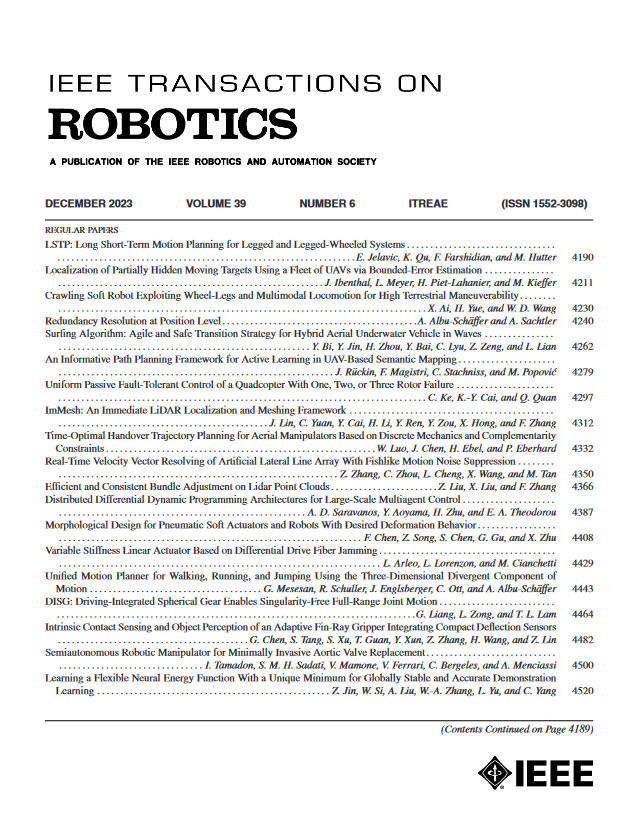
The IEEE Transactions on Robotics (T-RO) is dedicated to publishing fundamental papers covering all facets of robotics, drawing on interdisciplinary approaches from computer science, control systems, electrical engineering, mathematics, mechanical engineering, and beyond. From industrial applications to service and personal assistants, surgical operations to space, underwater, and remote exploration, robots and intelligent machines play pivotal roles across various domains, including entertainment, safety, search and rescue, military applications, agriculture, and intelligent vehicles.
Special emphasis is placed on intelligent machines and systems designed for unstructured environments, where a significant portion of the environment remains unknown and beyond direct sensing or control.



 京公网安备 11010802042870号
京ICP备2023020795号-1
京公网安备 11010802042870号
京ICP备2023020795号-1

 分享
分享
 求助内容:
求助内容: 应助结果提醒方式:
 扫码关注我们
