Yuke Zhao, Danping Chen, Haitao Tang, Hailin Liu, Yong Liu, Yangyang Dang and Qianqian Lin
{"title":"Cuprous-based layered single-crystalline scintillators for X-ray detection and imaging†","authors":"Yuke Zhao, Danping Chen, Haitao Tang, Hailin Liu, Yong Liu, Yangyang Dang and Qianqian Lin","doi":"10.1039/D4TC03080J","DOIUrl":null,"url":null,"abstract":"<p >High light yield, low detection limit, large X-ray attenuation efficiency and nontoxic composition are critical features of scintillators for ionizing radiation detection. We herein demonstrated a new layered organic–inorganic hybrid cuprous iodide single crystal (C<small><sub>6</sub></small>H<small><sub>10</sub></small>N<small><sub>2</sub></small>)<small><sub>2</sub></small>Cu<small><sub>2</sub></small>I<small><sub>3</sub></small>(PO<small><sub>2</sub></small>)<small><sub>3</sub></small> (C<small><sub>6</sub></small>H<small><sub>10</sub></small>N<small><sub>2</sub></small><small><sup>2+</sup></small> = 1,4-phenylenediaminium) for X-ray detection and imaging. Upon UV light excitation, (C<small><sub>6</sub></small>H<small><sub>10</sub></small>N<small><sub>2</sub></small>)<small><sub>2</sub></small>Cu<small><sub>2</sub></small>I<small><sub>3</sub></small>(PO<small><sub>2</sub></small>)<small><sub>3</sub></small> displays highly efficient yellow light emission with one dominant peak located at 578 nm, a large Stokes shift of 160 nm, and a high photoluminescence quantum yield (PLQY) of 96.4%. This crystal could also exhibit radioluminescence with a high scintillation light yield of 32 000 photons MeV<small><sup>−1</sup></small>. A detection limit of ∼39 nGy<small><sub>air</sub></small> s<small><sup>−1</sup></small> is determined, which is far lower than the required value of 5.5 μGy<small><sub>air</sub></small> s<small><sup>−1</sup></small> for regular medical diagnostics. Moreover, the (C<small><sub>6</sub></small>H<small><sub>10</sub></small>N<small><sub>2</sub></small>)<small><sub>2</sub></small>Cu<small><sub>2</sub></small>I<small><sub>3</sub></small>(PO<small><sub>2</sub></small>)<small><sub>3</sub></small>-based scintillation screen exhibits high-performance for X-ray imaging with a spatial resolution of 11.14 lp mm<small><sup>−1</sup></small>, indicating the great potential in X-ray radiography. In brief, combined merits of low toxicity and cost, negligible self-absorption, a low detection limit, a high light yield and a spatial resolution make (C<small><sub>6</sub></small>H<small><sub>10</sub></small>N<small><sub>2</sub></small>)<small><sub>2</sub></small>Cu<small><sub>2</sub></small>I<small><sub>3</sub></small>(PO<small><sub>2</sub></small>)<small><sub>3</sub></small> an excellent candidate for X-ray scintillation.</p>","PeriodicalId":84,"journal":{"name":"Journal of Materials Chemistry C","volume":" 43","pages":" 17587-17594"},"PeriodicalIF":5.1000,"publicationDate":"2024-09-20","publicationTypes":"Journal Article","fieldsOfStudy":null,"isOpenAccess":false,"openAccessPdf":"","citationCount":"0","resultStr":null,"platform":"Semanticscholar","paperid":null,"PeriodicalName":"Journal of Materials Chemistry C","FirstCategoryId":"1","ListUrlMain":"https://pubs.rsc.org/en/content/articlelanding/2024/tc/d4tc03080j","RegionNum":2,"RegionCategory":"材料科学","ArticlePicture":[],"TitleCN":null,"AbstractTextCN":null,"PMCID":null,"EPubDate":"","PubModel":"","JCR":"Q2","JCRName":"MATERIALS SCIENCE, MULTIDISCIPLINARY","Score":null,"Total":0}
引用次数: 0
Abstract
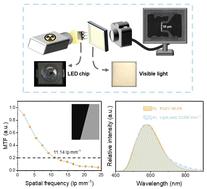
High light yield, low detection limit, large X-ray attenuation efficiency and nontoxic composition are critical features of scintillators for ionizing radiation detection. We herein demonstrated a new layered organic–inorganic hybrid cuprous iodide single crystal (C6H10N2)2Cu2I3(PO2)3 (C6H10N22+ = 1,4-phenylenediaminium) for X-ray detection and imaging. Upon UV light excitation, (C6H10N2)2Cu2I3(PO2)3 displays highly efficient yellow light emission with one dominant peak located at 578 nm, a large Stokes shift of 160 nm, and a high photoluminescence quantum yield (PLQY) of 96.4%. This crystal could also exhibit radioluminescence with a high scintillation light yield of 32 000 photons MeV−1. A detection limit of ∼39 nGyair s−1 is determined, which is far lower than the required value of 5.5 μGyair s−1 for regular medical diagnostics. Moreover, the (C6H10N2)2Cu2I3(PO2)3-based scintillation screen exhibits high-performance for X-ray imaging with a spatial resolution of 11.14 lp mm−1, indicating the great potential in X-ray radiography. In brief, combined merits of low toxicity and cost, negligible self-absorption, a low detection limit, a high light yield and a spatial resolution make (C6H10N2)2Cu2I3(PO2)3 an excellent candidate for X-ray scintillation.
期刊介绍:
The Journal of Materials Chemistry is divided into three distinct sections, A, B, and C, each catering to specific applications of the materials under study:
Journal of Materials Chemistry A focuses primarily on materials intended for applications in energy and sustainability.
Journal of Materials Chemistry B specializes in materials designed for applications in biology and medicine.
Journal of Materials Chemistry C is dedicated to materials suitable for applications in optical, magnetic, and electronic devices.
Example topic areas within the scope of Journal of Materials Chemistry C are listed below. This list is neither exhaustive nor exclusive.
Bioelectronics
Conductors
Detectors
Dielectrics
Displays
Ferroelectrics
Lasers
LEDs
Lighting
Liquid crystals
Memory
Metamaterials
Multiferroics
Photonics
Photovoltaics
Semiconductors
Sensors
Single molecule conductors
Spintronics
Superconductors
Thermoelectrics
Topological insulators
Transistors




 京公网安备 11010802042870号
京ICP备2023020795号-1
京公网安备 11010802042870号
京ICP备2023020795号-1

 分享
分享
 求助内容:
求助内容: 应助结果提醒方式:
 扫码关注我们
