Qicheng He, Zhihao Zhang, Quanxi Zhang and Zhifeng Zhang
{"title":"Synergistic modulation of BiOI by atomic-level vacancies and dominant facets for efficient photocatalytic degradation of bisphenol A†","authors":"Qicheng He, Zhihao Zhang, Quanxi Zhang and Zhifeng Zhang","doi":"10.1039/D4TC02536A","DOIUrl":null,"url":null,"abstract":"<p >Precise control of desirable facets and vacancies is expected to be a promising strategy for improving the photocatalytic performance of catalysts. Herein, BiOI-1 and BiOI-2 were designed and prepared with (102) and (110) as the dominant exposed facets, respectively. Moreover, BiOI-1 and BiOI-2 correspond to the major types <em>V</em><small><sub>BiIBi</sub></small> and <em>V</em><small><sub>BiOBiBi</sub></small>, respectively. The experimental results showed that the degradation and mineralization of bisphenol A (BPA) by BiOI-2 could reach 100% and 95.90% under visible light irradiation. The excellent catalytic performance of BiOI-2 is attributed to the optimization of the energy band structure by its special facets and vacancies, and the narrow band gap promotes the separation of photogenerated electron–hole pairs. Meanwhile, the strong reducing property of the conduction band (CB) and the strong adsorption capacity for water and oxygen contribute to the fact that BiOI-2 can generate a large amount of reactive oxygen species (ROS). This work provides an atomic-scale understanding of the synergistic effects of vacancies and facets on catalysts and offers new directions in the management of water environmental pollution.</p>","PeriodicalId":84,"journal":{"name":"Journal of Materials Chemistry C","volume":" 43","pages":" 17676-17686"},"PeriodicalIF":5.1000,"publicationDate":"2024-09-28","publicationTypes":"Journal Article","fieldsOfStudy":null,"isOpenAccess":false,"openAccessPdf":"","citationCount":"0","resultStr":null,"platform":"Semanticscholar","paperid":null,"PeriodicalName":"Journal of Materials Chemistry C","FirstCategoryId":"1","ListUrlMain":"https://pubs.rsc.org/en/content/articlelanding/2024/tc/d4tc02536a","RegionNum":2,"RegionCategory":"材料科学","ArticlePicture":[],"TitleCN":null,"AbstractTextCN":null,"PMCID":null,"EPubDate":"","PubModel":"","JCR":"Q2","JCRName":"MATERIALS SCIENCE, MULTIDISCIPLINARY","Score":null,"Total":0}
引用次数: 0
Abstract
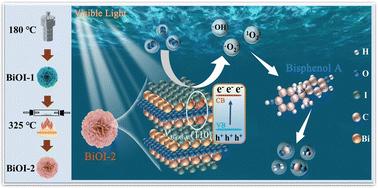
Precise control of desirable facets and vacancies is expected to be a promising strategy for improving the photocatalytic performance of catalysts. Herein, BiOI-1 and BiOI-2 were designed and prepared with (102) and (110) as the dominant exposed facets, respectively. Moreover, BiOI-1 and BiOI-2 correspond to the major types VBiIBi and VBiOBiBi, respectively. The experimental results showed that the degradation and mineralization of bisphenol A (BPA) by BiOI-2 could reach 100% and 95.90% under visible light irradiation. The excellent catalytic performance of BiOI-2 is attributed to the optimization of the energy band structure by its special facets and vacancies, and the narrow band gap promotes the separation of photogenerated electron–hole pairs. Meanwhile, the strong reducing property of the conduction band (CB) and the strong adsorption capacity for water and oxygen contribute to the fact that BiOI-2 can generate a large amount of reactive oxygen species (ROS). This work provides an atomic-scale understanding of the synergistic effects of vacancies and facets on catalysts and offers new directions in the management of water environmental pollution.
期刊介绍:
The Journal of Materials Chemistry is divided into three distinct sections, A, B, and C, each catering to specific applications of the materials under study:
Journal of Materials Chemistry A focuses primarily on materials intended for applications in energy and sustainability.
Journal of Materials Chemistry B specializes in materials designed for applications in biology and medicine.
Journal of Materials Chemistry C is dedicated to materials suitable for applications in optical, magnetic, and electronic devices.
Example topic areas within the scope of Journal of Materials Chemistry C are listed below. This list is neither exhaustive nor exclusive.
Bioelectronics
Conductors
Detectors
Dielectrics
Displays
Ferroelectrics
Lasers
LEDs
Lighting
Liquid crystals
Memory
Metamaterials
Multiferroics
Photonics
Photovoltaics
Semiconductors
Sensors
Single molecule conductors
Spintronics
Superconductors
Thermoelectrics
Topological insulators
Transistors



 京公网安备 11010802042870号
京ICP备2023020795号-1
京公网安备 11010802042870号
京ICP备2023020795号-1

 分享
分享
 求助内容:
求助内容: 应助结果提醒方式:
 扫码关注我们
