Kwabena Frimpong, Samuel Adomako, Nguyen Phong Nguyen, Obaid AI-Shuridah
{"title":"Sustainability orientation and post-entry performance: The role of brand and market-oriented capabilities","authors":"Kwabena Frimpong, Samuel Adomako, Nguyen Phong Nguyen, Obaid AI-Shuridah","doi":"10.1002/bse.4043","DOIUrl":null,"url":null,"abstract":"<p>The adoption of sustainability orientation (SO) by international new ventures (INVs) has been generally noted to positively influence their post-entry performance. However, knowledge is lacking on organizational mechanisms and firm capabilities which combine with SO to help firms achieve improved post-entry performance. Consequently, we adopted the natural resource-based view (NRBV) to explore how international brand orientation (IBO) mediates this relationship. In addition, we shed light on when the relationship is more pronounced by examining how firms' dynamic capability, relating to levels of market orientation (MO), enhances or attenuates this linkage. Using time-lagged data from 288 INVs operating in Ghana, the results reveal that the positive effect of SO on post-entry performance is mediated by IBO. Additionally, the effect of IBO on post-entry performance is amplified when a firm's MO is high. Thus, we show that INVs from developing markets are more likely to maximize the positive effects of pro-environmental strategies on their global market performance if these are complemented by effective brand management and elevated market-oriented capabilities.</p>","PeriodicalId":9518,"journal":{"name":"Business Strategy and The Environment","volume":"34 1","pages":"1189-1205"},"PeriodicalIF":13.3000,"publicationDate":"2024-11-07","publicationTypes":"Journal Article","fieldsOfStudy":null,"isOpenAccess":false,"openAccessPdf":"https://onlinelibrary.wiley.com/doi/epdf/10.1002/bse.4043","citationCount":"0","resultStr":null,"platform":"Semanticscholar","paperid":null,"PeriodicalName":"Business Strategy and The Environment","FirstCategoryId":"91","ListUrlMain":"https://onlinelibrary.wiley.com/doi/10.1002/bse.4043","RegionNum":1,"RegionCategory":"管理学","ArticlePicture":[],"TitleCN":null,"AbstractTextCN":null,"PMCID":null,"EPubDate":"","PubModel":"","JCR":"Q1","JCRName":"BUSINESS","Score":null,"Total":0}
引用次数: 0
Abstract
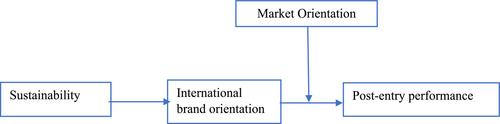
The adoption of sustainability orientation (SO) by international new ventures (INVs) has been generally noted to positively influence their post-entry performance. However, knowledge is lacking on organizational mechanisms and firm capabilities which combine with SO to help firms achieve improved post-entry performance. Consequently, we adopted the natural resource-based view (NRBV) to explore how international brand orientation (IBO) mediates this relationship. In addition, we shed light on when the relationship is more pronounced by examining how firms' dynamic capability, relating to levels of market orientation (MO), enhances or attenuates this linkage. Using time-lagged data from 288 INVs operating in Ghana, the results reveal that the positive effect of SO on post-entry performance is mediated by IBO. Additionally, the effect of IBO on post-entry performance is amplified when a firm's MO is high. Thus, we show that INVs from developing markets are more likely to maximize the positive effects of pro-environmental strategies on their global market performance if these are complemented by effective brand management and elevated market-oriented capabilities.
期刊介绍:
Business Strategy and the Environment (BSE) is a leading academic journal focused on business strategies for improving the natural environment. It publishes peer-reviewed research on various topics such as systems and standards, environmental performance, disclosure, eco-innovation, corporate environmental management tools, organizations and management, supply chains, circular economy, governance, green finance, industry sectors, and responses to climate change and other contemporary environmental issues. The journal aims to provide original contributions that enhance the understanding of sustainability in business. Its target audience includes academics, practitioners, business managers, and consultants. However, BSE does not accept papers on corporate social responsibility (CSR), as this topic is covered by its sibling journal Corporate Social Responsibility and Environmental Management. The journal is indexed in several databases and collections such as ABI/INFORM Collection, Agricultural & Environmental Science Database, BIOBASE, Emerald Management Reviews, GeoArchive, Environment Index, GEOBASE, INSPEC, Technology Collection, and Web of Science.



 京公网安备 11010802042870号
京ICP备2023020795号-1
京公网安备 11010802042870号
京ICP备2023020795号-1

 分享
分享
 求助内容:
求助内容: 应助结果提醒方式:
 扫码关注我们
