{"title":"Lexicographic Optimization-Based Priority Ascending Strategy for Feasibility Judgment and Soft Constraint Adjustment","authors":"Jianbang Liu;Yaqing Jv;Zhaowei Wang;Yi Zhang;Haojie Sun;Hongyu Zheng","doi":"10.1109/TASE.2024.3490620","DOIUrl":null,"url":null,"abstract":"Feasibility judgment and soft constraint adjustment play vital roles in process optimization and control. Priority ascending strategy is one of the most widely used methods to deal with feasibility analysis problem and has been popularly deployed in many industrial commercial control software including DMC3 of AspenTech and RMPCT of Honeywell. However, our recent research has identified that multiple optimal solutions may exist during the feasibility analysis of a specific priority and current methods lack the capability to retain all these solutions for subsequent priorities’ optimization. Motivated by this, our work proposes a novel lexicographic optimization-based priority ascending strategy for feasibility judgment and soft constraint adjustment. Firstly, we theoretically demonstrated that multiple optimal solutions could exist during the feasibility judgment and soft constraint adjustment of a specific priority. An illustrative example is provided to validate this theoretical finding. Subsequently, an inequality equation group which can encompass all multiple optimal solutions is introduced into the optimization process of priority ascending strategy. This ensures that all optimal solutions at a specific priority can be preserved in subsequent priorities’ optimization. Finally, an inequality equation group covering all optimal solutions of the last priority’s optimization is applied to the subsequent economic self-optimization and target tracking, guaranteeing the optimality and completeness of the entire steady-state optimization process. The proposed approach effectively minimizes the relaxation of controlled variable constraints, enhancing safety and maximizing economic profits. Extensive experimental validation confirms the effectiveness and reliability of the proposed approach.Note to Practitioners—The two-layer model predictive control finds extensive application in practical process control software like DMCPlus and DMC3 of AspenTech and RMPCT of Honeywell, demonstrating reliability and practicality. However, from a theoretical analysis standpoint, this algorithm exhibits minor deficiencies. This paper highlights a small specific issue termed “multi-solution incompleteness” and offers a simple solution. Addressing this problem could notably enhance the performance of relevant control software and elevate the safety and reliability of controlled plants. This paper is anticipated to interest researchers focusing on control theory and applications, along with engineers dedicated to utilizing practical control software.","PeriodicalId":51060,"journal":{"name":"IEEE Transactions on Automation Science and Engineering","volume":"22 ","pages":"8828-8843"},"PeriodicalIF":6.4000,"publicationDate":"2024-11-07","publicationTypes":"Journal Article","fieldsOfStudy":null,"isOpenAccess":false,"openAccessPdf":"","citationCount":"0","resultStr":null,"platform":"Semanticscholar","paperid":null,"PeriodicalName":"IEEE Transactions on Automation Science and Engineering","FirstCategoryId":"94","ListUrlMain":"https://ieeexplore.ieee.org/document/10747239/","RegionNum":2,"RegionCategory":"计算机科学","ArticlePicture":[],"TitleCN":null,"AbstractTextCN":null,"PMCID":null,"EPubDate":"","PubModel":"","JCR":"Q1","JCRName":"AUTOMATION & CONTROL SYSTEMS","Score":null,"Total":0}
引用次数: 0
Abstract
Feasibility judgment and soft constraint adjustment play vital roles in process optimization and control. Priority ascending strategy is one of the most widely used methods to deal with feasibility analysis problem and has been popularly deployed in many industrial commercial control software including DMC3 of AspenTech and RMPCT of Honeywell. However, our recent research has identified that multiple optimal solutions may exist during the feasibility analysis of a specific priority and current methods lack the capability to retain all these solutions for subsequent priorities’ optimization. Motivated by this, our work proposes a novel lexicographic optimization-based priority ascending strategy for feasibility judgment and soft constraint adjustment. Firstly, we theoretically demonstrated that multiple optimal solutions could exist during the feasibility judgment and soft constraint adjustment of a specific priority. An illustrative example is provided to validate this theoretical finding. Subsequently, an inequality equation group which can encompass all multiple optimal solutions is introduced into the optimization process of priority ascending strategy. This ensures that all optimal solutions at a specific priority can be preserved in subsequent priorities’ optimization. Finally, an inequality equation group covering all optimal solutions of the last priority’s optimization is applied to the subsequent economic self-optimization and target tracking, guaranteeing the optimality and completeness of the entire steady-state optimization process. The proposed approach effectively minimizes the relaxation of controlled variable constraints, enhancing safety and maximizing economic profits. Extensive experimental validation confirms the effectiveness and reliability of the proposed approach.Note to Practitioners—The two-layer model predictive control finds extensive application in practical process control software like DMCPlus and DMC3 of AspenTech and RMPCT of Honeywell, demonstrating reliability and practicality. However, from a theoretical analysis standpoint, this algorithm exhibits minor deficiencies. This paper highlights a small specific issue termed “multi-solution incompleteness” and offers a simple solution. Addressing this problem could notably enhance the performance of relevant control software and elevate the safety and reliability of controlled plants. This paper is anticipated to interest researchers focusing on control theory and applications, along with engineers dedicated to utilizing practical control software.
期刊介绍:
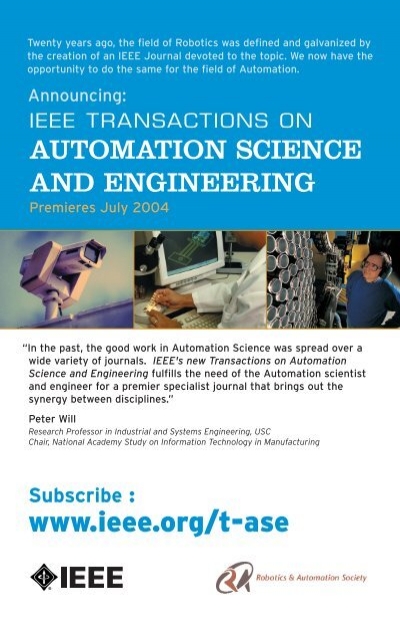
The IEEE Transactions on Automation Science and Engineering (T-ASE) publishes fundamental papers on Automation, emphasizing scientific results that advance efficiency, quality, productivity, and reliability. T-ASE encourages interdisciplinary approaches from computer science, control systems, electrical engineering, mathematics, mechanical engineering, operations research, and other fields. T-ASE welcomes results relevant to industries such as agriculture, biotechnology, healthcare, home automation, maintenance, manufacturing, pharmaceuticals, retail, security, service, supply chains, and transportation. T-ASE addresses a research community willing to integrate knowledge across disciplines and industries. For this purpose, each paper includes a Note to Practitioners that summarizes how its results can be applied or how they might be extended to apply in practice.




 京公网安备 11010802042870号
京ICP备2023020795号-1
京公网安备 11010802042870号
京ICP备2023020795号-1

 分享
分享
 求助内容:
求助内容: 应助结果提醒方式:
 扫码关注我们
