Herbivorous insects sustain their populations by oviposition. To reduce the damage caused by herbivores, the host plant triggers a defensive response upon detection of egg deposition. However, the specific impact of the egg deposition time of the cotton bollworm Helicoverpa armigera (Lepidoptera: Noctuidae), on the tomato plant defense remains obscure.
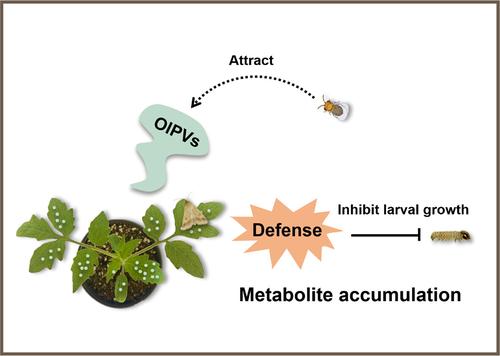
This study investigated the effects of tomato plant defenses on cotton bollworm eggs and larvae at different time intervals following egg deposition. The study revealed that tomato plant defense triggered by egg deposition did not directly affect the hatchability of the eggs. Nevertheless, it attracted Trichogramma chilonis 48 h after the egg deposition. Gas chromatography–mass spectrometry analysis of the oviposition-induced plant volatiles (OIPVs) revealed a considerable increase in the amount of α-pinene released by tomato plants 48 h after egg deposition. The olfactory results from Y-tube experiments showed that α-pinene exhibited a substantial attraction towards T. chilonis. In addition, it was found that the defense response induced by egg deposition for 24 and 48 h significantly inhibited the growth and development of the larvae. Metabolomics analysis revealed that the egg deposition of cotton bollworm altered the metabolite composition and caused significant modifications in the metabolic pathways of tomato plants.
These findings provide novel insights into pest management by using egg-induced plant defenses to reduce egg hatching, and impede larval growth and development in herbivorous insects. © 2024 Society of Chemical Industry.







 京公网安备 11010802042870号
京ICP备2023020795号-1
京公网安备 11010802042870号
京ICP备2023020795号-1

 分享
分享
 求助内容:
求助内容: 应助结果提醒方式:
 扫码关注我们
