Yi Wang , Haoyang Li , Keke Ding , Xueyu Zhao , Miao Liu , Linji Xu , Li Gu , Jinze Li , Lin Li , Qiang He , Jianjun Liang
{"title":"Improved anaerobic digestion of food waste under ammonia stress by side-stream hydrogen domestication","authors":"Yi Wang , Haoyang Li , Keke Ding , Xueyu Zhao , Miao Liu , Linji Xu , Li Gu , Jinze Li , Lin Li , Qiang He , Jianjun Liang","doi":"10.1016/j.watres.2024.122770","DOIUrl":null,"url":null,"abstract":"<div><div>High ammonia concentration inhibits archaea's activity, causing the accumulation of H<sub>2</sub> and acetate, which suppresses methane production in anaerobic digestion (AD). The study aimed to enhance microbial hydrogen metabolism through a side-stream hydrogen domestication (SHD) strategy, which involves applying hydrogen stimulation to a portion of the sludge separately. SHD maintained a stable methane yield of 407.5 mL/g VS at a high total ammonia nitrogen (TAN) concentration of 3.1 g/L. In contrast, the control group gradually decreased and stopped methane production at a TAN concentration of 2.3 g/L. Further analysis using enzyme activity assays, flow cytometry, and metagenomics explored the mechanisms underlying ammonia tolerance of SHD-treated group. SHD reshaped the microbial community, enriching homoacetogens and <em>Methanosaeta</em>-dominated methanogenic archaea. Key metabolic pathways including homoacetogenesis, butyrate degradation, propionate degradation, and methane production were enhanced. The activity of related enzymes also increased. Gene abundance in energy-generating pathways, such as glycolysis, was enhanced, ensuring adequate ATP production. Additionally, the high gene abundance of ion transport systems contributed to regulating proton imbalance and supplementing intracellular <em>K</em><sup>+</sup>. This study provides important insights and practical guidance for developing novel techniques in the field of anaerobic digestion.</div></div>","PeriodicalId":443,"journal":{"name":"Water Research","volume":"268 ","pages":"Article 122770"},"PeriodicalIF":12.4000,"publicationDate":"2025-01-01","publicationTypes":"Journal Article","fieldsOfStudy":null,"isOpenAccess":false,"openAccessPdf":"","citationCount":"0","resultStr":null,"platform":"Semanticscholar","paperid":null,"PeriodicalName":"Water Research","FirstCategoryId":"93","ListUrlMain":"https://www.sciencedirect.com/science/article/pii/S0043135424016695","RegionNum":1,"RegionCategory":"环境科学与生态学","ArticlePicture":[],"TitleCN":null,"AbstractTextCN":null,"PMCID":null,"EPubDate":"2024/11/8 0:00:00","PubModel":"Epub","JCR":"Q1","JCRName":"ENGINEERING, ENVIRONMENTAL","Score":null,"Total":0}
引用次数: 0
Abstract
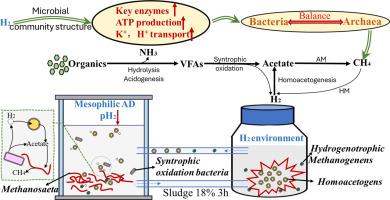
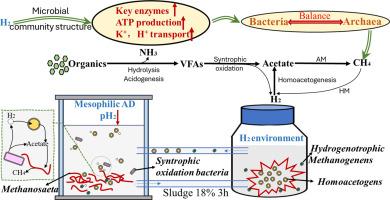
High ammonia concentration inhibits archaea's activity, causing the accumulation of H2 and acetate, which suppresses methane production in anaerobic digestion (AD). The study aimed to enhance microbial hydrogen metabolism through a side-stream hydrogen domestication (SHD) strategy, which involves applying hydrogen stimulation to a portion of the sludge separately. SHD maintained a stable methane yield of 407.5 mL/g VS at a high total ammonia nitrogen (TAN) concentration of 3.1 g/L. In contrast, the control group gradually decreased and stopped methane production at a TAN concentration of 2.3 g/L. Further analysis using enzyme activity assays, flow cytometry, and metagenomics explored the mechanisms underlying ammonia tolerance of SHD-treated group. SHD reshaped the microbial community, enriching homoacetogens and Methanosaeta-dominated methanogenic archaea. Key metabolic pathways including homoacetogenesis, butyrate degradation, propionate degradation, and methane production were enhanced. The activity of related enzymes also increased. Gene abundance in energy-generating pathways, such as glycolysis, was enhanced, ensuring adequate ATP production. Additionally, the high gene abundance of ion transport systems contributed to regulating proton imbalance and supplementing intracellular K+. This study provides important insights and practical guidance for developing novel techniques in the field of anaerobic digestion.
期刊介绍:
Water Research, along with its open access companion journal Water Research X, serves as a platform for publishing original research papers covering various aspects of the science and technology related to the anthropogenic water cycle, water quality, and its management worldwide. The audience targeted by the journal comprises biologists, chemical engineers, chemists, civil engineers, environmental engineers, limnologists, and microbiologists. The scope of the journal include:
•Treatment processes for water and wastewaters (municipal, agricultural, industrial, and on-site treatment), including resource recovery and residuals management;
•Urban hydrology including sewer systems, stormwater management, and green infrastructure;
•Drinking water treatment and distribution;
•Potable and non-potable water reuse;
•Sanitation, public health, and risk assessment;
•Anaerobic digestion, solid and hazardous waste management, including source characterization and the effects and control of leachates and gaseous emissions;
•Contaminants (chemical, microbial, anthropogenic particles such as nanoparticles or microplastics) and related water quality sensing, monitoring, fate, and assessment;
•Anthropogenic impacts on inland, tidal, coastal and urban waters, focusing on surface and ground waters, and point and non-point sources of pollution;
•Environmental restoration, linked to surface water, groundwater and groundwater remediation;
•Analysis of the interfaces between sediments and water, and between water and atmosphere, focusing specifically on anthropogenic impacts;
•Mathematical modelling, systems analysis, machine learning, and beneficial use of big data related to the anthropogenic water cycle;
•Socio-economic, policy, and regulations studies.



 京公网安备 11010802042870号
京ICP备2023020795号-1
京公网安备 11010802042870号
京ICP备2023020795号-1

 分享
分享
 求助内容:
求助内容: 应助结果提醒方式:
 扫码关注我们
